
Service Matters: Promotion, Seniority, Disciplinary Action, Pay and Pension
"Service matters" covers every dispute between employees and their employer about the terms of service.
In brief
- "Service matters" covers every dispute between employees and their employer about the terms of service. The employer may be the Government, a public sector undertaking or a statutory body. The disputes include appointment, seniority, promotion, pay fixation, transfer, suspension, charge-sheets, penalties, retirement, pension and gratuity.
- Central Government employees, and employees of bodies notified under the Administrative Tribunals Act, 1985, go first to the Central Administrative Tribunal (CAT). They do not go first to the High Court.
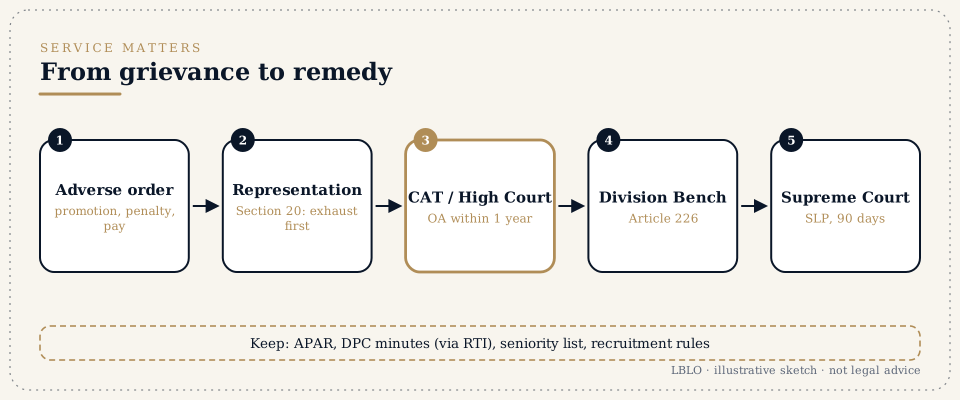
- Before going to the CAT, an employee must usually use the remedies available inside the department, such as a representation or a departmental appeal (Section 20).
- Time matters. An Original Application under Section 19 must ordinarily be filed within one year (Section 21). Delay can be condoned only where sufficient cause is shown (Section 21(3)).
- Employees of bodies outside the CAT's jurisdiction usually approach the High Court in a writ petition under Article 226. Examples are many public sector undertakings, banks and autonomous bodies that have not been notified.
- A disciplinary case is mostly won or lost on the record: the charge-sheet, the documents relied on, the inquiry report and the reply. The reply to the charge-sheet is often the most important document in the case.
- The Office reads the service record, identifies the correct forum and limitation, drafts the representation or reply, and takes the matter to the CAT, the High Court or the Supreme Court where needed.
Terms you will hear
- Original Application (OA)
- the petition filed before the CAT under Section 19.
- Representation
- a written request to the competent authority asking it to correct a decision. It is often the first step, and sometimes a required one.
- APAR (Annual Performance Appraisal Report)
- the yearly assessment of an officer. Its grading feeds promotion.
- DPC (Departmental Promotion Committee)
- the committee that assesses officers for promotion.
- Sealed cover
- the procedure under which the DPC's finding on an officer facing a disciplinary or criminal case is kept sealed until the case ends.
- MACP (Modified Assured Career Progression)
- financial upgradation granted at fixed service milestones where no promotion has come.
- Seniority list
- the ranked list of officers in a cadre. Promotion depends on it, so errors in it are worth challenging promptly.
- Charge-sheet (memorandum of charges)
- the document that starts a disciplinary inquiry. It sets out the articles of charge, the imputations, and the lists of documents and witnesses.
- Minor and major penalty
- the two levels of punishment under conduct and discipline rules. Censure or withholding of an increment, for example, is minor. Reduction in rank, compulsory retirement, removal or dismissal is major and needs a full inquiry.
- Inquiry Officer and Presenting Officer
- the officer who conducts the inquiry, and the officer who presents the department's case.
- Suspension and subsistence allowance
- suspension is not a penalty. While suspended, the employee receives a subsistence allowance.
- Deemed suspension
- suspension that follows automatically by rule, for example after detention in custody beyond a set period.
- Pay fixation
- placing an employee at a stage in the pay matrix on promotion, upgradation or revision.
- Recovery of excess payment
- a demand by the employer to return pay it says was paid by mistake.
- Gratuity, commutation and family pension
- the retirement benefits. They are governed by the pension rules applicable to the employee.
In detail
1. Which forum?
The first question in every service matter is where to go.
- CAT: Central Government employees and employees of notified bodies approach the CAT. The CAT's Principal Bench sits in New Delhi, and its benches sit across India.
- High Court: employees of bodies the CAT does not cover usually file a writ petition in the High Court.
- Labour forums: a workman in an industry may have remedies under the labour law, which since 21/11/2025 is the Industrial Relations Code, 2020.
Choosing the wrong forum costs months. So the Office confirms the forum from the employer's status before drafting anything.
2. Exhaust the departmental remedy first.
Section 20 of the Administrative Tribunals Act, 1985 says the CAT will not ordinarily admit an application unless the employee has used the remedies available under the service rules. The CAT still has power to hear a matter where the remedy is ineffective or the action is plainly without jurisdiction.
In practice, this means a well-drafted representation or appeal is the first legal document in most service cases. It should:
- state the facts with dates;
- cite the rule or office memorandum relied on;
- set out the relief sought;
- ask for a reasoned decision.
3. Limitation.
Section 21 sets a one-year period for an Original Application, counted from the final order on the appeal or representation. Where an appeal or representation was made and six months have passed without a final order, the year runs from the end of those six months (Section 21(1)(b)).
The CAT may condone delay for sufficient cause. Delay is still the most common reason good cases fail. The safest course is to act when the adverse order is received, not when the next promotion list comes out.
4. Promotion and seniority.
Most promotion cases turn on three things:
- whether the DPC met when it should have;
- whether the APAR gradings it considered were correct and had been communicated to the officer;
- whether the officer's seniority was fixed correctly.
Where an adverse or below-benchmark entry was never communicated, there are recognised grounds to seek a review of the DPC's assessment.
Where the sealed cover was opened after the officer was exonerated, the question becomes notional promotion and arrears.
The Office builds these cases from the documents:
- the seniority list;
- the DPC minutes, obtained under RTI where necessary;
- the APAR dossier;
- the relevant recruitment rules.
5. Disciplinary proceedings.
The usual sequence is:
- a preliminary inquiry or fact-finding;
- a charge-sheet;
- the employee's written statement of defence;
- the appointment of an Inquiry Officer;
- the inquiry, with documents and witnesses;
- the Inquiry Officer's report;
- a copy of the report to the employee for a representation;
- the penalty order;
- an appeal or revision;
- then the CAT or the High Court.
Three points recur:
- Copies of documents: the employee is entitled to copies of the documents relied on and to cross-examine the witnesses.
- Disagreement note: where the disciplinary authority disagrees with an Inquiry Officer who exonerated the employee, it must record its reasons and give the employee a chance to answer them.
- Proportionality: a penalty that is shockingly disproportionate to the charge can be interfered with.
Delay in serving a charge-sheet, or a charge-sheet issued after retirement outside the time the pension rules allow, can be a ground of challenge in its own right.
The inquiry itself is explained step by step on the page on departmental inquiries and disciplinary proceedings.
6. Suspension.
Suspension should be reviewed within the period the rules prescribe. Prolonged suspension without a charge-sheet is open to challenge.
The subsistence allowance should be revised where the rules allow. The employee should keep a record of every review order.
7. Pay, MACP and recovery.
Pay fixation and MACP disputes are document cases. They turn on:
- the pay matrix;
- the date of the upgradation;
- the benchmark grading;
- the applicable office memorandum.
Recovery of an alleged excess payment from a retired or low-paid employee, made years later with no fault on the employee's part, is a recognised area of challenge.
8. Retirement, pension and gratuity.
Common disputes are:
- withholding of gratuity because a case is pending;
- wrong qualifying service;
- denial of family pension;
- delay in settling dues.
Interest on delayed retirement dues is a claim worth making where the delay is not the employee's fault.
9. Writs and appeals.
An order of the CAT is challenged before a Division Bench of the High Court under Article 226. From there, a Special Leave Petition lies to the Supreme Court. It is ordinarily filed within 90 days of the High Court's judgment, or within 60 days where a certificate has been refused.
Questions people ask
Can I go to the High Court directly against a transfer order?
Not if your employer falls under the CAT. The CAT is the forum of first instance for those employees. Transfer orders are also interfered with only on limited grounds, such as mala fides or breach of a binding policy or rule.
My promotion was denied because of an APAR I never saw. What can I do?
Ask for a copy, make a representation for upgradation, and, if the DPC relied on it, seek a review DPC. Uncommunicated entries are a recognised ground.
I have been charge-sheeted. Should I reply in detail or briefly?
In detail, from documents. The written statement of defence fixes your case for the inquiry. Ask for every document listed in the charge-sheet before you reply.
Can the department stop my gratuity while a case is pending?
The pension rules allow withholding in some situations. Whether it is lawful in your case depends on the rule and the stage of the case.
How long does a CAT case take?
It varies by bench and the nature of the matter. Interim relief, such as a stay of recovery or of a reversion, can be sought at the first hearing where the case is urgent.
These answers are educational summaries; they are not legal advice on any individual matter.
A serious question deserves a read brief.
Conferences are by appointment at G-46, Basement, Greater Kailash III, New Delhi. The principal reads the correspondence.
This page gives general information about the work of Lokesh Bhardwaj Law Offices, as permitted under the Bar Council of India Rules. It is not legal advice, and it does not create an advocate-client relationship. LBLO acts in a matter only on an engagement agreed in writing.
Last reviewed: 15/11/2026. Lokesh Bhardwaj Law Offices.
Law stated as at 15/11/2026.