
Utilities, Civic Regulators and RTI: Electricity, Water, Pollution Consents and Getting Information From Government
Electricity disputes in Delhi (wrong bills, theft assessments, disconnection, new connections) start with the distribution company's grievance process.
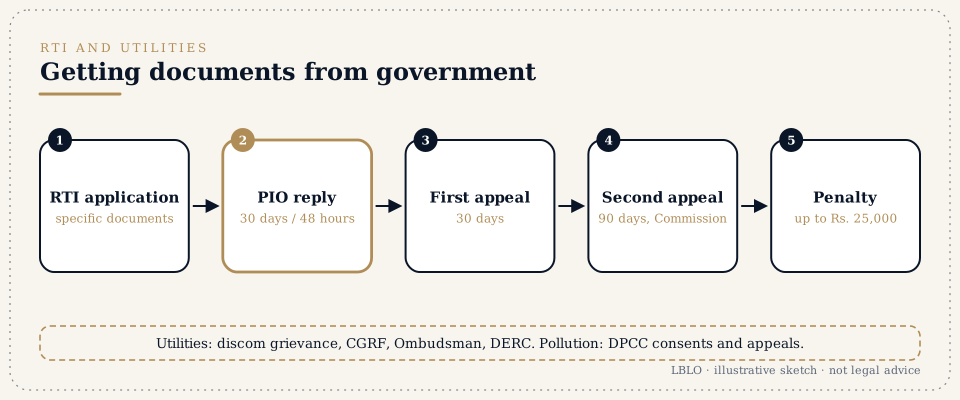
In brief
- Electricity disputes in Delhi (wrong bills, theft assessments, disconnection, new connections) start with the distribution company's grievance process. They then go to the Consumer Grievance Redressal Forum and the Electricity Ombudsman, with tariff and regulatory issues before the Delhi Electricity Regulatory Commission (DERC).
- Water and sewer disputes with the Delhi Jal Board start with the Board's grievance system. Writs lie where statutory duties are not performed.
- Pollution consents. Businesses need consents to establish and operate from the Delhi Pollution Control Committee (DPCC) for many activities. Closure directions and environmental compensation orders can be challenged before the appellate authority and the National Green Tribunal.
- RTI. The Right to Information Act, 2005 is often the fastest way to get the documents a dispute needs:
- the Public Information Officer must reply within 30 days, or 48 hours where life or liberty is involved;
- first appeal within 30 days;
- second appeal to the Information Commission within 90 days;
- the Commission can penalise a defaulting officer up to Rs. 25,000.
- The Office uses RTI as a litigation tool: DPC minutes in service cases, file notings in licensing disputes, inspection reports in MCD cases.
Terms you will hear
- CGRF and Electricity Ombudsman
- the forums for consumer complaints against distribution companies under the Electricity Act, 2003.
- Assessment bill (theft or unauthorised use)
- a bill raised after inspection, with a separate appeal route.
- Consent to Establish (CTE) and Consent to Operate (CTO)
- the pollution control permissions.
- Environmental compensation
- a payment imposed for environmental harm.
- PIO and FAA
- the Public Information Officer, and the First Appellate Authority.
- Deemed refusal
- no reply within the time is treated as a refusal, and the appeal can be filed.
- Section 8 exemptions
- the grounds on which information can be withheld, subject to the public interest override.
- File notings
- the internal notes on a government file. They are often the most revealing documents.
In detail
1. Electricity bills.
Pay the undisputed portion. Dispute the rest in writing. Seek inspection reports and meter test results. Approach the CGRF if the issue is not resolved. Disconnection during a pending dispute can be restrained in suitable cases.
2. Pollution consents and closures.
Check which category your activity falls in. Renew consents on time. Respond to show cause notices with test reports and compliance proof. Appeal promptly against closure directions.
3. Writing an RTI that works.
- Ask for specific documents, not opinions or reasons.
- Identify the file, the date range and the subject.
- Ask for inspection of files where volumes are large.
- Pay the fee by the prescribed mode.
- File online on the RTI portal for central bodies, and on the Delhi portal for Delhi bodies.
4. Appeals.
A first appeal against refusal or an inadequate reply goes to the FAA, a senior officer, within 30 days. A second appeal goes to the Central or State Information Commission within 90 days of the FAA's decision, or of the date it was due.
Questions people ask
The discom has raised a huge theft bill. Must I pay before disputing?
The law and the regulations decide this. Seek advice quickly, as payment conditions can apply to appeals.
Can RTI be used to get my APAR or DPC minutes?
Generally yes, for your own records, subject to exemptions.
The PIO has not replied in 30 days. What now?
File the first appeal. Silence is deemed refusal.
Can a private company be asked for information under RTI?
Not directly, unless it is a public authority. Information about it held by a public authority can be sought.
The DPCC has ordered closure. How fast can we challenge?
Immediately. Appeals and stay applications should be filed promptly, with compliance evidence.
These answers are educational summaries; they are not legal advice on any individual matter.
A serious question deserves a read brief.
Conferences are by appointment at G-46, Basement, Greater Kailash III, New Delhi. The principal reads the correspondence.
This page gives general information about the work of Lokesh Bhardwaj Law Offices, as permitted under the Bar Council of India Rules. It is not legal advice, and it does not create an advocate-client relationship. LBLO acts in a matter only on an engagement agreed in writing.
Law stated as at 14/11/2026.