
Investment Legality Review: Before You Put Money Into a Company, Scheme or Property
Before investing, check that the investment is lawful and that the people behind it are what they claim to be.
In brief
- Before investing, check that the investment is lawful and that the people behind it are what they claim to be. This applies to:
- private company shares;
- a franchise;
- a partnership;
- a property development;
- a "high return" scheme;
- a start-up.
- Many frauds are legal-structure frauds. Examples are unregistered deposit schemes, unregistered collective investment schemes, chit-fund look-alikes, and companies issuing shares to the public without complying with the law. Regulators publish lists and alerts. Check them.
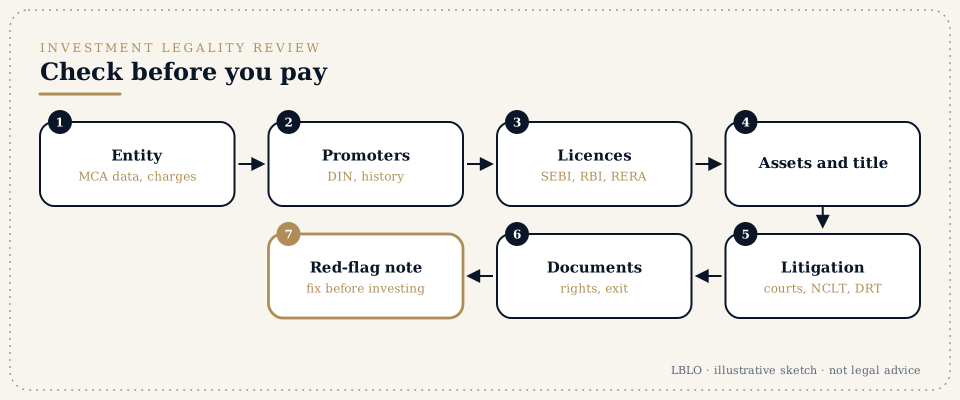
- A legality review covers:
- the entity's status and filings;
- the promoters' records;
- regulatory registrations (SEBI, RBI, RERA, IRDAI as relevant);
- title to key assets;
- pending litigation and insolvency;
- charges on assets;
- the investment documents themselves.
- Foreign investors. Where the investor is outside India, the review also checks the foreign exchange route: automatic or approval, sector caps, pricing rules and reporting.
- The output is a short written note: red flags, things to fix before investing, and the protective clauses to insist on.
Terms you will hear
- MCA master data and ROC filings
- the company's registered details, directors, charges and annual filings on the Ministry of Corporate Affairs portal.
- DIN
- the Director Identification Number, which links a person to every company they direct.
- Charge
- a registered security interest over the company's assets in favour of a lender.
- Collective investment scheme (CIS)
- pooling money from investors to earn returns from a scheme managed for them. It requires SEBI registration.
- Deposit
- money accepted with a promise of return. Companies may accept deposits only in compliance with the law. Unregulated deposit schemes are banned.
- Private placement
- issuing shares or securities to a limited number of identified persons under Section 42 of the Companies Act. Offers beyond the permitted number become a public issue.
- Ponzi features
- returns paid from new investors' money, guaranteed high returns, and pressure to recruit others.
- FDI automatic route and approval route
- whether a foreign investment needs prior government approval.
- Escrow, conditions precedent, information rights, board seat
- protective terms in the investment documents.
In detail
1. The entity.
Check:
- the incorporation date;
- its active status;
- the directors and their other companies;
- whether filings are up to date;
- registered charges;
- the authorised and paid-up capital.
A recently incorporated company with large claimed operations is a question mark.
2. The promoters.
Check:
- other directorships, including struck-off or insolvent companies;
- reported litigation in the eCourts and NCLT records;
- regulatory orders;
- news reports.
Ask for identity and address proof that matches the filings.
3. Regulatory status.
Ask what licence the business needs and verify it: SEBI registration for advisory or portfolio services, RBI registration for lending or NBFC activity, RERA registration for real estate projects, and so on. Check the regulators' caution lists.
4. Assets.
For property-backed investments, run a title check (see the title verification pages). For intellectual property-backed businesses, check the registrations.
5. Litigation.
Search the courts, the NCLT and the DRT for the company and its promoters. Pending insolvency or recovery cases change everything.
6. The documents.
Read the investment agreement for:
- what you get;
- your exit rights;
- the warranties;
- the information rights;
- the governing law;
- dispute resolution.
A promise not written into the document is not part of the bargain.
7. Red flags.
- Guaranteed returns.
- No written agreement.
- Payment in cash or to a personal account.
- Pressure to decide quickly.
- Reluctance to share documents.
- Inconsistent addresses.
Questions people ask
A friend's company promises 3% a month. Is it legal?
Guaranteed high returns from a company that is not a regulated entity is a serious warning sign. Get it reviewed before paying.
How long does a legality review take?
For a private company with organised records, typically days, not weeks. It depends on how quickly documents are shared.
Does the review guarantee the investment is safe?
No. It identifies legal and documentary risks. Business risk remains.
I am an NRI. Can I invest in a friend's private company?
Usually yes, subject to the foreign exchange rules for the sector and the reporting requirements.
What if I have already invested and suspect fraud?
Collect the documents, stop further payments, and take advice on recovery and complaint options at once.
These answers are educational summaries; they are not legal advice on any individual matter.
A serious question deserves a read brief.
Conferences are by appointment at G-46, Basement, Greater Kailash III, New Delhi. The principal reads the correspondence.
This page gives general information about the work of Lokesh Bhardwaj Law Offices, as permitted under the Bar Council of India Rules. It is not legal advice, and it does not create an advocate-client relationship. LBLO acts in a matter only on an engagement agreed in writing.
Law stated as at 14/11/2026.