
MSME Delayed Payments: Recovering Dues With Interest Through the Facilitation Council
Where a micro or small enterprise registered under Udyam supplies goods or services, the buyer must pay by the agreed date.
In brief
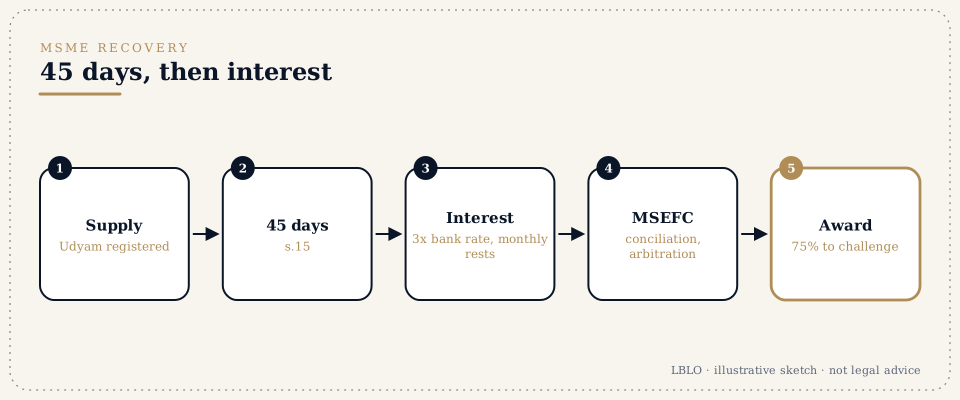
- The supplier's protection. Where a micro or small enterprise registered under Udyam supplies goods or services, the buyer must pay by the agreed date. That date can be no later than 45 days from acceptance. Where no date is agreed, the buyer must pay within 15 days (Section 15, MSMED Act, 2006).
- Interest on late payment. The buyer owes compound interest with monthly rests at three times the RBI bank rate (Section 16). This interest overrides any contract term to the contrary.
- How to recover. The supplier can refer the dispute to the Micro and Small Enterprises Facilitation Council (MSEFC) of its State (Section 18). The Council first attempts conciliation. If that fails, it arbitrates, or refers the dispute to arbitration.
- Challenging the award. A buyer who wants to challenge the Council's award must first deposit 75% of the amount awarded (Section 19). This makes the route powerful.
- Online filing. References are filed online, on the portal the Ministry of MSME provides for delayed-payment disputes.
- For buyers. Track MSME suppliers. Pay within the statutory period. Report delays as the law requires. The interest liability grows fast.
Terms you will hear
- Udyam registration
- the registration that identifies a micro, small or medium enterprise. The Council route is for micro and small suppliers.
- Appointed day
- the agreed payment date or the statutory default.
- Day of acceptance
- when goods or services are accepted, or deemed accepted where no objection is raised in time.
- Bank rate
- the RBI's notified bank rate, which the interest formula multiplies by three.
- MSEFC
- the State council that conciliates and arbitrates MSME payment disputes.
- Conciliation and arbitration
- settlement assisted by the Council, then a binding decision.
- Pre-deposit (75%)
- the deposit a buyer must make before a court hears its challenge to the award.
In detail
1. Check eligibility.
Was the supplier registered as micro or small when the contract was made and the supply took place? The registration date matters, and the law on it has been litigated.
2. Prepare the reference.
- invoices;
- delivery proof;
- acceptance evidence;
- a ledger statement;
- correspondence;
- the Udyam certificate;
- an interest calculation.
3. The Council proceedings.
- Notice to the buyer.
- Conciliation meetings.
- If no settlement, arbitration.
- A reasoned award.
The process is designed to be quicker than a suit.
4. Enforcement and challenge.
The award is enforced like a court decree. A challenge under Section 34 of the Arbitration Act needs the 75% deposit first. The court can release part of the deposit to the supplier on terms.
5. Interaction with insolvency and suits.
A supplier can choose between the Council, a civil suit or insolvency proceedings. The Council route usually gives the best interest outcome.
Questions people ask
My contract says 90 days. Is that valid?
The statute caps the agreed period at 45 days from acceptance, for micro and small suppliers.
We registered on Udyam after supplying. Can we still use the Council?
The timing of registration is critical and has been contested. Get advice on your dates.
Is the interest really three times the bank rate, compounded monthly?
Yes, under Section 16. It runs from the appointed day.
Can the buyer avoid the Council by citing an arbitration clause?
The statute gives the Council's process priority in many situations. The interplay has been litigated, so each case is checked.
How long does the Council take?
It varies by State. Statutory timelines exist for conciliation and the award, but practice differs.
These answers are educational summaries; they are not legal advice on any individual matter.
A serious question deserves a read brief.
Conferences are by appointment at G-46, Basement, Greater Kailash III, New Delhi. The principal reads the correspondence.
This page gives general information about the work of Lokesh Bhardwaj Law Offices, as permitted under the Bar Council of India Rules. It is not legal advice, and it does not create an advocate-client relationship. LBLO acts in a matter only on an engagement agreed in writing.
Law stated as at 14/11/2026.