
Legal Notices and Pre-Litigation: The Letter That Shapes the Case
A legal notice is a formal written demand, usually sent through an advocate, before going to court.
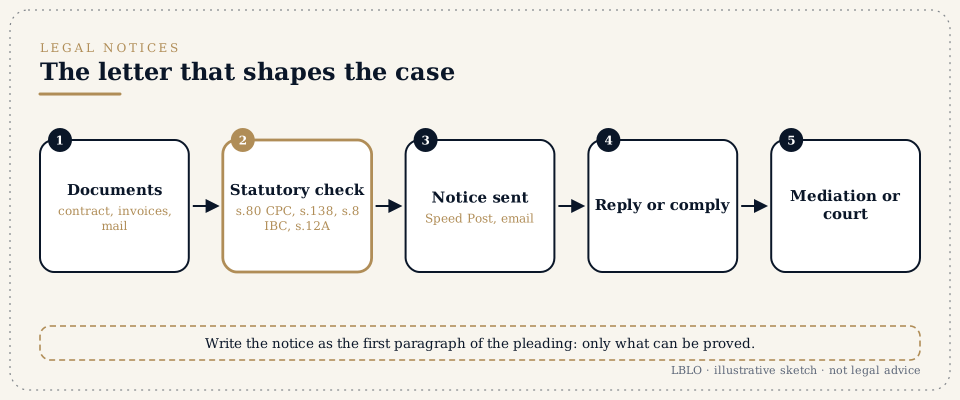
In brief
- A legal notice is a formal written demand, usually sent through an advocate, before going to court.
- Some notices are required by law, and a case filed without them can fail:
- Section 80 CPC, before suing the Government (two months);
- Section 138 NI Act, for a cheque (30 days from the return memo);
- Section 8 IBC, the demand notice before an operational creditor's insolvency application;
- Section 13(2) SARFAESI, for secured creditors;
- pre-institution mediation under Section 12A of the Commercial Courts Act, for most commercial suits that do not seek urgent interim relief.
- Other notices are strategic. They fix facts and dates, start time limits running, invite settlement, and show the court later that you behaved reasonably.
- A notice should state only what you can prove. It becomes evidence, and what it says can be used against you.
- Receiving a notice? Do not ignore it, and do not reply in anger. A measured, documented reply, or a considered decision not to reply, protects you.
- The Office drafts notices and replies from the documents, with the statutory time limits checked against the bare Act.
Terms you will hear
- Demand notice
- a notice asking for payment or performance within a set time.
- Cease and desist
- a notice to stop an act, such as using a trade mark, publishing content or breaching a contract.
- Reply notice and rejoinder notice
- the response, and the response to the response.
- Without prejudice
- a label for settlement correspondence, intended to keep the offer out of evidence. It must be used carefully.
- Mode of dispatch
- Speed Post with acknowledgement, email or WhatsApp. Courts accept electronic service in many settings. Keep proof of every mode used.
- Pre-institution mediation (Section 12A)
- compulsory mediation before most commercial suits. It runs for three months, extendable by two, through the legal services authority.
- Limitation
- the time within which a case must be filed. A notice does not usually stop limitation running, unless a statute says otherwise or the other side acknowledges the debt in writing.
- Acknowledgement of debt (Section 18, Limitation Act)
- a signed written acknowledgement before limitation expires starts a fresh period.
In detail
1. What a good notice contains.
The Office's notice format follows a fixed sequence:
- Reference number and date.
- Mode of dispatch.
- Addressee, at every known address.
- Your client's identity and instructions.
- Facts, in date order, with document references.
- The legal basis, by statute and contract clause.
- The specific demand.
- The time for compliance, stated in days and as a calendar date.
- The consequences.
- A reservation of rights.
- Signature.
2. What a notice must not do.
- Do not threaten criminal proceedings to recover a civil debt. It can amount to an offence and weakens the case.
- Do not overstate the claim.
- Do not make allegations you cannot support.
- Do not disclose privileged legal advice.
3. Statutory notices, one by one.
- Section 80 CPC. Two months' notice before a suit against the Government or a public officer acting officially. Urgent relief may be sought with the court's leave without waiting.
- Section 138 NI Act. Within 30 days of the return memo. See the cheque bounce page.
- Section 8 IBC. An operational creditor serves a demand notice. The debtor has 10 days to pay or point to a pre-existing dispute.
- Section 13(2) SARFAESI. The bank gives 60 days to repay. An objection under Section 13(3A) must be answered by the bank within 15 days.
- Section 12A Commercial Courts Act. This is not strictly a notice. It is a compulsory mediation step before most commercial suits, and it is often triggered after a notice fails.
- Consumer and RERA matters. No statutory notice is required, but a prior written complaint to the builder, seller or insurer is good evidence.
- Employment and service. A representation is often a required first step. See the service matters page.
4. Receiving a notice.
Within the time stated:
- Collect the documents the notice refers to.
- Check the deadlines. A Section 8 IBC notice gives only 10 days to point to a pre-existing dispute.
- Decide your approach: pay, negotiate, deny, or reply with your own claims.
A reply that sets out a genuine pre-existing dispute can be decisive in insolvency and summary suit matters. Silence is not an admission, but an unexplained silence can weigh against you.
5. Notices as evidence.
Courts read notices closely. Inconsistencies between the notice and the later plaint are a standard line of cross-examination. That is why the Office drafts the notice as if it were the first paragraph of the pleading.
Questions people ask
Is a legal notice mandatory before every case?
No. Only where a statute requires it. It is usually advisable anyway.
Does sending a notice extend the time to sue?
Generally no. A written acknowledgement of the debt by the other side can.
Can a notice be sent by WhatsApp?
Often yes, alongside Speed Post. Keep screenshots showing delivery.
I received a notice demanding money I do not owe. Must I reply?
A short, firm reply denying liability and stating the basic facts is usually wise, especially before insolvency or summary proceedings.
What does it cost to ignore a Section 12A mediation notice?
If you do not appear, a non-starter report is issued and the suit proceeds. Your conduct may be considered on costs.
These answers are educational summaries; they are not legal advice on any individual matter.
A serious question deserves a read brief.
Conferences are by appointment at G-46, Basement, Greater Kailash III, New Delhi. The principal reads the correspondence.
This page gives general information about the work of Lokesh Bhardwaj Law Offices, as permitted under the Bar Council of India Rules. It is not legal advice, and it does not create an advocate-client relationship. LBLO acts in a matter only on an engagement agreed in writing.
Law stated as at 14/11/2026.