
Telecom Disputes and TDSAT
The Telecom Disputes Settlement and Appellate Tribunal (TDSAT) is set up under Section 14 of the Telecom Regulatory Authority of India Act, 1997.
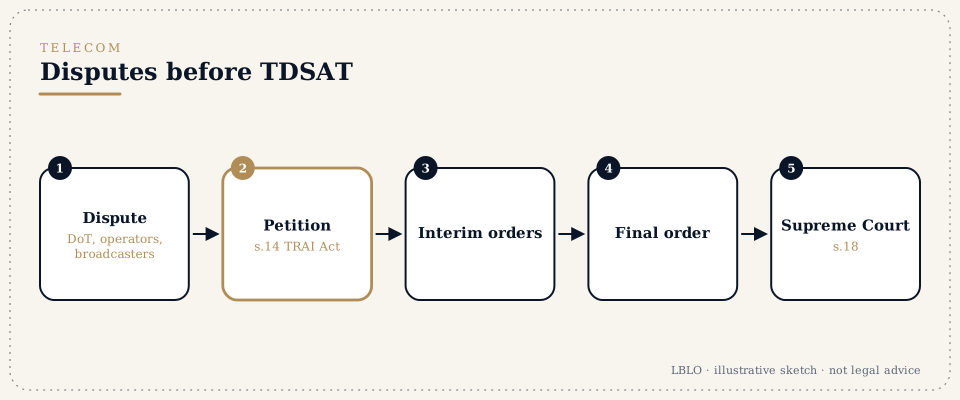
In brief
- What it is. The Telecom Disputes Settlement and Appellate Tribunal (TDSAT) is set up under Section 14 of the Telecom Regulatory Authority of India Act, 1997. It hears two kinds of matter:
- disputes between the licensor (the Department of Telecommunications) and a licensee, and between service providers, and between a service provider and a group of consumers;
- appeals against directions, decisions and orders of TRAI.
- Who it concerns.
- Telecom operators, internet and infrastructure providers.
- Broadcasters, distribution platform operators and cable operators.
- Companies facing licence-fee, spectrum or penalty demands.
- Civil courts are barred. They cannot decide these disputes.
- Appeal. An appeal against a final TDSAT order lies to the Supreme Court on substantial questions of law.
- The steps, in short:
- identify whether the matter is a dispute or an appeal;
- check the time limit;
- file the petition or appeal with documents;
- seek interim relief if a demand or disconnection is imminent;
- pleadings and hearing;
- final order;
- appeal or compliance.
- Keep ready:
- the licence or interconnection agreement;
- the demand, direction or order;
- all correspondence with DoT, TRAI or the other operator;
- the relevant TRAI regulations;
- calculation sheets.
Terms you will hear
- Licensee, licensor (DoT)
- the telecom operator, and the Department of Telecommunications.
- Licence fee and AGR
- the licence fee, and spectrum usage charges where they apply, are computed as a percentage of adjusted gross revenue.
- Interconnection and IUC
- the terms on which networks connect, and the usage charges between operators that TRAI's regulations prescribe.
- Tariff order
- a TRAI order fixing or regulating charges.
- Original jurisdiction of TDSAT (Section 14)
- disputes between licensor and licensee, between service providers, and between a provider and a group of consumers.
- Appeal (Section 18)
- an appeal against a TDSAT order, other than an interlocutory order, to the Supreme Court on a substantial question of law.
- Broadcasting and cable disputes
- carriage fees, channel placement and subscription revenue between broadcasters, distributors and operators.
In detail
Step 1: Is it a dispute or an appeal?
| Type | What it covers |
|---|---|
| Dispute | Licence-fee or spectrum demands, interconnection terms, signal disconnection between broadcasters and distributors, and other disputes between the parties named in the Act |
| Appeal | A direction, decision or order of TRAI |
The line matters. The Supreme Court has held that TRAI may issue directions to enforce its regulations without trespassing on TDSAT's jurisdiction, while a dispute between two service providers belongs before TDSAT.
Step 2: Time limits
An appeal against a direction, decision or order of TRAI must be filed within 30 days of receiving a copy (Section 14A(3), TRAI Act); an appeal under the AERA Act is also due within 30 days (Section 18), and one under the Information Technology Act within 45 days (Section 57(3)). A dispute must be brought within the time allowed for the underlying claim. Both are checked against the date of the order or the cause of action.
Step 3: The petition and interim relief
The petition sets out the facts, the demand or direction under challenge and the relief sought. Where an amount is about to be recovered, a licence is at risk, or signals are about to be disconnected, an application for interim relief is filed with it.
Step 4: Pleadings and hearing
The other side files a reply and the petitioner files a rejoinder. The Tribunal may call for accounts or technical material. Matters involving large demands often turn on how the licence terms and the regulations are read, and on the figures.
Step 5: Final order, appeal and compliance
TDSAT's orders are executable as a decree. An appeal against a final order lies to the Supreme Court under Section 18 of the Act, on the grounds the Act allows. In Information Technology Act matters the appeal lies instead to the High Court, within 60 days (Section 62 of that Act).
Common mistakes
- Taking a TDSAT matter to a civil court or a High Court first, which wastes time.
- Paying a disputed demand without recording protest, which can weaken a later claim for refund.
- Treating a regulatory direction as a commercial dispute, or the other way round.
How LBLO handles TDSAT matters
Each TDSAT matter starts with a reconciliation of the demand against:
- the licence terms;
- the regulations;
- earlier orders on the same question.
Questions people ask
Can an individual subscriber go to TDSAT?
Not individually. A group of consumers can bring a dispute against a service provider.
Can TDSAT stop a demand while the case is heard?
Yes. TDSAT can pass interim orders, often on terms such as a part deposit.
Where does an appeal from TDSAT go?
In TRAI Act and AERA Act matters, to the Supreme Court on substantial questions of law (Section 18, TRAI Act; Section 31, AERA Act); in Information Technology Act matters, to the High Court within 60 days (Section 62, IT Act).
These answers are educational summaries; they are not legal advice on any individual matter.
A serious question deserves a read brief.
Conferences are by appointment at G-46, Basement, Greater Kailash III, New Delhi. The principal reads the correspondence.
This page gives general information about the work of Lokesh Bhardwaj Law Offices, as permitted under the Bar Council of India Rules. It is not legal advice, and it does not create an advocate-client relationship. LBLO acts in a matter only on an engagement agreed in writing.
Last reviewed: 14/11/2026. Lokesh Bhardwaj Law Offices.
Law stated as at 14/11/2026.