
Regulatory Compliance for Businesses: POSH, Competition Basics and White-Collar Risk
Three areas of compliance reach most businesses: the POSH Act, the basics of competition law, and white-collar risk.
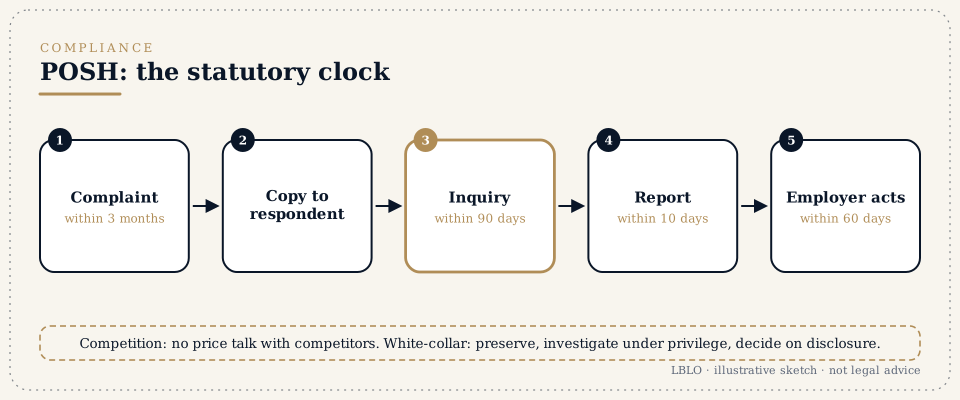
In brief
- POSH. Every employer with 10 or more employees must:
- set up an Internal Committee under the Sexual Harassment of Women at Workplace (Prevention, Prohibition and Redressal) Act, 2013;
- adopt a policy;
- train staff;
- file an annual report.
- POSH timelines:
- complaint within three months of the incident, extendable by three months;
- inquiry completed within 90 days;
- report within 10 days of the inquiry;
- employer acts on the recommendations within 60 days.
- POSH penalty. Failure to constitute the Committee or comply can attract a fine of up to Rs. 50,000, and higher consequences for repeat breaches.
- Competition law. The Competition Act, 2002 prohibits:
- cartels: price-fixing, bid-rigging and market sharing with competitors;
- abuse of a dominant position.
Penalties can be severe. A short competition policy and training for sales teams prevent most problems. Large deals need CCI approval (see the M&A page).
- White-collar risk. Fraud, bribery, data misuse and regulatory breaches are best handled by prevention:
- policies;
- approvals;
- audit trails.
When something goes wrong, the response should be prompt: preserve evidence, run an internal investigation under legal privilege, and decide on disclosure.
- The Office drafts the policies, constitutes and trains committees, runs or reviews inquiries, and advises on regulatory responses.
Terms you will hear
- Internal Committee (IC) and Local Committee (LC)
- the employer's committee, and the district-level committee for workplaces with fewer than 10 employees or complaints against the employer.
- External member
- the IC must include a member from an NGO or a person familiar with the issues.
- Conciliation
- a settlement at the complainant's request before the inquiry. No monetary settlement can be its basis.
- Interim relief
- a transfer, leave or a restraint during the inquiry.
- Cartel, bid-rigging, resale price maintenance
- illegal agreements between competitors, or with distributors in some cases.
- Leniency
- a reduced penalty for a cartel member who discloses the cartel to the CCI.
- Internal investigation, privilege, whistle-blower
- a fact-finding exercise led by counsel; the protection of legal advice from disclosure; and an employee who reports wrongdoing.
In detail
1. POSH compliance programme.
- Policy.
- IC constitution order, displayed at the workplace.
- Training for employees and for the IC.
- Complaint register.
- Inquiry procedure following natural justice.
- Annual report.
Inquiries that fail on procedure (no copy of the complaint to the respondent, no chance to cross-examine, a biased member) are open to challenge. Get the procedure right.
2. Running a POSH inquiry.
- Receipt.
- Copy to the respondent within the prescribed time.
- Reply.
- Hearing of both sides and witnesses.
- Findings.
- Report to the employer and to both parties.
- Employer action.
An appeal lies against the recommendations within 90 days of the recommendations (Section 18).
3. Competition compliance.
- No discussions with competitors on prices, bids, capacity or customers.
- Trade association meetings with an agenda and minutes.
- Distributor arrangements reviewed for resale price maintenance and exclusivity.
- Training for sales and procurement teams.
4. White-collar readiness.
- Delegation of authority.
- Vendor due diligence.
- An anti-bribery policy.
- Gifts and entertainment rules.
- Data access controls.
- A whistle-blower channel.
When an allegation arrives:
- Preserve emails and devices.
- Appoint counsel to run the investigation, to preserve privilege.
- Interview witnesses with care.
- Report to the board.
- Decide on regulator or police disclosure.
Questions people ask
We have nine employees. Do we need an IC?
The IC requirement applies at 10 or more. Complaints from smaller workplaces go to the Local Committee. A policy is still good practice.
Can the IC be only our own managers?
No. It needs a presiding officer who is a senior woman employee, employee members, and an external member, with at least half the members women.
A competitor called to "align prices". What do we do?
End the call, record that you refused, and take advice. Do not discuss prices with competitors.
Should our internal investigation be run by HR or by lawyers?
Where litigation or regulatory action is possible, counsel-led investigations better protect privilege.
Do POSH rules cover consultants and interns?
The Act's definition of "employee" is broad and includes trainees and others. Check the specific relationship.
These answers are educational summaries; they are not legal advice on any individual matter.
A serious question deserves a read brief.
Conferences are by appointment at G-46, Basement, Greater Kailash III, New Delhi. The principal reads the correspondence.
This page gives general information about the work of Lokesh Bhardwaj Law Offices, as permitted under the Bar Council of India Rules. It is not legal advice, and it does not create an advocate-client relationship. LBLO acts in a matter only on an engagement agreed in writing.
Law stated as at 14/11/2026.