
Mergers, Acquisitions, Investment Rounds and ESOPs: When Do the Shares Actually Move?
There are three common ways to combine businesses or bring in money: a share purchase, an investment round, and a merger or amalgamation.
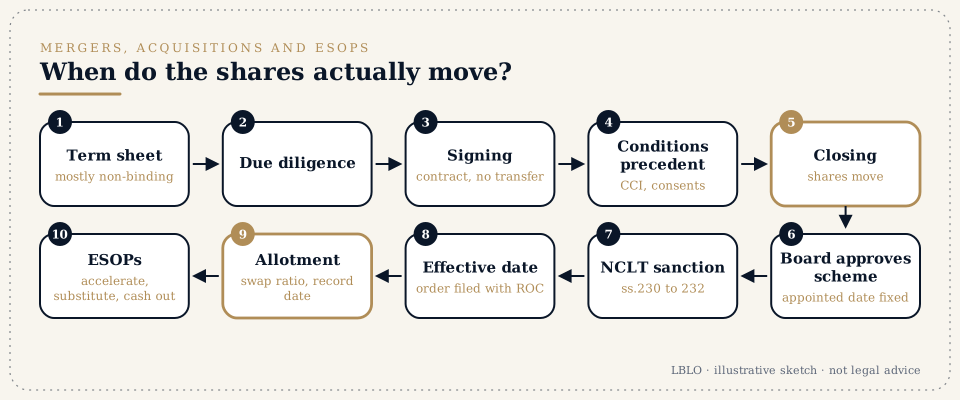
In brief
- There are three common ways to combine businesses or bring in money:
- share purchase: buying shares from the existing shareholders;
- investment round: subscribing to new shares issued by the company;
- merger or amalgamation: a scheme approved by the NCLT, in which one company is absorbed into another.
- In a share purchase or an investment round, the shares move at closing (completion). Closing comes after the conditions precedent are met. Signing the agreement does not move the shares.
- In an NCLT merger, the shareholders of the company being absorbed receive shares of the surviving company under the swap ratio, after the scheme becomes effective. The absorbed company is dissolved without winding up.
- Two dates confuse almost everyone:
- the appointed date, from which the scheme takes effect for accounts and tax;
- the effective date, when the NCLT orders are filed with the Registrar of Companies.
- Mergers between small companies, or between a holding company and its wholly owned subsidiary, can use a fast-track route under Section 233. That route needs approval from the Regional Director, not the NCLT.
- Large deals need prior approval from the Competition Commission of India (CCI). This includes deals worth more than Rs. 2,000 crore where the target has substantial business operations in India. The deal cannot close until the CCI approves it or the review period runs out.
- ESOPs need specific planning in every deal:
- Do unvested options accelerate?
- Are they substituted with options in the buyer?
- Are they cashed out?
- Who bears the tax?
Terms you will hear
- Term sheet
- the short, mostly non-binding summary of commercial terms signed before the definitive agreements. Its confidentiality, exclusivity and governing-law clauses are usually binding.
- Due diligence (DD)
- the buyer's legal, financial and tax review of the target.
- SPA, SSA, SHA
-
- the share purchase agreement (buying existing shares);
- the share subscription agreement (subscribing to new shares);
- the shareholders' agreement (how the company is run after the deal).
- Conditions precedent (CPs)
- what must happen before closing. Examples are regulatory approvals, third-party consents, the cure of DD findings, and board and shareholder resolutions.
- Signing and closing
- signing creates the contract. Closing (completion) is when the money is paid and the shares are transferred or allotted. The gap between them can be weeks or months.
- Long-stop date
- the date by which closing must happen, failing which either party may walk away.
- Representations, warranties and indemnities
- the seller's statements about the business, and the promise to compensate the buyer if they prove untrue.
- Escrow and holdback
- part of the price held back to secure the indemnities.
- Earn-out
- part of the price paid later, linked to future performance.
- Pre-money and post-money valuation; dilution
- the value of the company before and after the new investment. Dilution is the fall in existing holders' percentage when new shares are issued.
- Liquidation preference, anti-dilution, ROFR, ROFO, tag-along, drag-along
-
- liquidation preference: the investor is paid first on a sale or wind-up;
- anti-dilution: protection if later shares are issued at a lower price;
- ROFR and ROFO: the right of first refusal and the right of first offer on a sale of shares;
- tag-along: the right to join a sale on the same terms;
- drag-along: the right to force minority holders to join a sale.
- Scheme of arrangement
- the NCLT-approved plan for a merger, demerger or reorganisation under Sections 230 to 232 of the Companies Act, 2013.
- Transferor and transferee company
- the company being absorbed, and the company that survives.
- Swap ratio
- how many shares of the transferee a shareholder of the transferor receives. It is supported by a valuation report from a registered valuer.
- Record date
- the date that fixes which shareholders receive the new shares.
- Appointed date and effective date
- explained in point 4 below.
- ESOP, grant, vesting, cliff, exercise
-
- grant: the option is given;
- vesting: the option becomes exercisable, usually over four years with a one-year cliff;
- exercise: the employee pays the exercise price and gets shares.
- Acceleration (single-trigger, double-trigger)
- vesting brought forward on a sale (single-trigger), or on a sale followed by loss of the job (double-trigger).
- Good leaver and bad leaver
- how options are treated when an employee leaves, depending on the circumstances of leaving.
In detail
1. Three structures, three moments of transfer.
Share purchase. The buyer purchases existing shares from the promoters or other holders. The money goes to the sellers, not the company.
- At closing, the sellers deliver signed transfer instructions. For dematerialised shares, the depository participant processes the transfer.
- The company records the buyer in its register of members.
- Until closing, the sellers own the shares, vote them and bear the risk.
Investment round (primary issue). The company issues new shares to the investor, usually by private placement or preferential allotment.
- The investor pays into a separate bank account.
- The board allots the shares.
- The company files the return of allotment with the Registrar.
- If the investor is foreign, the company reports the investment under the foreign exchange rules within the prescribed time.
Merger by scheme. No one "buys" shares. The NCLT sanctions a scheme under which:
- the transferor's assets, liabilities, employees and contracts vest in the transferee;
- the transferor's shareholders receive new shares of the transferee under the swap ratio;
- the transferor is dissolved without being wound up.
The shares are allotted after the effective date, to holders on the record date.
2. The usual timeline of a share deal.
- Confidentiality agreement.
- Term sheet.
- Due diligence, usually three to eight weeks for a mid-sized target.
- Negotiation of the SPA or SSA and the SHA.
- Signing.
- Satisfaction of the CPs.
- Closing.
- Post-closing filings and integration.
The buyer's protection lies mainly in three places: the warranties, the disclosure letter against them, and the indemnity cap and escrow. The seller's protection lies in the cap, the time limits for claims, and a carefully drafted disclosure letter.
3. The usual timeline of an NCLT merger.
- Board approval of the scheme.
- Valuation report and swap ratio.
- Application to the NCLT.
- Meetings of shareholders and creditors as the NCLT directs.
- Notices to regulators, including the Central Government, the Registrar, the Official Liquidator where applicable, and the income-tax authorities.
- Final hearing and sanction.
- Certified copy of the order filed with the Registrar. This is the effective date.
- Allotment of shares under the swap ratio.
For the fast-track route under Section 233, the scheme goes to the Regional Director and the Registrar instead of the NCLT. That route is available to small companies and to a holding company merging with its wholly owned subsidiary.
4. Appointed date and effective date, explained.
Section 232(6) lets the scheme specify an appointed date. From that date, the merger is treated as having happened for accounting and tax purposes, even if the NCLT approves the scheme months later.
The effective date is when the scheme becomes operative in law, on filing the NCLT order with the Registrar. Between the two dates, the transferor carries on business "in trust" for the transferee.
For an employee, a lender or a counterparty, this explains why letters, payslips and bank statements may still carry the old company's name for some time after an announced merger.
5. Competition approval.
India's merger control is mandatory and suspensory. A notifiable deal cannot be completed until the CCI approves it.
Deals are notifiable if they cross the asset or turnover thresholds. Since 10/09/2024, a deal is also notifiable if:
- the value of the transaction exceeds Rs. 2,000 crore; and
- the target has substantial business operations in India, a test the CCI (Combinations) Regulations, 2024 define by reference to users, turnover or gross merchandise value in India.
The overall review period is 150 days. The small-target exemption does not apply where the deal-value threshold is met.
For a start-up being acquired at a high valuation with modest turnover, this is the provision to check first.
6. ESOPs in a deal.
Under Section 62(1)(b) of the Companies Act and Rule 12 of the Share Capital Rules, options must vest over at least one year. The four-year vesting with a one-year cliff is market practice, not law.
In a deal, the scheme or the SPA should say what happens to:
- vested options: exercised before closing, bought out for cash, or rolled over;
- unvested options: accelerated, substituted with equivalent options in the buyer, or cancelled with compensation;
- the ESOP trust, if there is one.
Tax follows the structure:
- On exercise, the difference between the fair market value and the exercise price is taxed as salary (a perquisite). The employer deducts tax at source.
- On a later sale, capital gains tax applies.
- Eligible start-ups have a deferral facility for the perquisite tax.
From 01/04/2026, the Income-tax Act, 2025 governs these provisions.
Employees should read three documents before signing anything at a deal: the ESOP scheme, their grant letter, and the deal's employee communication.
7. Disputes after closing.
Most post-deal disputes concern:
- warranty claims: an undisclosed tax demand, litigation or a regulatory breach;
- earn-out calculations;
- non-compete and non-solicit breaches;
- deadlock under the SHA.
These usually go to arbitration under the SPA or SHA. Some go to the NCLT as oppression and mismanagement petitions under Sections 241 and 242.
Questions people ask
We signed the SPA last month. Do we own the shares?
Not until closing. Signing creates the obligation. Ownership passes when the CPs are met, the price is paid and the transfer is recorded.
I hold shares in a company merging into a listed company. When do I get the new shares?
After the scheme is effective, for holders on the record date, at the swap ratio. Fractional entitlements are usually consolidated and sold, with the proceeds paid out.
My unvested ESOPs: will I lose them in the acquisition?
Not automatically. Your grant letter and the scheme decide. Look for acceleration, substitution or cash-out clauses.
Do we need CCI approval for a small acquisition?
Only if a threshold is crossed. Remember that the deal-value test can catch a target with small assets but a large price.
Why does the merger scheme have a date in the past?
That is the appointed date. The merger takes accounting and tax effect from then, while the effective date comes later.
These answers are educational summaries; they are not legal advice on any individual matter.
A serious question deserves a read brief.
Conferences are by appointment at G-46, Basement, Greater Kailash III, New Delhi. The principal reads the correspondence.
This page gives general information about the work of Lokesh Bhardwaj Law Offices, as permitted under the Bar Council of India Rules. It is not legal advice, and it does not create an advocate-client relationship. LBLO acts in a matter only on an engagement agreed in writing.
Law stated as at 14/11/2026.