
ED and PMLA Proceedings: Summons, Arrest, Attachment, Appeals and Bail under Section 45
The Prevention of Money-laundering Act, 2002 (PMLA) is enforced by the Directorate of Enforcement (ED). It runs on two tracks at once: a criminal prosecution before a Special Court, and proceedings to attach and confiscate property before the Adjudicating Authority.
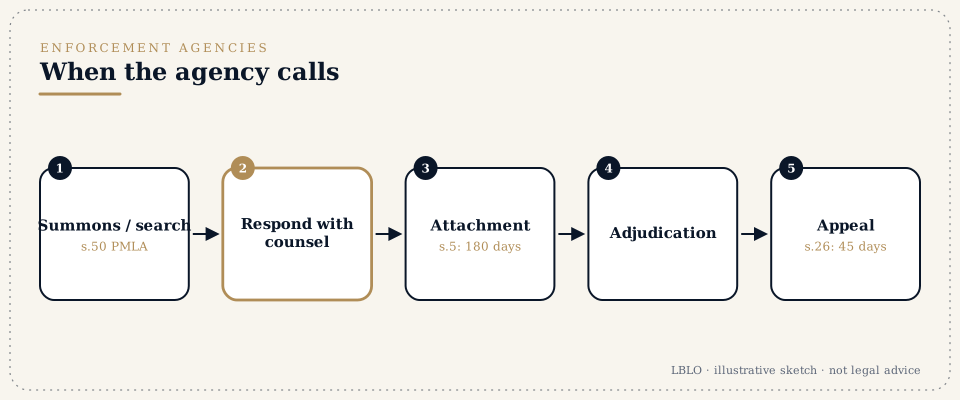
In brief
- The offence. Money-laundering is any process or activity connected with the proceeds of crime, including concealment, possession, acquisition or use, and projecting or claiming it as untainted property (Section 3). Punishment is rigorous imprisonment of three to seven years and fine, up to ten years where the crime relates to the NDPS Act (Section 4).
- A scheduled offence comes first. Proceeds of crime are property derived from criminal activity relating to a scheduled offence listed in the Schedule (Section 2(1)(u) and (y)).
- Summons. ED officers may summon any person to give evidence or produce records; the person must attend and state the truth, and the proceeding is a judicial proceeding (Section 50).
- Arrest. An authorised officer may arrest only on the basis of material in his possession and a reason to believe, recorded in writing, that the person is guilty; the grounds must be told to the person and he must be produced before the court within 24 hours (Section 19).
- Attachment. Property may be provisionally attached for up to 180 days; a complaint must go to the Adjudicating Authority within 30 days, which confirms or releases the property after notice of at least 30 days (Sections 5 and 8).
- Appeals. To the Appellate Tribunal within 45 days (Section 26), and then to the High Court within 60 days on any question of law or fact (Section 42).
- Bail. Section 45 adds twin conditions to the ordinary law of bail.
Terms you will hear
- ECIR
- Enforcement Case Information Report, the record the ED opens when it begins a money-laundering case. The PMLA does not use the term; it is the ED's internal record and is not an FIR under the BNSS.
- Scheduled offence
- an offence listed in Part A of the Schedule, an offence in Part B where the total value involved is Rs. 1 crore or more, or an offence in Part C (Section 2(1)(y)).
- Proceeds of crime
- property derived or obtained, directly or indirectly, as a result of criminal activity relating to a scheduled offence, or its value, including equivalent property held in India or abroad where the property is taken or held outside India (Section 2(1)(u)).
- Provisional attachment
- an order under Section 5 that the property shall not be transferred or dealt with, valid for up to 180 days unless confirmed.
- Adjudicating Authority
- the body of a Chairperson and two Members appointed under Section 6, which decides whether attached, seized or frozen property is involved in money-laundering. Its Benches ordinarily sit at New Delhi.
- Appellate Tribunal
- the Appellate Tribunal constituted under Section 12(1) of the Smugglers and Foreign Exchange Manipulators (Forfeiture of Property) Act, 1976, which hears appeals under the PMLA (Section 25).
- Special Court
- a Court of Session designated by the Central Government, in consultation with the Chief Justice of the High Court, to try PMLA offences (Section 43).
In detail
The PMLA is a separate statute, but it depends on the ordinary criminal law at two points: there must be a scheduled offence, investigated by the police or another agency, and the Special Court applies the ordinary criminal procedure except where the PMLA provides otherwise (Section 46). The PMLA's text still refers to the Code of Criminal Procedure, 1973 and the Indian Penal Code; those references are now read with the BNSS and the BNS.
ED and PMLA proceedings
What money-laundering means
Section 3 makes it an offence directly or indirectly to attempt to indulge in, knowingly assist, knowingly be a party to, or actually be involved in any process or activity connected with the proceeds of crime, including its concealment, possession, acquisition or use, and projecting or claiming it as untainted property. An Explanation added in 2019 makes each of those activities sufficient by itself, and states that the activity continues for as long as a person enjoys the proceeds of crime by concealment, possession, acquisition, use, projection or claim.
The scheduled offence
Proceeds of crime must relate to a scheduled offence (Section 2(1)(u)). The Schedule lists offences under many laws in Part A; Part B offences count only where the total value involved is Rs. 1 crore or more; Part C is a further category. If no scheduled offence is involved, the PMLA does not apply.
Who investigates and who tries
The authorities under the Act are the Director, Additional Directors, Joint Directors, Deputy Directors, Assistant Directors and other officers appointed (Section 48). No police officer may investigate a PMLA offence unless specifically authorised by the Central Government (Section 45(1A)). The offence is tried by a Special Court, which also tries the connected scheduled offence (Section 44(1)(a)); where the scheduled offence is before another court, that court commits it to the Special Court on the authority's application (Section 44(1)(c)). The Special Court takes cognizance only on a complaint in writing by the Director or an authorised officer (Section 45(1), second proviso). If investigation shows no money-laundering offence, the authority must file a closure report before the Special Court (proviso to Section 44(1)(b)).
Two tracks at once
Attachment runs before the Adjudicating Authority, the Appellate Tribunal and the High Court; the prosecution runs before the Special Court, whose jurisdiction over the PMLA offence does not depend on orders passed in the scheduled offence (Explanation to Section 44(1)). Each track needs its own answer within its own time.
ECIR, summons, search and arrest under Section 19
The ECIR
A PMLA case usually begins with an ECIR recorded by the ED. The Act does not provide for an FIR, and the provisions on registration of FIRs in the BNSS do not apply to the ED's case. A person summoned may not know whether he is a witness or a suspect, and the summons should be read for what it asks: attendance to give evidence, production of records, or both.
Summons under Section 50
The Director, an Additional, Joint, Deputy or Assistant Director may summon any person whose attendance is considered necessary, to give evidence or produce records, during any investigation or proceeding under the Act (Section 50(2)). The persons summoned are bound to attend in person or through authorised agents as the officer directs, to state the truth upon any subject on which they are examined, and to produce the documents required (Section 50(3)). Every such proceeding is deemed a judicial proceeding (Section 50(4)), so a false statement can have consequences of its own.
Search, seizure and freezing
A search under Section 17 needs a reason to believe, recorded in writing, on the basis of information in the officer's possession. Where seizure is not practicable, the officer may freeze the property, and it may not then be dealt with without his permission (Section 17(1A)). A copy of the reasons and material goes to the Adjudicating Authority in a sealed envelope, and an application for retention of what was seized or frozen must be filed before the Adjudicating Authority within thirty days (Section 17(2) and (4)). Seized property may be retained for up to 180 days and must then be returned unless the Adjudicating Authority permits continued retention (Section 20). A person whose records are seized is entitled to copies (Section 21(2)), and no female may be searched except by a female (Section 18(8)).
Arrest under Section 19
Section 19(1) allows the Director, a Deputy Director, an Assistant Director or another authorised officer to arrest a person only if, on the basis of material in his possession, he has reason to believe (the reason to be recorded in writing) that the person has been guilty of an offence punishable under the Act. The person must be informed of the grounds of arrest as soon as may be. Immediately after the arrest, a copy of the order and the material must be sent to the Adjudicating Authority in a sealed envelope (Section 19(2)), and the person must be taken within twenty-four hours, excluding the journey, to the Special Court or the Judicial or Metropolitan Magistrate having jurisdiction (Section 19(3)).
These safeguards are conditions on the power, and the remand hearing is the first opportunity to test them: whether the reasons to believe were recorded, whether they rest on material, and whether the grounds were given in writing. The constitutional requirement to inform a person of the grounds of arrest, and the Supreme Court's recent decisions on written grounds, are discussed in When can the police arrest you?.
Preparing for a summons
- Read the summons for the section, the case reference, and what is to be produced.
- Assemble the documents asked for, keep a full copy, and review the transactions before attending.
- If a statement recorded is incomplete or wrong, correct it in writing at the first opportunity.
- Do not move, transfer or encumber property connected with the inquiry.
Attachment and the Adjudicating Authority
Provisional attachment: Section 5
The Director or an officer not below the rank of Deputy Director may provisionally attach property by a written order for up to 180 days, if he has reason to believe, recorded in writing and based on material in his possession, that a person is in possession of proceeds of crime and that they are likely to be concealed, transferred or dealt with in a way that may frustrate confiscation (Section 5(1)). Ordinarily, attachment requires that a police report or complaint on the scheduled offence has been filed before a Magistrate or court; but property may be attached immediately, notwithstanding that condition, where the officer records reasons to believe that non-attachment is likely to frustrate any proceeding under the Act. Any period during which the proceedings are stayed by the High Court is excluded from the 180 days, and a further thirty days are counted from the vacation of the stay.
A copy of the order and the material goes to the Adjudicating Authority in a sealed envelope (Section 5(2)). The attachment ceases on the expiry of 180 days or on the Adjudicating Authority's order, whichever is earlier (Section 5(3)). A person interested in attached immovable property is not prevented from enjoying it (Section 5(4)). The officer must file a complaint before the Adjudicating Authority within thirty days of the attachment (Section 5(5)).
Adjudication: Section 8
On the complaint, the Adjudicating Authority may serve a notice of not less than thirty days calling on the person to indicate the sources of his income, earnings or assets out of which he acquired the property, the evidence he relies on, and to show cause why the property should not be declared to be involved in money-laundering and confiscated (Section 8(1)). Where the notice says the property is held on behalf of another person, that person must also be served; joint holders must all be served. After considering the reply, hearing the aggrieved person and the ED, and taking into account all the material, the Authority records a finding whether the property is involved in money-laundering (Section 8(2)). A person who claims the property, though not served, must also be given an opportunity of being heard.
If the Authority confirms the attachment, it continues during investigation for a period not exceeding 365 days, or during the pendency of proceedings relating to the offence before a court, and becomes final on an order of confiscation by the Special Court (Section 8(3)). The ED then takes possession (Section 8(4)). At the end of the trial, the Special Court orders confiscation if the offence is proved, or release to the person entitled if it is not (Section 8(5) and (6)); where the trial cannot be held or concluded, the Special Court decides on an application (Section 8(7)). The Special Court may restore confiscated property to a claimant with a legitimate interest who has suffered a quantifiable loss, acted in good faith and is not involved in the offence (Section 8(8)).
The procedure before the Authority
The Adjudicating Authority is not bound by the Code of Civil Procedure but is guided by the principles of natural justice and may regulate its own procedure (Section 6(15)). The reply to the show-cause notice should trace the source of funds for each property with documents and raise every legal objection, including whether the statutory conditions for attachment were met.
The Appellate Tribunal and appeals to the High Court
Appeal to the Appellate Tribunal: Section 26
The Director, or any person aggrieved by an order of the Adjudicating Authority, may appeal to the Appellate Tribunal (Section 26(1)). The appeal must be filed within forty-five days from the date on which a copy of the order is received, in the prescribed form and with the prescribed fee; the Tribunal may entertain a later appeal if satisfied that there was sufficient cause (Section 26(3)). After hearing the parties it may confirm, modify or set aside the order (Section 26(4)), and it is to endeavour to dispose of the appeal within six months of filing (Section 26(6)).
Appeal to the High Court: Section 42
Any person aggrieved by a decision or order of the Appellate Tribunal may appeal to the High Court within sixty days from the date the decision or order is communicated to him, on any question of law or fact arising out of it. The High Court may allow a further period of not more than sixty days if the appellant was prevented by sufficient cause. The High Court is the one within whose jurisdiction the aggrieved party ordinarily resides, carries on business or personally works for gain; where the Central Government is the aggrieved party, the High Court where the respondent resides or works.
Orders of the Special Court
Against orders of the Special Court, the High Court exercises the appellate and revisional powers of the Code as if the Special Court were a Court of Session within its jurisdiction (Section 47). Bail orders, orders on cognizance and judgments are challenged through those routes, and a petition under Section 528 BNSS may lie in a suitable case. A further challenge lies to the Supreme Court by special leave under Article 136.
Common mistakes
- Counting the 45 days from the date of the order rather than the date the copy is received, or from neither and losing time.
- Treating the attachment track and the prosecution as one proceeding and answering only one.
- Failing to file a third party's claim before the Adjudicating Authority.
Bail under Section 45
The twin conditions
Section 45(1) provides that, notwithstanding the ordinary criminal procedure, no person accused of an offence under the PMLA shall be released on bail or on his own bond unless (i) the Public Prosecutor has been given an opportunity to oppose the application, and (ii) where he opposes it, the court is satisfied that there are reasonable grounds for believing that the accused is not guilty of the offence and is not likely to commit any offence while on bail. These limits are in addition to the limits under the general law (Section 45(2)). An Explanation added in 2019 declares that all PMLA offences are cognizable and non-bailable, and that authorised officers may arrest without warrant subject to Section 19 and Section 45.
The proviso
A person under sixteen years of age, a woman, a person who is sick or infirm, and a person accused, alone or together with co-accused, of money-laundering a sum of less than one crore rupees may be released on bail if the Special Court so directs (first proviso to Section 45(1)). The proviso gives the court a discretion; it does not make bail automatic.
Which court, and how
The Special Court is deemed a Court of Session and the ordinary bail provisions apply to it except as the PMLA provides (Section 46). The High Court's special powers regarding bail are preserved (Section 44(2)). The application must meet both limbs of Section 45 on the record: it should show from the ED's own material why there are reasonable grounds to believe the accused is not guilty, and address the risk of further offences. The Supreme Court in Satender Kumar Antil v. Central Bureau of Investigation, (2022) 10 SCC 51 treated offences under special Acts with such provisions as a separate category, in which the special condition must be satisfied in addition to the ordinary considerations.
What the court looks at in practice
- whether the property alleged to be proceeds of crime is traced to a scheduled offence, and the status of that case;
- the material relied on in the prosecution complaint, and what the accused's own records show;
- the period already spent in custody and the likely length of the trial;
- the accused's cooperation with summonses before arrest, and the conditions he is willing to accept.
The general law of bail, including anticipatory bail and default bail, is explained on the bail page.
Questions people ask
What is an ECIR, and is it the same as an FIR?
An ECIR, or Enforcement Case Information Report, is the record the Enforcement Directorate opens when it begins a money-laundering case. The PMLA does not use the term or provide for an FIR; the ECIR is the ED's internal record. A PMLA case also depends on a separate scheduled offence, which is usually the subject of its own FIR or complaint under the ordinary criminal law.
Do I have to go when the ED summons me under Section 50?
Yes. Section 50(3) of the PMLA makes every person summoned bound to attend, in person or through an authorised agent as the officer directs, to state the truth on the subjects examined and to produce the documents required. The proceeding is deemed a judicial proceeding, so false statements have consequences. Preparation, accurate answers and a written correction of any mistake in the recorded statement are what matter.
When can the ED arrest someone?
Only an authorised officer may arrest, and only if, on the basis of material in his possession, he has reason to believe, recorded in writing, that the person is guilty of an offence under the PMLA (Section 19). The grounds must be told to the person as soon as may be, a copy of the order and material must go to the Adjudicating Authority in a sealed envelope, and the person must be produced before the Special Court or Magistrate within 24 hours.
How long can the ED keep my property provisionally attached?
A provisional attachment under Section 5 lasts for up to 180 days, excluding any period during which the High Court has stayed the proceedings. The ED must file a complaint before the Adjudicating Authority within 30 days of the attachment. If the Authority confirms it, the attachment continues during investigation for up to 365 days, or while proceedings are pending before a court, and becomes final only on confiscation by the Special Court.
My property is attached but I am not accused. What can I do?
You can appear before the Adjudicating Authority and show that the property is not involved in money-laundering. Section 8 requires notice to a person on whose behalf property is said to be held and to all joint holders, and gives any claimant an opportunity of being heard. Your reply should trace the source of funds with documents. If the attachment is confirmed, you may appeal to the Appellate Tribunal within 45 days.
What is the time limit for appealing an Adjudicating Authority order?
An appeal to the Appellate Tribunal must be filed within 45 days from the date on which a copy of the Adjudicating Authority's order is received (Section 26(3)). The Tribunal may admit a later appeal if there was sufficient cause. A further appeal lies to the High Court within 60 days from the communication of the Tribunal's order, extendable by up to 60 days, on any question of law or fact (Section 42).
What are the twin conditions for PMLA bail?
Section 45 requires that the Public Prosecutor be given an opportunity to oppose the application, and that, if he opposes it, the court be satisfied that there are reasonable grounds for believing that the accused is not guilty and is not likely to commit any offence while on bail. The conditions apply in addition to the ordinary law of bail. A person under sixteen, a woman, a sick or infirm person, or a person accused of laundering less than one crore rupees may be released if the Special Court so directs.
Which court tries a PMLA case?
A Special Court, which is a Court of Session designated by the Central Government in consultation with the Chief Justice of the High Court (Section 43). It takes cognizance on a complaint in writing by the Director or an authorised officer, and also tries the connected scheduled offence. It follows the ordinary procedure for a Sessions trial, except where the PMLA provides otherwise.
Can the ED attach property before any charge-sheet is filed?
Ordinarily, Section 5 requires that a police report or complaint on the scheduled offence has been filed before a Magistrate or court. But the second proviso allows immediate attachment, notwithstanding that condition, where the officer has reason to believe, recorded in writing on the basis of material in his possession, that non-attachment is likely to frustrate proceedings under the Act. Whether that condition was genuinely met is a point to raise before the Adjudicating Authority.
What happens to the property if the accused is acquitted?
If, at the end of the trial, the Special Court finds that money-laundering has not taken place or the property is not involved in money-laundering, it orders the property released to the person entitled to it (Section 8(6)). The ED may withhold release for up to 90 days if it considers the property relevant to an appeal (Section 20(6)). If the offence is proved, the property is confiscated to the Central Government.
These answers are educational summaries; they are not legal advice on any individual matter.
A serious question deserves a read brief.
Conferences are by appointment at G-46, Basement, Greater Kailash III, New Delhi. The principal reads the correspondence.
This page gives general information about the work of Lokesh Bhardwaj Law Offices, as permitted under the Bar Council of India Rules. It is not legal advice, and it does not create an advocate-client relationship. LBLO acts in a matter only on an engagement agreed in writing.
Last reviewed: 16/11/2026. Lokesh Bhardwaj Law Offices.
Law stated as at 16/11/2026.