
When an Enforcement Agency Comes Calling: ED, CBI, GST and DRI
A summons, a search or an attachment order is a crisis for any business.
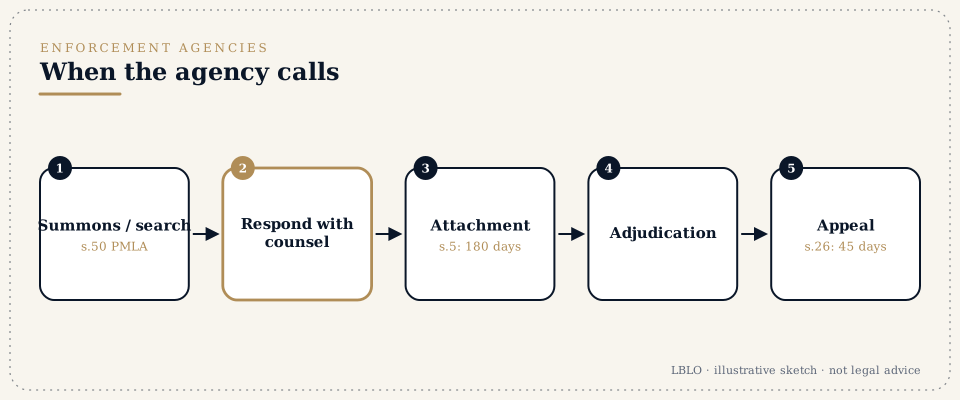
In brief
- Who the agencies are:
- the Directorate of Enforcement (ED), for money laundering and foreign exchange;
- the Central Bureau of Investigation (CBI);
- the GST intelligence wing (DGGI);
- the Directorate of Revenue Intelligence (DRI), for customs.
- State police economic offences wings deal with similar matters.
- The usual stages:
- summons to appear and give a statement;
- search and seizure;
- freezing or attachment of property;
- arrest in some cases;
- a complaint or charge sheet;
- trial.
- Attachment of property under the PMLA:
- The ED can provisionally attach property it believes to be proceeds of crime, for up to 180 days.
- Within that time an independent Adjudicating Authority must decide whether to confirm the attachment, after hearing the owner.
- A confirmation order can be appealed to the Appellate Tribunal within 45 days, and then to the High Court.
- Rights that matter:
- to be represented;
- to know the case against you at the adjudication stage;
- to apply for anticipatory or regular bail;
- to challenge unlawful action before the High Court.
- What to do first:
- do not ignore a summons;
- do not destroy or move documents;
- get the summons, search memo or order to an advocate the same day.
- Keep ready:
- the summons or order;
- the search list and panchnama;
- the company's books for the period in question;
- bank statements;
- the transaction documents the agency is asking about.
Terms you will hear
- ECIR
- the Enforcement Directorate's internal case record. It is not an FIR.
- Scheduled offence and proceeds of crime
- the predicate crime, and the property derived from it, under the PMLA.
- Summons under Section 50 PMLA
- a direction to appear and give evidence or produce documents.
- Provisional attachment (Section 5)
- valid for up to 180 days. A complaint goes to the Adjudicating Authority within 30 days.
- Search and seizure, panchnama
- the record of what was searched and taken.
- Look Out Circular
- a notice that can stop a person leaving India.
- Anticipatory bail and regular bail
- protection before arrest (Section 482 of the BNSS), and release after arrest. In PMLA cases the further conditions of Section 45 of the PMLA apply.
- Appellate Tribunal (Section 26)
- the forum for appeals against an order of the Adjudicating Authority, such as one confirming an attachment, within 45 days.
In detail
Step 1: The summons
A summons may call a person to give a statement and to produce documents. The person summoned must attend. Whether the person is a witness or a suspect, and what they are asked about, decides how to prepare.
Statements are recorded. Preparation means:
- understanding what documents the agency already has;
- answering accurately;
- correcting the record in writing where a statement is wrong.
Step 2: Search and seizure
During a search the officers prepare a list of what is seized. The person searched should:
- receive a copy of that list;
- check that it is accurate;
- record any objection in writing.
Electronic devices and data are seized as well. A copy of what is taken should be requested.
Step 3: Attachment under the PMLA
- Provisional attachment. Under Section 5 of the Prevention of Money-Laundering Act, 2002, the ED can provisionally attach property for up to 180 days. It must record its reason to believe that the property is proceeds of crime.
- Complaint. A complaint must be filed with the Adjudicating Authority within 30 days of the attachment.
- Adjudication. Under Section 8 the Authority issues notice to the owner, hears them, and decides whether to confirm the attachment.
- If not confirmed in time. Where the Authority does not confirm the attachment within the period, the provisional attachment comes to an end.
- Appeals. An appeal against a confirmation order lies to the Appellate Tribunal within 45 days. From there an appeal lies to the High Court.
Third parties also have a right to be heard. A bank holding a mortgage over attached property, or a buyer who paid for it in good faith, may be one of them.
Step 4: Arrest and bail
- Before arrest. Where arrest is apprehended, anticipatory bail can be sought.
- After arrest. The grounds of arrest must be communicated, and a regular bail application is filed.
- Special laws. Some statutes, including the PMLA, impose additional conditions for bail. Applications under them are prepared with those conditions in mind.
Step 5: Complaint, charge sheet and trial
Once the agency files its complaint or charge sheet, the case goes to the trial court. Issues at this stage include:
- discharge;
- inspection of documents relied on and not relied on;
- the trial itself.
The High Court can be approached to quash proceedings that disclose no offence.
Common mistakes
- Attending a summons unprepared, or giving a statement without having reviewed the relevant documents.
- Signing a seizure list without checking it.
- Letting the deadline to reply before the Adjudicating Authority pass.
- Moving assets after an attachment or freeze, which creates a fresh problem.
How LBLO handles these matters
- On instructions: the summons, order or search record is reviewed and a list of dates is prepared.
- Before any appearance: the client is prepared on the documents.
- Attachment, bail and quashing are run as connected proceedings.
Questions people ask
Do I have to go when the ED or GST officers summon me?
Yes. A summons must be obeyed. How to prepare depends on what it asks for.
My property has been attached but I am not accused of anything. What can I do?
You can oppose confirmation before the Adjudicating Authority. If it is confirmed, you can appeal to the Appellate Tribunal.
How long can the ED keep property provisionally attached?
Up to 180 days, unless the Adjudicating Authority confirms the attachment within that time.
These answers are educational summaries; they are not legal advice on any individual matter.
A serious question deserves a read brief.
Conferences are by appointment at G-46, Basement, Greater Kailash III, New Delhi. The principal reads the correspondence.
This page gives general information about the work of Lokesh Bhardwaj Law Offices, as permitted under the Bar Council of India Rules. It is not legal advice, and it does not create an advocate-client relationship. LBLO acts in a matter only on an engagement agreed in writing.
Last reviewed: 14/11/2026. Lokesh Bhardwaj Law Offices.
Law stated as at 14/11/2026.