
Challenging Government and Regulatory Action: Writs, Customs Seizures, Tax Demands and Tenders
Government action can be challenged when it is without authority, unfair in procedure, unreasoned or discriminatory.
In brief
- What it is. Government action can be challenged when it is without authority, unfair in procedure, unreasoned or discriminatory. This covers:
- seizure of goods;
- a tax demand;
- cancellation of a licence;
- disqualification from a tender;
- blacklisting.
- Where.
- Many orders have an appeal provided in the statute itself, to an appellate authority or tribunal.
- Where there is no effective remedy, or the action is plainly without jurisdiction or breaches natural justice, a writ petition can be filed in the High Court under Article 226 of the Constitution.
- Writs on fundamental rights can also be filed in the Supreme Court under Article 32.
- Customs seizures, in short.
- When goods are seized, a show cause notice must ordinarily be issued within six months. That period can be extended by up to six months more.
- If no notice is issued in time, the goods must be returned.
- The goods can also be released provisionally on bond and security while the case is decided.
- Different rules apply where provisional release has already been ordered.
- Tenders and blacklisting. A bidder can challenge disqualification or blacklisting that is arbitrary, disproportionate or ordered without a hearing.
- What to do first:
- get the order or notice in writing;
- note the date it was received;
- do not miss a deadline to reply or appeal while deciding strategy.
- Keep ready:
- the notice or order and all correspondence;
- the seizure memo or panchnama;
- invoices and import documents;
- the tender document and the bid;
- any earlier orders in the matter.
Terms you will hear
- Writ petition (Article 226)
- the High Court petition against State action.
- Show cause notice
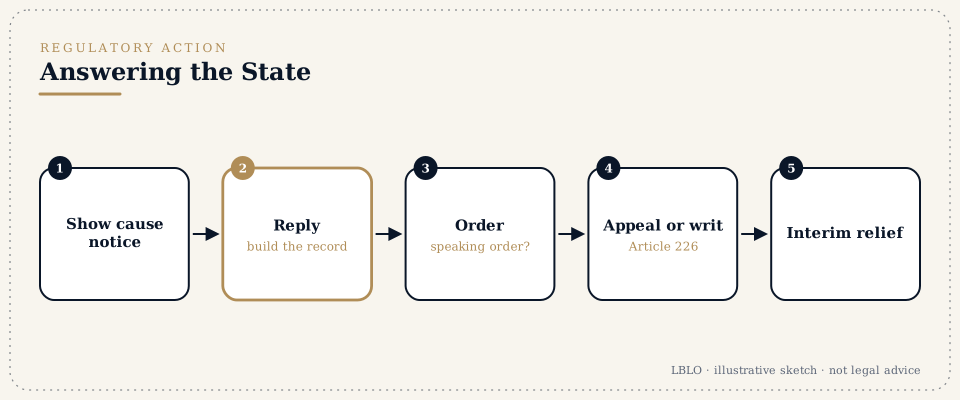
- the notice before an adverse order. The reply builds the record.
- Speaking order
- an order that gives reasons. A bare order is open to challenge.
- Seizure and provisional release (customs)
- goods detained, and their release on a bond and security pending the case.
- Bid security and technical evaluation (tenders)
- the deposit with a bid, and the stage at which bids are screened.
- Blacklisting and debarment
- exclusion from future tenders. It requires notice and proportionality.
- Alternative remedy
- the statutory appeal the court may expect you to use first.
In detail
Step 1: Read the notice and fix the dates
Every government action has a source of power and a time limit for the next step, for the department and for the business alike. The first task is to identify both. Missing a reply date or an appeal date can close a remedy that would otherwise have been available.
Step 2: Choose the forum
| Situation | Usual first forum |
|---|---|
| Order under a tax or customs statute that provides an appeal | The appellate authority, then the appellate tribunal |
| Action plainly without jurisdiction, or ordered without a hearing | Writ petition in the High Court |
| Seized goods held beyond the time the law allows | Writ petition for release, or the statutory route, depending on the facts |
| Disqualification from a tender or blacklisting | Representation, then a writ petition |
| Violation of a fundamental right | High Court, or the Supreme Court under Article 32 |
The High Court ordinarily expects the statutory appeal to be used first. It may entertain a writ despite an available appeal where the action is without jurisdiction, breaches natural justice or offends a fundamental right.
Step 3: Customs seizures in particular
- Seizure. Goods are seized under Section 110 of the Customs Act, 1962.
- Deadline for the notice. Section 110(2) requires a show cause notice within six months of seizure. The Principal Commissioner or Commissioner may extend it by up to six months more, for reasons recorded in writing, and must inform the person before the first six months end. If no notice is issued within the period, the goods are to be returned to the person from whom they were seized.
- Provisional release. Under Section 110A the goods can be released provisionally, on a bond and security, while the case is decided.
- The 2018 amendment. A proviso added in 2018 says that the six-month period does not apply where provisional release has been ordered. Whether that proviso applies depends on when the seizure took place, so the dates matter.
- Adjudication. After the notice, the matter is adjudicated by the officer. The order can be appealed through the appellate authority and then the tribunal (CESTAT).
Step 4: Tax demands
A demand should be checked for:
- whether it was issued within the limitation period;
- whether the officer had jurisdiction;
- whether the business was heard before the order was made;
- whether the order gives reasons.
The statutory appeal is usually the main remedy. Some appeals require a pre-deposit, so the cost of that deposit is part of the decision on which route to take.
Step 5: Tenders and blacklisting
Courts do not ordinarily re-evaluate bids. They do intervene where:
- the process is arbitrary;
- the conditions were applied unequally;
- a bidder was disqualified on a ground not in the tender;
- a blacklisting order was passed without a show cause notice and hearing, or is out of proportion to the default.
Step 6: Interim relief
Where loss is immediate, such as perishable goods, a running business, or a contract about to be awarded to someone else, interim relief is asked for at the first hearing. The application must show why waiting would cause harm that cannot be undone.
Common mistakes
- Replying to a show cause notice without first obtaining the documents it relies on.
- Filing a writ when the statute provides an effective appeal, without explaining why the writ route is needed.
- Missing the appeal deadline while negotiating with the department.
- Not recording dates of seizure and notice, which decide whether goods must be returned.
How LBLO handles these matters
- When the notice or order arrives, it is read and a list of dates is prepared.
- The client is told which forum applies and why, and what each route involves, including any deposit.
- Where urgency justifies it, an application for early listing is made.
Questions people ask
Customs seized my goods months ago and nothing has happened. What can I do?
If no show cause notice has been issued within the period the law allows, the goods are ordinarily to be returned. Whether that applies depends on the dates and on whether provisional release was ordered, so the dates must be checked first.
Can I go straight to the High Court against a tax demand?
Usually the statutory appeal comes first. A writ may be entertained where the order is without jurisdiction or was made without a hearing.
We were blacklisted without a hearing. Is that lawful?
Blacklisting has serious consequences, and the authority is ordinarily expected to issue a show cause notice and hear the bidder before ordering it.
These answers are educational summaries; they are not legal advice on any individual matter.
A serious question deserves a read brief.
Conferences are by appointment at G-46, Basement, Greater Kailash III, New Delhi. The principal reads the correspondence.
This page gives general information about the work of Lokesh Bhardwaj Law Offices, as permitted under the Bar Council of India Rules. It is not legal advice, and it does not create an advocate-client relationship. LBLO acts in a matter only on an engagement agreed in writing.
Last reviewed: 14/11/2026. Lokesh Bhardwaj Law Offices.
Law stated as at 14/11/2026.