
Stalled and Distressed Real-Estate Projects: Takeovers and Acquisitions
Unfinished housing and commercial projects are often offered for sale or takeover. This page explains what an acquirer must check, and how such a takeover is put in place.
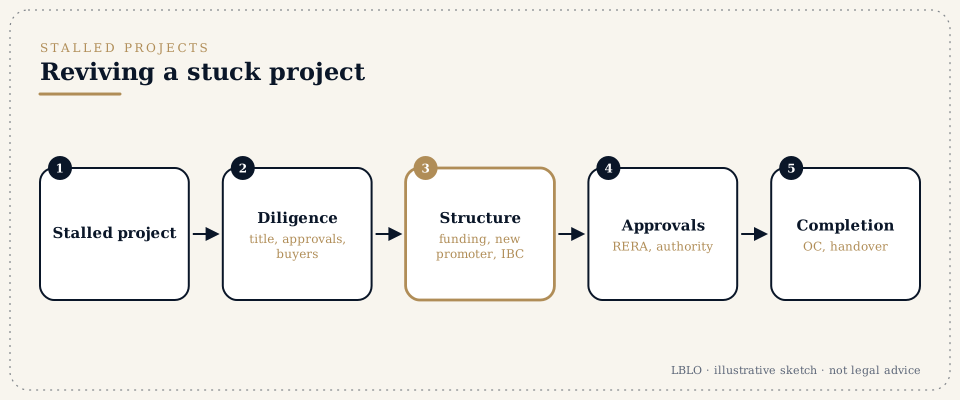
In brief
- What it is. A developer that cannot complete a project may sell it, bring in a co-developer, or lose it to insolvency. An incoming developer or investor can take over the land, the approvals and the obligations to buyers, but only with proper checks and approvals.
- The main routes:
- a direct purchase of the project or land;
- acquisition of the developer company's shares;
- a development or joint development agreement;
- a resolution plan in insolvency.
- Who must agree.
- A transfer of a registered project to a new promoter needs the consent the Real Estate (Regulation and Development) Act, 2016 requires from allottees, and the approval of the RERA authority.
- Lenders holding a charge must also agree.
- What is checked:
- title to the land;
- the licence and its renewal, including any land-use change permission;
- building approvals;
- RERA registration and its status;
- dues to the authority;
- buyer agreements and payments received;
- pending cases;
- lender charges;
- construction completed against the approved plans.
- The steps, in short:
- confidentiality agreement;
- due diligence;
- structure;
- term sheet;
- approvals (authority, RERA, lenders, allottees);
- definitive agreements;
- closing;
- communication to allottees.
- Keep ready, or ask the seller for:
- title documents;
- licences and approvals;
- the RERA registration and quarterly updates;
- allottee lists with amounts received;
- loan documents;
- the list of pending cases.
Terms you will hear
- Stalled project
- a project where construction has stopped for financial, legal or regulatory reasons.
- Last-mile funding
- finance to complete a nearly finished project.
- Change of promoter
- replacing the developer, with the RERA authority's approval.
- Development rights
- the right to build on land owned by another.
- Collaboration agreement
- the landowner-developer agreement that shares built area or revenue.
- Resolution plan for a real-estate company
- a bid for the project in insolvency, voted on by the homebuyers among others.
- Escrow account
- the separate project bank account that RERA requires the promoter to keep.
In detail
Step 1: Due diligence
Title is checked as described on the title verification page. In addition, a stalled project needs a regulatory history:
- whether the licence lapsed or was renewed;
- whether the authority has imposed penalties or begun resumption;
- whether RERA has taken action;
- how many allottees have pending complaints or refund orders.
The money is reconciled too: what buyers paid, what was spent on construction, and what is owed to lenders and the authority.
Step 2: Choosing the structure
| Structure | What it involves |
|---|---|
| Buying the company's shares | Keeps licences in place, but brings every liability with it |
| Buying the project | Gives a cleaner start, but needs transfer approvals |
| Development agreement | Leaves title with the landowner company and gives development rights |
| Resolution plan in insolvency | Can give the greatest protection from past claims, but only through the insolvency process and its approvals |
Step 3: Approvals
- The planning authority must approve any change of developer or transfer of the licence.
- RERA must approve a transfer of the project to a new promoter, with the allottee consent the Act requires.
- Lenders must release or restructure their charges.
The sequence matters, because each approval is often conditional on another.
Step 4: Agreements and closing
The definitive agreements cover:
- price and payment milestones;
- treatment of existing allottees;
- indemnities for past liabilities;
- what happens if approvals are refused;
- dispute resolution.
Closing follows once the approvals are in hand.
Step 5: Allottees
Allottees must be informed of the change and of the revised completion timeline. Their consent, complaints and refund claims are a central risk and are planned for from the start.
Common mistakes
- Paying advances before approvals are certain.
- Buying the company without a full list of allottee claims and pending cases.
- Underestimating dues to the authority and penalties.
- Not planning how existing allottees will be dealt with.
How LBLO handles these matters
LBLO's advice on these transactions covers:
- due diligence;
- structure;
- approvals;
- agreements;
- the disputes that follow such transactions, including RERA, consumer and insolvency proceedings.
Questions people ask
Can a stalled project be taken over without the buyers' consent?
A transfer of a registered project to a new promoter needs the allottee consent and authority approval that the RERA Act requires.
Is it safer to buy through insolvency?
An approved resolution plan can give strong protection against past claims, but the process is longer and competitive.
Who pays the authority's dues?
That is negotiated in the agreements, but the authority will usually require the dues to be cleared or scheduled before it approves a change.
These answers are educational summaries; they are not legal advice on any individual matter.
A serious question deserves a read brief.
Conferences are by appointment at G-46, Basement, Greater Kailash III, New Delhi. The principal reads the correspondence.
This page gives general information about the work of Lokesh Bhardwaj Law Offices, as permitted under the Bar Council of India Rules. It is not legal advice, and it does not create an advocate-client relationship. LBLO acts in a matter only on an engagement agreed in writing.
Law stated as at 14/11/2026.