
Property Title Verification and Due Diligence: Is the Seller Really the Owner?
A title review asks three questions about a property: who owns it, what burdens it carries, and whether it can lawfully be used as intended.
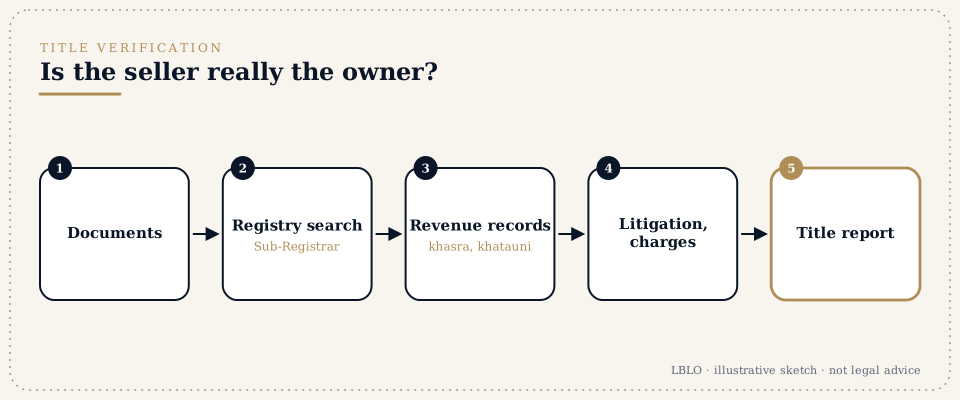
In brief
A title review asks three questions about a property:
- Ownership: does the seller hold a title that the law recognises, through an unbroken chain of valid documents?
- Burdens: is the property free of mortgages, attachments, litigation, acquisition and other claims?
- Use: can the property lawfully be used for the purpose the buyer intends, under the zoning, building and land-use rules that apply to it?
The review ends in a written, reasoned report. It states whether the title is clear and marketable, clear subject to conditions, or defective, and gives the reasons for that conclusion.
Terms you will hear
- Title chain
- The sequence of documents tracing ownership back over the period searched.
- Encumbrance
- A mortgage, lien, lease or other burden on the property.
- Sub-Registrar search
- The search of registered documents in the registry.
- Khasra, khatauni, jamabandi
- Land revenue records in North India.
- Mutation
- The revenue or municipal entry. It does not confer title.
- Power of attorney sale
- Does not transfer title. Only a registered sale deed does.
- Litigation search
- A search of court records for disputes about the property.
- Public notice
- A newspaper notice inviting objections before purchase.
Area of practice
Property title verification and due diligence is one of the areas in which Lokesh Bhardwaj Law Offices (LBLO) practises. The work covers residential, commercial, agricultural and industrial property, and land and units in Special Economic Zones (SEZs).
This page explains how a title review is carried out; the checks on the seller and the buyer; what is examined for each kind of property, from a flat or a farm to a factory, an authority plot, an auction purchase or an SEZ unit; and the warning signs of fraud. The special areas and State laws that restrict land, the documents to keep ready and the steps after purchase are on separate pages linked from this one. It is general legal information, not advice on any particular property.
Why a title must be verified
In India, ownership of land is not proved by any single document, and no government register guarantees title. Title has to be traced, document by document, through every transfer, and tested against the records of several offices. Five settled rules explain why.
- A sale can be made only by a registered deed. A sale of tangible immovable property worth Rs. 100 or more can be made only by a registered instrument, and a contract for sale does not, of itself, create any interest in the property (Section 54, Transfer of Property Act, 1882). Sales made through an agreement to sell, a general power of attorney and a will ("GPA sales") therefore do not convey title.
- Mutation is not title. An entry in the revenue record or the municipal record is made for collecting land revenue or tax. It neither creates nor ends ownership.
- A buyer takes the property subject to pending litigation. A transfer made while a suit concerning the property is pending is subject to the result of that suit (Section 52, Transfer of Property Act, 1882, the rule of lis pendens).
- A buyer is treated as knowing what a search would have shown. Under Section 3 of the Transfer of Property Act, 1882, a buyer is deemed to have notice of an instrument that had to be registered and was registered, and of the title of any person in actual possession of the property.
- Lawful use is a separate question from ownership. A clear title does not mean the building was lawfully built or that the land may be used for a shop, a factory or a farmhouse. Use is governed by the master plan, the building bye-laws and the land-use laws of the State concerned.
The process, step by step
A title review runs in 10 stages. The chain of title is tested against certified copies and extracts from the offices of record, not only against copies supplied by the parties.
- Scope and conflict check. The property, the parties and the intended use are identified. A conflict check is run against the firm's records. The scope, the documents required and the time needed are fixed in a written engagement letter before any work begins.
- Collection of documents. The client supplies what is available, by upload or at a meeting: the title deeds, previous chain deeds, allotment or lease papers, sanctioned plans, tax receipts, revenue extracts, identity and authority documents of the seller, and any court papers.
- Identification of the land. The property is fixed on the ground and on paper: survey, khasra or plot number, village or sector, area, boundaries and the cadastral map. Discrepancies in area or boundaries between the deed, the revenue map and the site are noted.
- Chain of title. Every transfer is traced back, ordinarily over 30 years, or to the original government grant, allotment or settlement where that is the stronger root. Each link is examined for the right document, due execution, adequate stamping, registration, and capacity of the person who signed. Inheritance links are checked against succession law, wills and probate, and the consent of all legal heirs.
- Certified copies from the offices of record. Certified copies or official extracts are obtained, in person or through the official portals, from the Sub-Registrar (registered deeds and encumbrances), the Tehsil or revenue office (jamabandi, khatauni, mutation, girdawari, maps), the municipal body or development authority (sanction, allotment, lease, tax), and where relevant the consolidation, ceiling or acquisition authorities.
- Encumbrance search. The Sub-Registrar's records are searched for mortgages, charges, agreements to sell and other registered instruments for the search period. The CERSAI register is searched for security interests created in favour of banks and financial institutions.
- Litigation and public-notice search. Searches are made in the civil, revenue, consumer, RERA, NCLT and High Court records available for the district and State, through the eCourts and court portals, for suits, attachments, insolvency and acquisition proceedings. Where the matter needs it, a public notice inviting objections is published in newspapers.
- Land-use and regulatory check. The permitted use is checked against the master plan or development plan, the zoning regulations and the building bye-laws in force, and the sanctioned plan, completion and occupation certificates, change-of-land-use permission and other approvals are matched against what stands on the site. The checks for each kind of property are set out in the next section.
- Site inspection. The property is inspected, in person or by a guided video inspection, to confirm possession, boundaries, occupants, tenants, access, construction and any visible deviation from the sanctioned plan.
- Report and closing points. The findings are set out in a reasoned report (see "The report" below). Where the transaction proceeds, the report lists what must happen at or before registration: discharge of mortgages, releases from co-owners, permissions, payment of dues, and tax deducted at source.
Further checks ordinarily made
- Possession: who is actually in possession, and on what basis. Long, open possession by a stranger can ripen into a claim of title by adverse possession.
- Earlier agreements: any earlier agreement to sell, option or right of first refusal given by the seller, whether registered or not.
- Stamping of earlier deeds: a deed in the chain that was not properly stamped can be impounded and is not admissible in evidence until the deficit and penalty are paid.
- Mortgage by deposit of title deeds: a bank loan secured by deposit of the original deeds may not appear in the Sub-Registrar's records. Where the originals are with a lender, the loan account and the lender's no-dues and release are verified.
- Lost originals: where an original deed is lost, the police report, the public notice, certified copies of the lost deed and an indemnity are required, and the risk is stated in the report.
- Attachments and tax claims: attachments by income tax, GST or other authorities, orders under the anti-money-laundering and benami laws, and recovery certificates of debt recovery tribunals.
- Benami and enemy property: whether the property is held in the name of one person for another, or is recorded as enemy or evacuee property, both of which can lead to confiscation or vesting in the Government.
- Translation: revenue records in Hindi, Urdu, Gurmukhi or a regional language are read in the original, and translated for the report where the client needs it.
- Time limits: a document must be presented for registration within four months of its execution (Section 23, Registration Act, 1908). Mutation must be applied for within the time the State's law fixes.
Property and transactions outside Delhi
Where a matter or transaction is located outside Delhi, LBLO conducts it end to end from New Delhi: it scopes the work, engages and instructs local counsel where the forum or the records require it, coordinates searches and filings, and reports to the client through one point of contact. Local counsel's engagement and all costs are disclosed to the client and recorded in the engagement letter before work begins.
Who is selling, and who is buying
A perfect chain of documents is of no use if the person signing the sale deed cannot lawfully sell, or the buyer cannot lawfully buy. The checks depend on who the parties are.
The seller
| Seller | What is checked |
|---|---|
| Individual owner | Identity (PAN, Aadhaar, photograph matched with the title deed), marital status where the property is claimed as joint or matrimonial, and that the name, father's name and address match every document in the chain. |
| Co-owners | That every co-owner joins the sale, or that the share being sold is clearly defined. One co-owner cannot sell the whole. |
| Heirs of a deceased owner | Death certificate, the law of succession that applies (Hindu, Muslim, Christian, Parsi or Indian Succession Act), the complete list of legal heirs, any will (and its probate, if obtained or if the buyer's lender requires it), relinquishment deeds by heirs who are not selling, and mutation in the heirs' names. |
| Hindu Undivided Family (HUF) | Whether the property is HUF or self-acquired, the authority of the karta, the legal necessity or benefit for the sale, and the consent of adult coparceners. Daughters are now coparceners by birth, in the same way as sons. |
| Minor | The natural guardian of a Hindu minor cannot sell the minor's immovable property without the previous permission of the court (Section 8(2), Hindu Minority and Guardianship Act, 1956). A sale without it is voidable at the instance of the minor. Different rules apply to a minor's undivided interest in joint family property, and to minors of other communities. |
| Person of unsound mind | Sale only through a guardian appointed by the court, with court permission. |
| Company or LLP | Board or partners' resolution authorising the sale and the signatory, the charter documents, charges registered with the Registrar of Companies, a shareholders' special resolution where the property is the whole or substantially the whole of the undertaking, and whether any insolvency or winding-up proceeding is pending. A moratorium in insolvency bars transfer of the company's assets. |
| Partnership firm | The partnership deed, the authority of the partner signing, and consent of all partners where the deed requires it. |
| Trust, society, temple, gurudwara, church or waqf | The trust deed or bye-laws, the power of the trustees or managing committee to sell, any permission needed from a court, the Charity Commissioner or the Waqf Board. Waqf property is not ordinarily saleable. |
| Non-resident seller | Identity and authority documents legalised or apostilled, a power of attorney if the seller is abroad, and tax deducted at source at the higher rate applicable to non-residents. |
| Power of attorney holder | The original power of attorney, that it is registered where required, that it expressly authorises sale, that it has not been revoked, and that the principal is alive on the date of sale. A power of attorney ordinarily ends on the death of the principal, unless the agency is coupled with an interest. |
| Bank, liquidator or court (auction sale) | The sale notice, the reserve price, the sale certificate, confirmation of the sale, and the dues and claims the buyer takes over. Auction sales are made "as is where is", so the title must be checked as fully as in a private sale. |
| Builder or developer | Title to the land, development or collaboration agreement with the landowner, the licence or sanction, RERA registration, and mortgages created on the project for construction finance. |
The buyer
| Buyer | What is checked |
|---|---|
| Resident Indian | Whether the buyer may hold this class of land in this State, for example agricultural land in a State that restricts purchase to agriculturists. |
| NRI or OCI | Residential and commercial property may be bought without the Reserve Bank's approval. Agricultural land, plantation property and farmhouses cannot be bought, except by inheritance. Payment must come through banking channels, by remittance from abroad or from a non-resident account in India. |
| Foreign national or foreign company | A foreign national living outside India who is not an OCI may acquire immovable property only in the limited cases the foreign exchange regulations allow, such as property needed for a branch or other place of business set up in India under those regulations, or one property bought jointly with an NRI or OCI spouse. Citizens of Pakistan, Bangladesh, Sri Lanka, Afghanistan, China, Iran, Nepal, Bhutan, Hong Kong, Macau and North Korea need the prior permission of the Reserve Bank of India to acquire or transfer immovable property, other than on a lease of up to five years, unless they hold an OCI card. The position of a foreign national resident in India is checked in each case. |
| Company, LLP or trust | Authority to buy under its charter, the resolution, and any State restriction on purchase of agricultural land by companies. |
| Buyer with a home loan | The bank's own title search and its list of required documents, so that the report covers what the lender will ask for. |
What is checked, by type of property
The chain of title and the encumbrance search are common to every property. What changes from one kind of property to another is the land-use and regulatory layer. The checks below are the usual ones; the rules of the State and the local authority concerned are confirmed afresh in every matter, because they change often.
AResidential property (house, plot, builder floor, apartment)
- Nature of holding: freehold or leasehold; for leasehold, the lease terms, conversion to freehold (for example, DDA conversion in Delhi), and whether the lessor's permission is needed for sale.
- Sanctioned building plan: that a plan was sanctioned, and that the number of floors, height, coverage, FAR, setbacks and basement as built match it.
- Completion and occupation certificates: an apartment or floor occupied without an occupation certificate is at risk of sealing or penalty and may not get a home loan.
- The rules in force when the building was sanctioned, and now: for example, in Haryana the stilt-plus-four-floors policy notified on 02/07/2024 was stayed by the Punjab and Haryana High Court on 02/04/2026. On 27/04/2026 the Court clarified that the stay relates only to the district of Gurugram, and the Town and Country Planning Department has since directed that further stilt-plus-four approvals be kept on hold while the case is pending. A fourth floor built on that basis in Gurugram therefore needs particular scrutiny until the court decides the matter.
- Colony status: in Delhi, whether the property is in a planned colony, an unauthorised colony (and the status of rights under the Central law that recognises the property rights of residents of unauthorised colonies), a regularised colony, Lal Dora or extended Lal Dora; in Haryana, whether the colony is licensed by the Town and Country Planning Department. In Delhi, Master Plan for Delhi 2021 applied until the Master Plan for Delhi 2047 was notified on 20/08/2026.
- Projects under construction: registration of the project under the Real Estate (Regulation and Development) Act, 2016 (small projects below the limits of land area and number of apartments that the Act fixes are exempt, and some States have lowered those limits; West Bengal, for example, requires registration where the land exceeds 200 square metres or the apartments exceed six), the sanctioned plan on the RERA portal, the builder's title to the land, and the agreement for sale in the prescribed form.
- Society and maintenance: share certificate or membership transfer, no-dues from the society or RWA, and dues of property tax, water and electricity.
See also the checklist for buying a flat.
BCommercial property (shop, office, showroom, hotel, mixed use)
- Permitted commercial use: whether the plot is zoned commercial, or whether commercial use on a residential plot is permitted under a mixed-use or notified-street policy, and on payment of what conversion charges.
- Licences tied to the premises: fire safety certificate, trade licence, health or eating-house licence, and parking norms, because a buyer of a commercial unit usually buys it to run a particular business.
- Tenancies: existing tenants, the lease or leave-and-licence terms, rent control protection, security deposits and lock-in periods, which pass to the buyer.
- Outstanding dues: outstanding property tax at commercial rates, and charges for conversion or additional FAR.
CAgricultural land
- Revenue records: the jamabandi or record of rights, khatauni, khasra girdawari for recent crop seasons, mutation orders, and the village map (shajra or aks shajra), read together. Possession shown in the girdawari is compared with the ownership shown in the jamabandi.
- Who may buy: some States restrict purchase by non-agriculturists or by persons from outside the State. For example, in Uttarakhand a 2025 amendment bars persons from outside the State from buying agricultural and horticultural land in 11 of its 13 districts (all except Haridwar and Udham Singh Nagar). Non-resident Indians and Overseas Citizens of India cannot acquire agricultural land, plantation property or a farmhouse under foreign exchange regulations, except by inheritance.
- Restrictions on transfer: in Delhi, the Delhi Land Reforms Act, 1954 restricts a transfer by a bhumidhar that would leave a holding smaller than the minimum the Act fixes, and use of the land for non-agricultural purposes can lead to proceedings under that Act. Other States have ceiling, fragmentation, consolidation and tribal-land restrictions.
- Shared holdings: where the land is held jointly (a mushtarka khata), the share of each co-owner, whether a partition has been made, and the consent of all co-sharers.
- Land status: whether the land is shamlat, gram sabha, waqf, evacuee, forest, nazul or government land; whether it is under acquisition or in a notified planning area.
- Conversion for other use: change of land use (CLU) or non-agricultural (NA) permission where the buyer intends a farmhouse, warehouse, resort or factory, and the conditions and time limits attached to it.
See also buying agricultural land in India and special areas and land restrictions.
DIndustrial property
- Allotment and lease from the industrial authority: most industrial plots are leasehold from a State authority (such as DSIIDC, HSIIDC, UPSIDA, MIDC, GIDC or RIICO). The allotment letter and lease deed are checked for the permitted industry, the construction deadline, transfer permission, transfer charges and any forfeiture for breach.
- Change of land use: for an industrial unit on private land outside an industrial estate, the CLU or NA permission and its conditions.
- Pollution category: whether the intended industry is permitted at the site. The Central Pollution Control Board's January 2025 classification places 419 sectors in Red (125), Orange (137), Green (94), White (54) and Blue (nine) categories. Red-category industries are not normally permitted in ecologically fragile areas, and consent to establish and consent to operate are needed from the State Pollution Control Board for most categories.
- Other approvals: environmental clearance where the project falls under the Environment Impact Assessment Notification, fire safety, factory registration, groundwater permission and power load sanction.
- Dues and charges: dues of the industrial authority, maintenance charges, and any charge registered against the unit with the Registrar of Companies.
ESpecial Economic Zones
- The zone itself: notification of the SEZ under the Special Economic Zones Act, 2005, the developer's approval from the Board of Approval, and the developer's title or lease to the land. The Special Economic Zones Rules, 2006 fix the minimum contiguous land area by category; amendments notified on 03/06/2025 reduced it to 10 hectares for SEZs set up exclusively to manufacture semiconductors or electronic components.
- Encumbrances: SEZ land must ordinarily be free from encumbrances. Since the 2025 amendment, the Board of Approval may relax this where the land is mortgaged or leased to the Central or State Government or its agency.
- Processing and non-processing areas: which part of the zone the unit or plot falls in, because the permitted activities and the duty benefits differ.
- The unit: a unit needs a Letter of Approval from the Development Commissioner and must execute a bond-cum-legal undertaking. A unit's lease or sub-lease from the developer is checked for permitted activity and transfer conditions.
- What can be set up: manufacturing, services, trading and warehousing units are permitted, subject to the approval granted, the conditions on net foreign exchange earning, and the rules on sales into the domestic tariff area. Since the 2025 amendment, finished goods made by a unit providing manufacturing services for an overseas entity may also be supplied to the domestic tariff area on payment of the applicable duties.
- Exit: the procedure and duty consequences of exit, transfer of the unit, or de-notification of the zone.
See also Special Economic Zones in India.
FProperty allotted by a development authority (DDA, Noida, Greater Noida, YEIDA, HSVP, GMADA and others)
- Allotment trail: the allotment letter, demand and payment receipts, possession letter, and the lease deed or conveyance deed executed by the authority.
- Transfer permission: most authority leases need the authority's permission for each sale, on payment of transfer charges. The transfer memorandum or permission letter is checked for every earlier transfer, not only the last one.
- Lease conditions: time limits for construction, permitted use, lease rent and one-time lease rent, and any order of cancellation or resumption for breach.
- Builder projects on authority land: whether the builder has paid the authority's land dues, because unpaid dues have held up registration of flats in many projects. The tripartite agreement (authority, builder, buyer) and the sub-lease deed are examined.
- Freehold conversion: where conversion is available, whether it has been done and the conveyance deed registered.
GGroup housing and cooperative societies
- Society flats: membership and share certificate, the society's title to the land (often a perpetual lease from DDA or an authority), the registrar's approval for transfer of membership, and the society's no-dues certificate.
- Group housing projects: the licence, sanctioned plan, occupation certificate, the deed of declaration under the State's apartment ownership law where one applies, and the allotment of parking and common areas.
- Disputes: any dispute pending before the Registrar of Cooperative Societies or a consumer forum about the society or the project.
HFarmhouses and farmland near cities
- Land category: whether the land is in an area where farmhouses are permitted under the master plan or development plan, and the minimum plot size and maximum covered area allowed.
- Revenue and regularisation: the revenue record (the land usually remains agricultural), any regularisation or conversion charges, and whether construction exceeds the permitted coverage.
- Who may buy: the agriculturist and NRI restrictions in Part C apply in full.
IWarehouses, cold stores, hotels, hospitals, schools and petrol pumps
- Use permission: warehousing, hotel, institutional and fuel-station use each need the land to be zoned or converted for that use, with the specific approvals the activity needs (for example, the fire, pollution and health approvals for a hotel or hospital, the recognition and land norms for a school, and the explosives and oil-company approvals for a petrol pump).
- Institutional allotments: land allotted at concessional rates for a school, hospital or charity is usually restricted to that use and to the original allottee. A sale may be barred, or need permission and payment of the difference in land value.
- Running business: licences, leases to operators and employees often go with the property and are reviewed with it.
JProperty bought at an auction
- Bank auctions under SARFAESI and DRT sales: the demand and possession notices, the valuation, the auction notice and the reserve price, the sale certificate, and its registration. Pending applications by the borrower can unsettle a sale.
- Court and liquidation sales: the court's order confirming the sale, or in insolvency the liquidator's sale and the order of the Adjudicating Authority.
- Dues taken over: property tax, society dues, electricity arrears and authority charges that the auction notice says pass to the buyer.
KReligious, trust and charitable property
- Waqf: whether the property is recorded as waqf in the Waqf Board's records. The law governing waqf was substantially amended in 2025 and the Supreme Court has stayed some of those changes pending decision. The current position is checked in each matter.
- Temples, mutts and trusts: whether the property is dedicated to a deity or a public trust, whether the State's endowment or charity law applies, and what permission the trustees need to sell. Property dedicated to a deity is held by the shebait or trustees only as managers.
Some land carries restrictions that no title deed reveals, because they come from where the land is, not from who owns it. The areas concerned, and the regional regimes to watch, are set out on the page on special areas and land restrictions.
Warning signs
Many property frauds leave traces in the records. These are the signs that call for closer scrutiny before any payment is made.
- The seller offers only photocopies, or says the original title deed is lost.
- The price is far below the circle rate or the market rate, or the seller insists on part payment in cash.
- The seller acquired the property very recently, or the mutation in the seller's name was made in a hurry.
- The sale is through a power of attorney holder and the owner cannot be met or seen on a video call.
- Signatures, photographs, names or father's names differ between documents.
- The area, boundaries or khasra numbers in the deed do not match the revenue record or the site.
- Someone other than the seller is in possession, or a tenant does not know of the sale.
- The same property appears in two agreements to sell, or in a pending suit.
- The property is in a builder project where the builder has not paid the authority's dues or the project is not registered under RERA.
- The stamp paper, registration endorsement or certified copy does not match the Sub-Registrar's own record.
- There is pressure to close fast, before the searches are complete.
The report
The report gives a reasoned conclusion, never a one-word answer. Every finding is tied to the document or record that supports it, so that the buyer, the seller, a bank or a court can check it.
The report contains:
- A one-page summary: the property, the parties, the conclusion and the reasons in brief.
- A schedule of every document examined, with its date, registration particulars and the office from which a certified copy was obtained.
- The chain of title, set out as a table from the root document to the present owner, with each link marked as valid, defective or curable.
- The results of the encumbrance, CERSAI and litigation searches.
- The land-use and regulatory findings: zoning, sanction, completion and occupation, conversion and other approvals.
- The defects found, the risk each one carries, and the step that would cure it.
- The conclusion, with reasons.
- The conditions to be met at or before registration.
- The assumptions made and the limits of the review: what could not be verified, and why.
The conclusion takes one of three forms:
| Conclusion | What it means | What the buyer or seller should do |
|---|---|---|
| Clear and marketable title | Every link in the chain is valid, no encumbrance or litigation was found, and the intended use is permitted. | Proceed, on the closing conditions listed. |
| Clear, subject to conditions | The title is sound but a curable defect exists, such as an undischarged mortgage, a missing release from a co-heir, a pending mutation or a deviation from the sanctioned plan. | Proceed only once the stated cure is completed, or on stated protections in the agreement. |
| Defective title | A defect goes to the root, such as a GPA sale in the chain, a transfer barred by law, acquisition, a pending suit that challenges the seller's title, or land that cannot lawfully be used as intended. | Do not proceed as structured. The report explains why, and whether any route to cure exists. |
The report speaks as on the date of the searches. Records can change after that date, so registration should follow promptly, and a fresh search is advised if it is delayed.
For sellers: a title pack
A seller may also have the title reviewed before offering the property for sale. The review follows the same steps. It produces:
- an indexed set of the title documents and certified copies;
- the chain of title in a table;
- the search results; and
- a list of the defects found and the steps taken or needed to cure them, such as obtaining releases from co-heirs, discharging a mortgage, completing mutation or regularising construction.
Questions people ask
Is a sale through a GPA and agreement to sell enough?
No. It does not transfer ownership. The property must be conveyed by a registered sale deed. See also the Know the Law answers on buying a GPA property and on whether an agreement to sell gives ownership.
The mutation is in the seller's name. Is that proof of ownership?
No. Mutation is a revenue entry. It supports, but does not prove, ownership. Title is proved by the registered chain of documents.
How far back is the title traced?
Ordinarily 30 years, or to the original government grant, allotment or settlement, whichever gives the stronger root.
Is an encumbrance certificate enough?
No. It shows only transactions registered with that Sub-Registrar office. It does not show deposits of title deeds, unregistered agreements, litigation, attachments or regulatory defects.
Can an NRI buy agricultural land or a farmhouse?
Not by purchase. An NRI or OCI may inherit such land.
Can a builder floor or an apartment be bought without an occupation certificate?
It can be bought, but it carries the risk of penalty, sealing or a refusal of a home loan. The report states that risk and what would cure it.
Does a clean report guarantee the title?
No report can guarantee title against matters that are not on record, such as a forgery in the chain that cannot be detected from the records, or an unregistered claim. The report states exactly what was checked, on what date, and what could not be checked.
How long does a review take?
It depends on the length of the chain, the number of offices to be searched and how quickly certified copies are issued. A timeline is given in the engagement letter.
These answers are educational summaries; they are not legal advice on any individual matter.
A serious question deserves a read brief.
Conferences are by appointment at G-46, Basement, Greater Kailash III, New Delhi. The principal reads the correspondence.
This page gives general information about the work of Lokesh Bhardwaj Law Offices, as permitted under the Bar Council of India Rules. It is not legal advice, and it does not create an advocate-client relationship. LBLO acts in a matter only on an engagement agreed in writing.
Last reviewed: 14/11/2026. Lokesh Bhardwaj Law Offices. Law stated as at 14/11/2026.