
Special Areas and Land Restrictions: Can This Land Be Bought?
Some land carries restrictions that no title deed reveals, because they come from where the land is, not from who owns it.
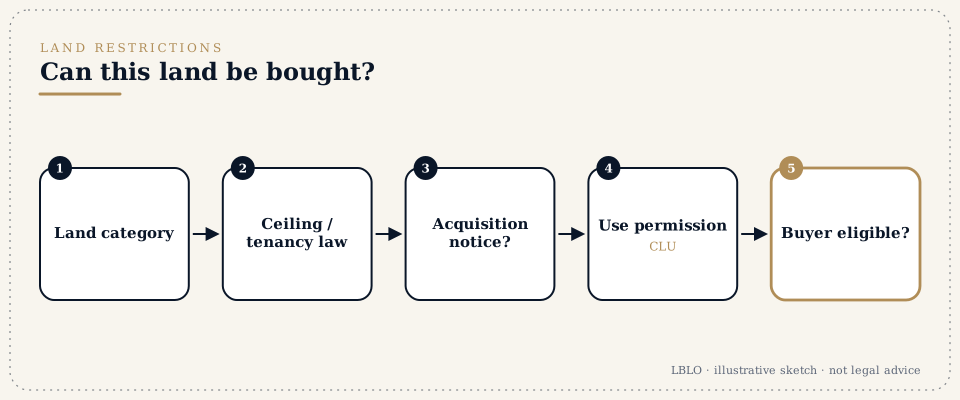
In brief
- Some land carries restrictions that no title deed reveals, because they come from where the land is, not from who owns it.
- A review ordinarily checks whether the property falls in any of these areas.
- Some States have land laws with no equivalent elsewhere.
- Who may buy a given class of land, including the limits on NRIs, OCIs and foreign nationals, is covered on the main title verification page.
Special areas and restrictions
Some land carries restrictions that no title deed reveals, because they come from where the land is, not from who owns it. A review ordinarily checks whether the property falls in any of these areas.
| Area | What the restriction is |
|---|---|
| Near a protected monument | Under the Ancient Monuments and Archaeological Sites and Remains Act, 1958, new construction is not permitted in the prohibited area immediately around a centrally protected monument, and construction in the regulated area beyond it needs prior permission. The Act fixes the extent of both areas, and the Central Government can extend them by notification. State laws protect State monuments with their own limits. |
| Coastal land | Land along the sea, creeks and tidal rivers falls under the Coastal Regulation Zone Notification. Construction and use are restricted according to the zone and the distance from the high tide line. |
| Near an airport or defence installation | Building height near airports needs a no objection certificate from the Airports Authority of India. Land near defence installations can carry restrictions on construction under the Works of Defence Act. |
| Forest and eco-sensitive zones | Land recorded as forest, or deemed forest, cannot be used for non-forest purposes without central approval. Eco-sensitive zones around national parks and sanctuaries restrict industry and construction. |
| River floodplains and water bodies | Floodplain zones (in Delhi, the Yamuna floodplain) and recorded ponds, johads and drains restrict or bar construction. |
| Land under acquisition | A notification for acquisition, or an award, freezes or extinguishes private title. The acquisition records are searched for the khasra or plot. |
| Tribal and Scheduled Areas | Many States bar or restrict transfer of land held by Scheduled Tribes to non-tribals (for example, in Jharkhand, Odisha, Andhra Pradesh and the North-Eastern States). |
| Hill and border States | Himachal Pradesh restricts purchase by non-agriculturists, and Uttarakhand by persons from outside the State. The Union Territory of Jammu and Kashmir, Sikkim and several North-Eastern States have their own restrictions on purchase by non-residents or non-agriculturists. |
| Ceiling and surplus land | Agricultural land declared surplus under a State's land ceiling law vests in the State and cannot be sold. |
| Heritage zones and special plans | Heritage precincts, metro corridors and special-area plans can change the permitted height, use and FAR. |
Regional regimes to watch
Some States have land laws with no equivalent elsewhere. The usual ones are listed here, as examples only.
| State or region | Regime |
|---|---|
| Haryana and Punjab | Land notified under the Punjab Land Preservation Act and the Aravalli areas restrict felling, construction and change of use. Licensed-colony rules govern plotted and group housing development. |
| Delhi | Ridge areas, the Yamuna floodplain, Lal Dora, unauthorised colonies, and the Delhi Land Reforms Act restrictions on agricultural land. |
| Uttar Pradesh | Restrictions under the State's revenue code on transfer of land held by Scheduled Castes and Scheduled Tribes, and on the conversion of agricultural land. |
| Gujarat | Under the State's disturbed areas law, sales in notified areas need the Collector's prior permission. |
| Maharashtra | 7/12 records, NA permission, tenancy-law restrictions on agricultural land, and slum-rehabilitation and redevelopment schemes in Mumbai. |
| Goa | Land of the comunidades (village communities), and older titles traced through Portuguese-era records. |
| Karnataka | The A khata and B khata distinction for urban property, and the Land Reforms Act regime for agricultural land. |
| Telangana and Andhra Pradesh | Assigned land, granted to landless persons by the Government, is generally not transferable. |
| Jharkhand and Odisha | Tenancy laws and regulations restricting transfer of tribal land, such as the Chotanagpur and Santhal Parganas tenancy laws in Jharkhand, and the regulation on transfer of immovable property by Scheduled Tribes in the Scheduled Areas of Odisha. |
| Kerala | Restrictions on conversion of paddy land and wetland. |
| Bihar and some other States | Rights of pre-emption, which let a co-sharer or neighbour claim the property on the same terms as the buyer. |
| Bhoodan and Gramdan land | Land donated under the Bhoodan movement is held under special laws and is usually not freely transferable. |
The checks made for each kind of property, and on the seller and the buyer, are on the page on property title verification and due diligence.
Frequently asked questions
Do I need to meet in person?
No. A first conference can be held by video, and a matter can be conducted entirely by email and video conference. Original documents are needed only where a court or authority requires them, and the Office tells the client in advance when that is.
Can I instruct the Office from abroad?
Yes. Papers are sent by email or secure upload, conferences are held by video, and a vakalatnama can be signed abroad and couriered. Where an affidavit is needed, it can be sworn before a notary or an Indian consular officer, as the case requires.
Is the first conversation confidential?
Yes. What a prospective client tells the Office in seeking advice is treated as confidential whether or not the matter is taken. For that reason the Office asks for only the names of the parties and a short description until the conflict check is complete.
Will I know the fee before work begins?
Yes. The basis of fees, whether fixed, stage-wise, retainer or hourly, is agreed in writing in the engagement letter before work begins, together with what it includes and which disbursements are billed at cost.
These answers are educational summaries; they are not legal advice on any individual matter.
A serious question deserves a read brief.
Conferences are by appointment at G-46, Basement, Greater Kailash III, New Delhi. The principal reads the correspondence.
This page gives general information about the work of Lokesh Bhardwaj Law Offices, as permitted under the Bar Council of India Rules. It is not legal advice, and it does not create an advocate-client relationship. LBLO acts in a matter only on an engagement agreed in writing.
Last reviewed: 14/11/2026. Lokesh Bhardwaj Law Offices. Law stated as at 14/11/2026.