
NRI and OCI Clients: Property, Family and Cases in India
Property, inheritance, tenants and family disputes in India, handled for clients who live abroad.
Lokesh Bhardwaj Law Offices (LBLO) acts for non-resident Indians, Overseas Citizens of India and their families in matters that sit in India while the client does not: property purchases and sales, inheritance and partition, tenants and encroachers, and matrimonial and custody disputes. Instructions are taken by email and video conference, and the matter is conducted in Delhi under a written engagement letter.
Who this is for
NRIs and OCIs who hold property in India
Buying, selling, letting or protecting a flat, plot or ancestral house from abroad, and moving the proceeds out lawfully.
Families dealing with an estate
Heirs abroad who need a succession certificate, probate, mutation or a partition of property held in India.
Spouses and parents in two countries
Divorce, maintenance and child custody where one side lives in India and the other does not.
What the Office takes on
Purchase and sale of property
FEMA eligibility, title search, agreement to sell, registration and handover. See Real Estate.
Repatriation of sale proceeds
Bank documentation under the Remittance of Assets Regulations, 2016, and coordination of Forms 15CA and 15CB with the client's accountant.
TDS on purchase from an NRI seller
The buyer's deduction under Section 195 of the Income-tax Act, 1961, now Section 393 of the Income-tax Act, 2025, and certificates for lower deduction.
Inheritance and succession
Succession certificates, probate and letters of administration under the Indian Succession Act, 1925, and mutation of records.
Partition suits and family settlements
Suits for partition of jointly held property, and settlement deeds recorded so that they hold.
Tenant eviction and encroachment
Eviction under the Delhi Rent Control Act, 1958, suits for possession, and injunctions against trespass on vacant property.
Matrimonial, maintenance and custody
Divorce, maintenance and custody where a spouse is in India or abroad. See Family Law.
Transfer petitions
Petitions under Section 25 of the Code of Civil Procedure, 1908 to move a case to a court the client can reach.
Powers of attorney
Drafting, execution before the consulate or a notary with apostille, stamping on arrival in India and registration where needed.
Evidence from abroad
Video-conference testimony under the High Court's rules, and affidavits sworn before consular officers.
FEMA compliance and compounding
Accounts, holding limits and compounding applications. See the FEMA explainer.
Opinions on Indian law
Written opinions for use in proceedings or transactions abroad, on title, succession and family law.
How it works from abroad
Write to the Office
An email with a short summary and the documents in hand. The names of the parties are checked for conflicts before anything else is read in detail.
Video conference
The question is identified and the route agreed. An engagement letter records the client, the person who gives instructions, the scope, the fee and how documents will move.
Power of attorney
Where a filing or a registration needs a signature in India, the Office drafts the power of attorney. It is signed before the Indian consulate or a local notary with apostille, and is stamped within three months of arriving in India.
Conduct of the matter
Filings, hearings and correspondence are handled in Delhi. The client receives a short note after each hearing, and documents are exchanged through a secure link.
Closing the matter
Certified copies of orders, registered deeds and, in a sale, the bank papers for repatriation are compiled and sent, with a closing note on what remains to be done.
Documents you will need
- Passport and OCI card, with visa or residence pages showing status abroad
- PAN card, and Aadhaar where held
- Title papers: sale deed, conveyance, allotment letter, mutation
- Latest property tax receipt and electricity or water bill
- Chain of title and encumbrance search, where available
- NRE, NRO or FCNR(B) account details
- Death certificate, will and family tree for succession matters
- Marriage certificate and any foreign court orders for family matters
- Notices, agreements and court papers received so far
- Identity and address of the proposed attorney in India
Not every matter needs every item. The engagement letter lists what is required for the particular case.
Doing it from abroad
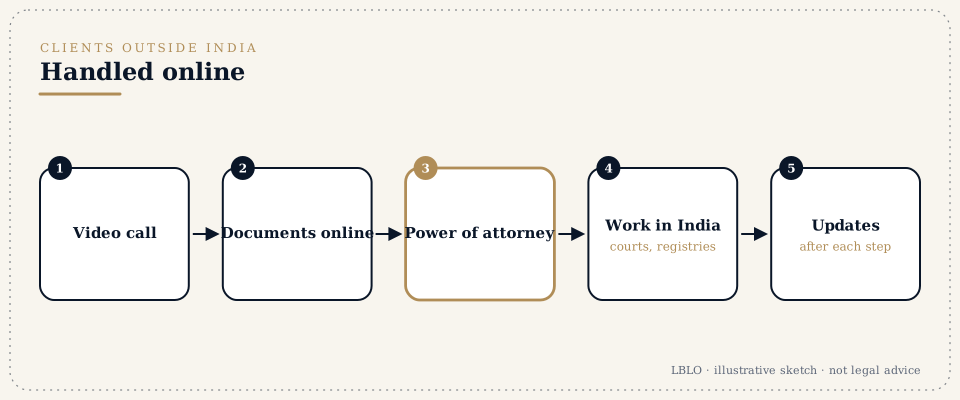
Instructions are taken by video meeting. Documents are exchanged by courier and secure upload. LBLO tells the client in advance which steps need their signature or presence, or that of their attorney in India. Work is done in English and Hindi, on Indian Standard Time, with meetings arranged to suit the client's time zone.
Your status matters
What a person living abroad may own or do in India depends on whether they are an NRI, an OCI cardholder or a foreign national, and on the current FEMA rules. Some kinds of property, agricultural land among them, are restricted for non-residents. LBLO confirms the position for each client at the start of the matter.
Terms used on this page
Probate
A court's confirmation of a will.
Letters of administration
Court authority to manage an estate where there is no will, or no executor.
Succession certificate
Court authority to collect the debts and securities of a person who has died.
Mutation
Updating the government land record to show the new owner.
Partition
Division of jointly owned property.
Fuller definitions are in the glossary. The other work LBLO takes on for clients outside India, companies and law firms is described on Working With Lokesh Bhardwaj Law Offices.
Frequently asked questions
Who counts as an NRI or OCI for property and FEMA purposes?
The Foreign Exchange Management Act, 1999 does not use the word NRI. It distinguishes a person resident in India, defined in Section 2(v), from a person resident outside India, defined in Section 2(w). Under the Foreign Exchange Management (Non-debt Instruments) Rules, 2019, an NRI is a person resident outside India who is a citizen of India, and an OCI is a person resident outside India registered as an Overseas Citizen of India Cardholder under Section 7A of the Citizenship Act, 1955. The older PIO category has been folded into the OCI scheme. Under Section 6(5), property acquired while resident, or inherited from a resident, may be kept after leaving India.
What immovable property can an NRI or OCI buy in India?
Under Rule 24 of the Foreign Exchange Management (Non-debt Instruments) Rules, 2019, an NRI or OCI may buy any immovable property in India other than agricultural land, a plantation property or a farm house. The same categories may be received as a gift from a relative who is resident in India or is an NRI or OCI. Any property, including agricultural land, may be acquired by inheritance. Payment must come through banking channels, by inward remittance or by debit to an NRE, NRO or FCNR(B) account; traveller's cheques and foreign currency notes are not permitted. No prior permission of the Reserve Bank is needed for these purchases.
Can I take the sale proceeds out of India after selling property?
Yes, within limits. Under Regulation 4(2) of the Foreign Exchange Management (Remittance of Assets) Regulations, 2016, an NRI or OCI may remit up to USD 1 million in each financial year out of NRO balances, sale proceeds of assets and inherited assets, on documentary evidence and after Indian tax has been paid. Where the property was bought with foreign exchange received through banking channels or from an NRE or FCNR(B) account, the bank may allow repatriation of the sale proceeds up to the amount so paid, and for residential property this facility is limited to two such properties. Anything beyond these limits needs the Reserve Bank's prior approval.
What tax does the buyer deduct when buying from an NRI seller?
The buyer must deduct tax at source on the whole consideration, not only the gain. For payments up to 31/03/2026 the provision is Section 195 of the Income-tax Act, 1961; from 01/04/2026 it is Section 393 of the Income-tax Act, 2025. Where the property was held for more than 24 months the gain is long-term and, for transfers from 23/07/2024, is taxed at 12.5 per cent without indexation, plus surcharge and cess; a shorter holding attracts slab rates. The seller may obtain a certificate of lower or nil deduction under Section 395 of the 2025 Act, formerly Section 197, so that only the tax on the actual gain is withheld.
How is a power of attorney signed abroad made usable in India?
Sign it before an Indian consular officer, or before a local notary with an apostille where the country is party to the Hague Apostille Convention, 1961, as India is. Section 33(1)(c) of the Registration Act, 1908 recognises a power of attorney executed outside India when authenticated by a Notary Public, a court, a judge or magistrate, or an Indian consul or vice-consul. Under Section 18 of the Indian Stamp Act, 1899 it must be stamped within three months of first arriving in India. Section 84 of the Bharatiya Sakshya Adhiniyam, 2023 then presumes due execution. Where the attorney is to sell property, registration of the power is commonly insisted upon.
Can I give evidence in an Indian court without travelling?
Often, yes. The High Court of Delhi Rules for Video Conferencing for Courts, 2021 allow a witness to depose over video from abroad, with a coordinator at the remote point and the court's permission obtained in advance. Section 530 of the Bharatiya Nagarik Suraksha Sanhita, 2023 permits criminal proceedings, including recording of evidence, to be held electronically. Affidavits and pleadings can be sworn before an Indian diplomatic or consular officer, who may administer oaths under Section 3 of the Diplomatic and Consular Officers (Oaths and Fees) Act, 1948. Court appearances are through counsel on a vakalatnama signed abroad and attested in the same way.
My spouse has filed a case in India. Can it be moved or defended from abroad?
It can be defended through counsel at most stages, with exemption from personal appearance sought where needed. Under Section 25 of the Code of Civil Procedure, 1908 the Supreme Court may transfer a case from one State to another, a route often used in matrimonial matters. Maintenance proceeds under Section 144 of the Bharatiya Nagarik Suraksha Sanhita, 2023, formerly Section 125 of the Code of Criminal Procedure, 1973. India is not a party to the Hague Convention on the Civil Aspects of International Child Abduction, 1980, so a foreign custody order is not enforced as such; custody turns on the child's welfare under the Guardians and Wards Act, 1890.
How do heirs living abroad obtain a succession certificate or probate?
A succession certificate for debts and securities is sought by petition under Section 372 of the Indian Succession Act, 1925 before the District Judge where the deceased ordinarily resided or the property lies. Probate of a will, or letters of administration, is sought under Section 276. For Hindus, Sikhs, Jains and Buddhists, Section 213 read with Section 57 makes probate compulsory only for wills made within, or concerning immovable property in, the former presidency towns; for a Delhi estate it is optional but often useful with banks and the registry. The petition is filed through an attorney holding an attested power, and evidence is given by affidavit or video conference.
These answers are educational summaries; they are not legal advice on any individual matter.
Instructions from abroad are taken in writing.
Write with a short summary and the documents you hold. Conferences are by video, or by appointment at G-46, Basement, Greater Kailash III, New Delhi.
This page is an educational summary of the law as at 14/11/2026. It is not legal advice.