
Family & Personal
Matrimonial and family work, resolved by consent where possible and conducted cleanly where it is not.
Matrimonial and family work is an area where the law of separation, maintenance, and custody often masks deeper questions of property, children, and dignity. The Office resolves matters by mutual consent where possible; where it is not possible, proceedings are conducted cleanly, on the record, with attention to long-term outcomes rather than short-term injuries.
The practice extends past the marriage itself: succession and inheritance, the drafting and probate of wills, adoption, and guardianship. These are matters in which a document drafted in calm prevents litigation in grief, and the Office treats the drafting side of family law with the same seriousness as the disputes.
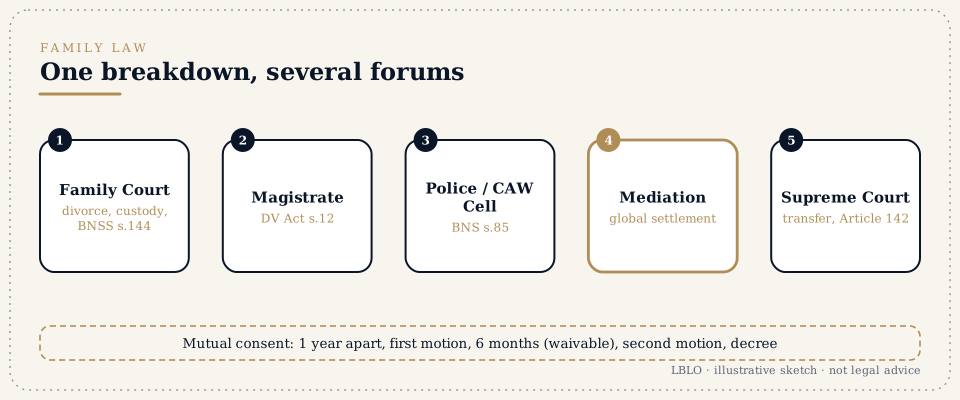
In brief
- A marriage breakdown usually generates several cases at once. Each has its own court and purpose:
- Divorce or judicial separation: before the Family Court, under the personal law or the Special Marriage Act.
- Maintenance: under Section 144 BNSS (formerly Section 125 CrPC), the personal law, and the Domestic Violence Act.
- Protection, residence and monetary relief: under the Protection of Women from Domestic Violence Act, 2005, Section 12.
- Criminal complaint for cruelty: under Section 85 BNS, with "cruelty" defined in Section 86 (formerly Section 498A IPC).
- Custody and guardianship: under the Guardians and Wards Act and the personal law.
- Return of stridhan.
- Mutual consent divorce (Section 13B, Hindu Marriage Act). The spouses must have lived separately for at least one year before the first motion. A six-month period then runs before the second motion. The Family Court can waive the six months in suitable cases. The Supreme Court can dissolve a marriage on irretrievable breakdown under Article 142 (Shilpa Sailesh v. Varun Sreenivasan, [2023] 5 SCR 165).
- Spouses in different cities. The Supreme Court can transfer a matrimonial case from one State to another under Section 25 CPC. Transfer petitions are usually filed by the wife.
- Settlement. Many matters settle through mediation. A global settlement should cover every pending case, the stridhan, the maintenance and the custody arrangements, and should be recorded before the court.
Terms you will hear
- First motion and second motion
- the two stages of a mutual consent divorce.
- Cooling-off period
- the six months between the motions.
- Contested divorce grounds
- for example cruelty, desertion and adultery. Each must be proved.
- Interim maintenance (pendente lite)
- maintenance during the case.
- Affidavit of assets and liabilities
- the financial disclosure required in maintenance cases.
- Stridhan
- the woman's own property, including gifts received at or around the marriage.
- Shared household
- the home in which the woman lived in a domestic relationship. The DV Act protects her right to reside there.
- Protection order, residence order, monetary relief, custody order, compensation
- the reliefs under the DV Act (Sections 18 to 22).
- CAW Cell
- the police Crime Against Women cell, where cruelty complaints are often first examined and conciliation is attempted.
- Visitation and access
- the time a non-custodial parent spends with the child.
- Welfare of the child
- the paramount consideration in every custody decision.
- Transfer petition
- a request to the Supreme Court to move a case from a court in one State to a court in another.
What the Office takes on
- Divorce & Judicial Separation
- Mutual Consent Divorce
- Transfer Petitions in Matrimonial Matters
- Maintenance, Section 144 BNSS & Interim Maintenance
- Domestic Violence Proceedings
- Cruelty Cases, Section 85 BNS (formerly 498A): Defence & Quashing
- Custody, Visitation & Guardianship
- Succession & Inheritance
- Will Drafting & Probate
- Family Settlements
- Private Trusts & Estate Planning
- Adoption
In detail
1. Mutual consent divorce.
- File a joint petition after at least one year of separation.
- The first motion is recorded.
- The six months run, unless waived.
- The second motion is filed and the statements are recorded.
- Decree.
Terms of settlement are annexed:
- permanent alimony, often paid partly at each motion;
- custody and access;
- withdrawal of other cases;
- return of articles.
2. Contested divorce.
The petitioner proves the ground through evidence. Cases are longer. Mediation is attempted at the start in most Family Courts.
3. Maintenance.
- Section 144 BNSS: a summary remedy for a wife, children and parents who cannot maintain themselves.
- Under the Hindu Marriage Act and the Hindu Adoptions and Maintenance Act: maintenance is decided with the main case.
- Under the DV Act: monetary relief.
Courts adjust for amounts awarded in parallel cases. Both sides must file affidavits disclosing their income and assets. Concealment is viewed seriously.
4. Domestic Violence Act.
The Section 12 application goes to the Magistrate. Interim and ex parte orders are possible where the case is urgent. It is a civil remedy within a criminal court, and breach of a protection order is an offence.
5. Cruelty complaints under Section 85 BNS.
Cruelty is a criminal offence. Complaints in Delhi are often examined first by the CAW Cell, where counselling and conciliation are attempted.
For the accused family, the usual questions are:
- anticipatory bail;
- whether general allegations against relatives disclose an offence;
- quashing under Section 528 BNSS (formerly Section 482 CrPC), particularly after a settlement.
6. Custody.
The welfare of the child decides custody, not the rights of either parent. The court considers:
- the child's age;
- continuity of schooling;
- each parent's circumstances;
- the child's own wishes where the child is old enough.
Interim custody and visitation schedules are common, including video access where a parent lives abroad.
7. NRI spouses.
Common issues are service abroad, recognition of foreign divorce decrees, and return of a child taken across borders. The Office coordinates with counsel abroad.
8. Transfer petitions.
Where the cases are in another State, a transfer petition to the Supreme Court is common. It can be filed through an Advocate-on-Record.
How the work is conducted
Family matters are heard first in conference, in full, before any notice is drafted, because the first communication often sets the temperature of the entire dispute. Where settlement is realistic the Office pursues it deliberately; where it is not, the pleadings are drafted to be lived with across the years such matters can run.
Frequently asked questions
What are the routes to divorce in India?
Broadly two. Divorce by mutual consent under Section 13B of the Hindu Marriage Act, 1955, or Section 28 of the Special Marriage Act, 1954, requires that the spouses have lived separately for at least a year and agree on separation and its terms; the second motion follows after a period of six months, which the court may waive in an appropriate case. Contested divorce is on the grounds in Section 13, such as cruelty, desertion for two years or adultery, and is a trial, with the time and cost a trial implies. Other personal laws make their own provision.
Can we get a divorce in less than 18 months?
Yes, where the court waives the six-month period on the facts, or where a settlement is recorded before the Supreme Court.
How is maintenance decided?
On the status of the parties, the income and earning capacity of each spouse, and the needs of the children. Maintenance can be claimed under Section 144 of the Bharatiya Nagarik Suraksha Sanhita, 2023 (formerly Section 125 of the Code of Criminal Procedure), under Sections 24 and 25 of the Hindu Marriage Act, 1955, under Section 18 of the Hindu Adoptions and Maintenance Act, 1956, and under Section 20 of the Protection of Women from Domestic Violence Act, 2005. Interim maintenance can be sought while proceedings continue. Since Rajnesh v. Neha, (2021) 2 SCC 324, both sides file an affidavit disclosing assets and liabilities, and amounts in parallel proceedings are adjusted.
I earn more than my wife. Will I pay maintenance?
Likely, if she cannot maintain herself at the standard of the marriage. The amount depends on both incomes and liabilities.
How do courts decide custody of children?
On the welfare of the child, which Section 13 of the Hindu Minority and Guardianship Act, 1956 and Section 17 of the Guardians and Wards Act, 1890 make the paramount consideration, above the rights or wishes of either parent. Under Section 6(a) of the 1956 Act, custody of a child below five years is ordinarily with the mother, but that too yields to welfare. Arrangements can be sole, joint or visitation-based, and the court hearing a divorce may make interim orders for custody under Section 26 of the Hindu Marriage Act, 1955. Custody orders can be revisited as the child's circumstances change.
My wife has taken our child to another country. What can I do?
Act at once. The remedy depends on the country and the orders in place. Habeas corpus and custody proceedings in India, and proceedings in the other country, may both be needed.
Can matrimonial proceedings be transferred to another city?
Yes. The Hon'ble Supreme Court of India can transfer a matrimonial case from a court in one State to a court in another under Section 25 of the Code of Civil Procedure, 1908, and a High Court can transfer a case between districts within its own State under Section 24. Courts are generally sympathetic to a wife's request to have proceedings heard where she resides, particularly where she has a young child or no independent income, though each petition turns on its own facts. The main proceedings are often stayed while the transfer petition is pending.
Can a dowry or cruelty case against my family be quashed?
Cruelty by a husband or his relatives, formerly Section 498A of the Indian Penal Code, 1860, is now an offence under Section 85 of the Bharatiya Nyaya Sanhita, 2023, with cruelty defined in Section 86; cases relating to acts before 01/07/2024 remain under the old Code. The High Court may quash the FIR under Section 528 of the Bharatiya Nagarik Suraksha Sanhita, 2023 where the allegations, even taken at face value, disclose no offence, where relatives are named through general and omnibus allegations, where the proceedings are an abuse of process, or where the parties have settled and the court considers it just to end the matter.
What protection does the domestic violence law give a woman?
Under the Protection of Women from Domestic Violence Act, 2005, a woman in a domestic relationship may apply to the Magistrate under Section 12, directly or through a Protection Officer. The Magistrate may pass protection orders under Section 18, residence orders under Section 19, monetary relief including maintenance under Section 20, custody orders under Section 21 and compensation under Section 22, and may make interim orders under Section 23. Section 17 gives her the right to reside in the shared household whether or not she has any right or title in it. Breach of a protection order is itself an offence under Section 31.
Can a DV case be filed against a woman relative?
The respondent must be in a domestic relationship with the aggrieved woman. Women relatives of the husband can be respondents.
Does a will have to be registered or probated to be valid?
Neither is required for validity. Under Section 63 of the Indian Succession Act, 1925, a will must be signed by the testator and attested by at least two witnesses, each of whom has seen the testator sign or received his acknowledgment of the signature. Registration is optional under Section 18 of the Registration Act, 1908, though a registered will is harder to dispute. Section 213 of the 1925 Act, which made probate compulsory for certain wills, has been omitted by the Repealing and Amending Act, 2025, but probate may still be sought and is sometimes asked for by banks and housing societies.
These answers are educational summaries; they are not legal advice on any individual matter.
A serious question deserves a read brief.
Conferences are by appointment at G-46, Basement, Greater Kailash III, New Delhi. The principal reads the correspondence.
This page gives general information about the work of Lokesh Bhardwaj Law Offices, as permitted under the Bar Council of India Rules. It is not legal advice, and it does not create an advocate-client relationship. LBLO acts in a matter only on an engagement agreed in writing.
Last reviewed: 15/11/2026. Lokesh Bhardwaj Law Offices.
Law stated as at 15/11/2026.