
Shareholder and Family-Business Disputes
When partners in a company fall out, or a family business divides, the law offers specific remedies. This page explains them.
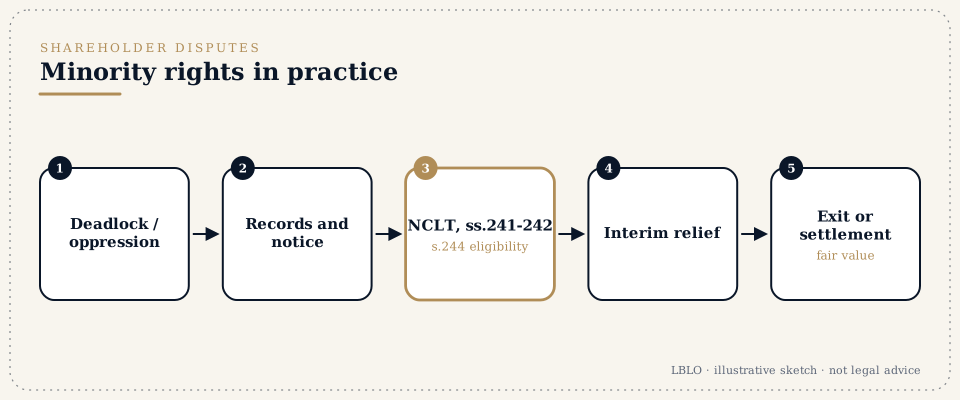
In brief
- What it is. Members of a company can apply to the NCLT under Sections 241 and 242 of the Companies Act, 2013 where:
- the company's affairs are run in a way that is oppressive to them;
- the affairs are run in a way that is prejudicial to the company or the public interest;
- there has been a material change in management or control that will cause prejudice.
- Who can apply. In a company with share capital, the application needs one of:
- at least 100 members;
- one-tenth of the members, whichever of these two is less;
- members holding one-tenth of the issued share capital.
The NCLT can waive these requirements in a suitable case.
- What the NCLT can do:
- regulate how the company is run;
- order one side to buy the other's shares;
- remove directors;
- set aside transactions;
- pass interim orders while the case is heard.
- Family businesses often involve more than one company, partnership firms and family property. The solution may combine an NCLT petition, a civil suit and a family settlement.
- The steps, in short:
- collect the company records;
- identify the acts complained of;
- check eligibility;
- file the petition with an interim application;
- pleadings;
- hearing;
- order.
Mediation or settlement can be tried at any point.
- Keep ready:
- the articles of association;
- shareholders' agreements;
- board and general meeting minutes;
- share registers;
- MCA filings;
- accounts;
- correspondence showing the conduct complained of.
Terms you will hear
- Oppression and mismanagement (Sections 241 and 242)
- the NCLT remedy for minority shareholders.
- Eligibility threshold (Section 244)
- the minimum holding or number of members needed to file, which the NCLT can waive.
- Deadlock
- where equal holders cannot decide.
- Articles of association
- the company's internal constitution. Share transfer limits sit here.
- Shareholders' agreement
- the private contract between shareholders.
- Exit at fair value
- a buy-out ordered or agreed at a value fixed by valuation.
- Family settlement
- a division agreed within the family, often covering several companies.
- Interim relief
- for example, freezing allotments, transfers or board changes during the case.
In detail
Step 1: Map the dispute
The first task is to separate the strands:
- what is a company dispute;
- what concerns a partnership firm;
- what concerns family property held outside the company.
Each goes to its own forum: the NCLT, a civil court or arbitration.
Step 2: Check eligibility
The thresholds under Section 244 are checked against the share register as it stands. Where they are not met, an application for waiver is filed with reasons.
Step 3: What counts as oppression or mismanagement
Common examples:
- removal of a director-shareholder without due process;
- dilution of a member's stake through an unfair allotment;
- diversion of business to a related concern;
- denial of access to accounts;
- decisions taken at meetings that were not properly called.
A mere disagreement over business decisions is not enough.
Step 4: Interim relief
Where an allotment, a sale of assets or a change in the board is imminent, interim relief is sought at the first hearing to preserve the position.
Step 5: Hearing and final relief
The NCLT decides on the record. Final relief is often a buy-out at a fair value fixed by valuation, or orders regulating the company's affairs.
Step 6: Family settlements
Where the family is willing, a written family settlement can divide companies, firms and property in one document. It must be stamped and registered where the law requires. Disputes are frequently resolved this way after interim orders have steadied the position.
Common mistakes
- Filing without checking the eligibility thresholds.
- Not seeking interim relief before an allotment or asset sale goes through.
- Mixing company, partnership and property claims in the wrong forum.
- Informal family settlements that are not stamped or registered where required.
How LBLO handles these matters
- The dispute is mapped across all entities and property before any filing.
- Interim relief is planned from the start.
- Settlement is pursued alongside the litigation where the client wants it.
- LBLO also acts in partition and family settlement suits, so property and company strands can be handled together.
Questions people ask
I hold less than 10% of the shares. Can I still apply?
Possibly. You may meet the alternative membership test, and the NCLT can waive the requirement in a suitable case.
Can the NCLT force the majority to buy my shares?
It can order a purchase of shares where oppression or mismanagement is established. The price is usually fixed by valuation.
Our family business has several companies and properties. Do we need several cases?
Often yes, but a single family settlement can resolve all of them together if the family agrees.
These answers are educational summaries; they are not legal advice on any individual matter.
A serious question deserves a read brief.
Conferences are by appointment at G-46, Basement, Greater Kailash III, New Delhi. The principal reads the correspondence.
This page gives general information about the work of Lokesh Bhardwaj Law Offices, as permitted under the Bar Council of India Rules. It is not legal advice, and it does not create an advocate-client relationship. LBLO acts in a matter only on an engagement agreed in writing.
Law stated as at 14/11/2026.