
Wills, Succession, Probate, Family Settlements and Estate Planning
A will decides who receives a person's property after death.
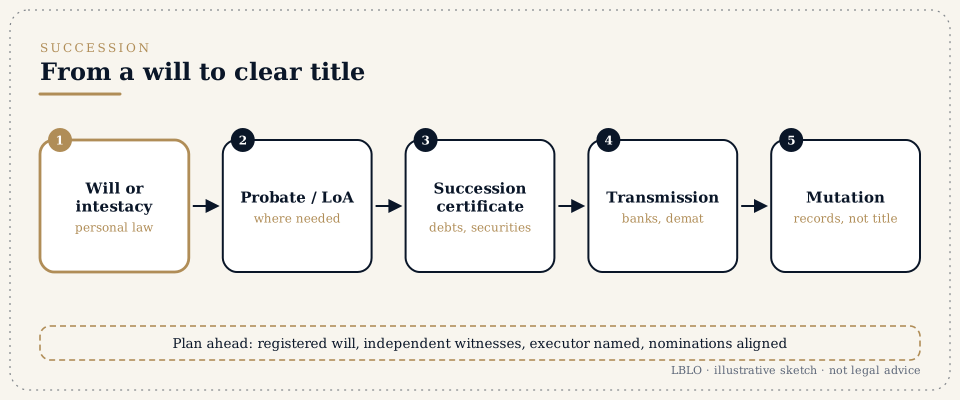
In brief
- A will decides who receives a person's property after death. It must be signed by the testator and attested by two witnesses. Registration is optional but recommended.
- Without a will, property passes under the personal law. For Hindus, Buddhists, Sikhs and Jains, that is the Hindu Succession Act, 1956.
- Probate is a court's certificate that a will is genuine. Section 213 of the Indian Succession Act had made probate compulsory for certain wills, chiefly wills made in, or dealing with immovable property in, the areas named in Section 57 (the old Bengal territories and the original civil jurisdiction of the High Courts at Madras and Bombay). The Repealing and Amending Act, 2025 (Act 37 of 2025, assent 20/12/2025) omitted Section 213 and modified the related bar on succession certificates in Section 370. In Delhi, probate was in any case not compulsory for a Hindu's will relating to property in Delhi. Many institutions still ask for it.
- For bank balances, deposits and shares without a nomination or will, a succession certificate (Part X, Indian Succession Act) is the usual route.
- A family settlement can divide property among family members without a court. Where it records a past arrangement it may not need registration. Where it creates new rights in immovable property, it should be registered. The drafting decides which.
- Private trusts and a well-structured will help with business succession, a dependent with special needs, or NRI children.
- NRIs can inherit Indian property. Moving the proceeds abroad has its own foreign exchange rules and documentation.
Terms you will hear
- Testator and testatrix
- the person who makes the will.
- Executor
- the person named to carry out the will.
- Beneficiary (legatee)
- the person who receives under the will.
- Codicil
- a document amending a will.
- Attesting witness
- a person who saw the testator sign. A beneficiary should not be an attesting witness.
- Suspicious circumstances
- facts that make a court doubt a will, such as the main beneficiary arranging it, the exclusion of natural heirs without reason, or doubts about the testator's health.
- Probate and letters of administration
- the court's grant, with the will (probate) or where there is no executor or no will (letters of administration).
- Succession certificate
- the court's certificate for collecting debts and securities of the deceased.
- Legal heir certificate
- issued by the revenue authorities. Banks and offices often ask for it.
- Mutation
- the change of name in municipal or revenue records after death. It records possession and tax liability. It does not confer title.
- Coparcener and HUF
- the members of a Hindu joint family with a birth right in coparcenary property. Daughters are coparceners in their own right after the 2005 amendment.
- Nomination
- naming a person to receive an account or policy. A nominee is generally a trustee for the legal heirs, not the owner, except where a statute says otherwise.
- Relinquishment deed and release deed
- a deed by which an heir gives up their share in favour of another.
In detail
1. Making a will that holds.
- Describe every property clearly.
- Name an executor and an alternate.
- Explain significant exclusions, briefly and without bitterness.
- Use independent witnesses, ideally including a doctor's note on capacity where age or health may be questioned later.
- Register the will.
- Keep it safe and tell the executor where it is.
- Review it after major life events.
2. After death: the documents.
- death certificate;
- the will, if any;
- legal heir certificate or family tree affidavit;
- property documents;
- bank and demat statements;
- insurance policies.
The Office prepares a schedule of assets and the route for each one: transmission, mutation, claim or court grant.
3. Probate in Delhi.
A probate petition goes to the District Judge or, above its pecuniary limit, to the Delhi High Court. Notices go to the legal heirs. Objections turn the matter into a contested suit.
4. Succession certificate.
For debts and securities. The court can require security. The certificate names the specific debts and securities covered.
5. Family settlements.
A good settlement deed:
- records the existing dispute or claim;
- lists the properties and their allocation;
- includes cross-releases;
- deals with stamp duty and registration;
- states what happens to pending litigation.
6. Trusts and business succession.
For shares in a family company, the will and the articles of association must work together. Transfer restrictions in the articles can defeat a bequest if they are not addressed.
7. NRIs.
- Inheriting immovable property in India is permitted.
- Repatriation of sale proceeds is subject to foreign exchange rules and annual limits.
- Documents signed abroad need notarisation and apostille or consular attestation.
- Executing a power of attorney abroad is often the practical first step.
Questions people ask
Is a handwritten will valid?
Yes, if signed and attested by two witnesses as the law requires.
Do I need probate for my father's Delhi flat?
In Delhi, probate of a Hindu's will relating to Delhi property was not compulsory, and the 2025 amendment removed the compulsory rule elsewhere. A society, bank or buyer may still ask for it.
My brother is the nominee. Does he own the deposit?
Generally, a nominee receives the money as a trustee for the legal heirs.
Can a daughter claim a share in ancestral property?
Yes, in the coparcenary property of a Hindu joint family governed by Mitakshara law. Since the 2005 amendment to Section 6 of the Hindu Succession Act, a daughter is a coparcener by birth in the same manner as a son. A partition made before 20/12/2004 by a registered deed or a court decree is not reopened.
Can I make a will for property in India while living abroad?
Yes. Follow the attestation formalities and plan how the executor will act in India.
These answers are educational summaries; they are not legal advice on any individual matter.
A serious question deserves a read brief.
Conferences are by appointment at G-46, Basement, Greater Kailash III, New Delhi. The principal reads the correspondence.
This page gives general information about the work of Lokesh Bhardwaj Law Offices, as permitted under the Bar Council of India Rules. It is not legal advice, and it does not create an advocate-client relationship. LBLO acts in a matter only on an engagement agreed in writing.
Last reviewed: 15/11/2026. Lokesh Bhardwaj Law Offices.
Law stated as at 15/11/2026.