
Suspension, Sealed Cover and Pension: When Service Benefits Are Held Back
Long before any penalty, a disciplinary or criminal case can stop an officer's work, promotion and retirement benefits; each of these is governed by its own rule, with its own limits and its own remedy.
In brief
- Suspension is not a penalty. Under Rule 10 of the CCS (CCA) Rules it may be ordered when disciplinary proceedings are contemplated or pending or a criminal case is under investigation, inquiry or trial, and it is deemed where the officer is in custody for more than 48 hours.
- A suspension must be reviewed before 90 days on the recommendation of a Review Committee and lapses after 90 days unless extended; each extension may not exceed 180 days.
- Following the Supreme Court in Ajay Kumar Choudhary, DoPT requires the charge sheet to be served within 90 days of suspension, failing which the suspension lapses.
- Under the DoPT OM of 14/09/1992, the Departmental Promotion Committee assesses an officer under suspension, under charge sheet or facing prosecution, and seals its findings until the case ends.
- On complete exoneration the sealed cover is opened and the officer is promoted notionally from the date the junior was promoted; arrears are decided by the appointing authority with reasons.
- Under Rule 8 of the CCS (Pension) Rules, 2021, pension and gratuity can be withheld or withdrawn only on a finding of grave misconduct or negligence in departmental or judicial proceedings.
- While proceedings are pending at retirement, a provisional pension is paid and gratuity is held back; a mere investigation does not justify either.
Terms you will hear
- Deemed suspension
- Suspension that follows automatically by rule, for example from the date of detention in custody for more than 48 hours (Rule 10(2)).
- Review Committee
- The committee on whose recommendation a suspension is reviewed and extended or revoked.
- Subsistence allowance
- The amount paid in place of pay during suspension, governed by Fundamental Rule 53.
- Departmental Promotion Committee (DPC)
- The committee that assesses officers for promotion.
- Sealed cover
- The envelope in which the DPC's assessment of an officer facing a case is kept unopened until the case ends.
- Notional promotion
- Promotion given effect from an earlier date for seniority and pay fixation, with or without arrears.
- Provisional pension
- The pension paid from retirement until final orders where departmental or judicial proceedings are pending (Rule 8(3) and (4)).
- Grave misconduct
- The finding the pension rules require before pension or gratuity can be withheld or withdrawn.
- Commutation
- Conversion of part of the pension into a lump sum, governed by the CCS (Commutation of Pension) Rules, 1981.
In detail
Suspension, review and revocation
When suspension may be ordered
Rule 10(1) of the CCS (CCA) Rules allows the appointing authority, an authority to which it is subordinate, the disciplinary authority or an empowered authority to place a government servant under suspension where a disciplinary proceeding is contemplated or pending, where the officer is considered to have engaged in activities prejudicial to the security of the State, or where a criminal case is under investigation, inquiry or trial. A lower authority that suspends must report the circumstances to the appointing authority at once.
Suspension is deemed in two situations (Rule 10(2)): from the date of detention, if the officer is detained in custody for more than 48 hours, and from the date of conviction, if the officer is sentenced to imprisonment for more than 48 hours and is not dismissed, removed or compulsorily retired at once. Where a penalty of dismissal, removal or compulsory retirement is set aside and further inquiry is ordered, the suspension is deemed to continue (Rules 10(3) and 10(4)).
Review and the 90-day rule
- A suspension must be reviewed by the authority competent to revoke it, on the recommendation of a Review Committee, before 90 days from its effective date, and the authority must either extend or revoke it (Rule 10(6)).
- A suspension is not valid after 90 days unless extended after such a review (Rule 10(7)). For deemed suspension on detention, the 90 days run from release or from intimation of release, whichever is later.
- An extension may not exceed 180 days at a time, and later reviews must take place before each extended period ends (Rule 10(6)).
In Ajay Kumar Choudhary v. Union of India, (2015) 7 SCC 291 the Supreme Court directed that a suspension should not continue beyond three months if the charge memorandum is not served within that period, and that if it is served, a reasoned order is needed to extend the suspension. DoPT's OM of 23/08/2016 applies this: the charge sheet must be issued within 90 days of suspension, failing which the suspension lapses. The Court also noted that the Government may instead transfer the officer or restrict contact with records and witnesses.
Subsistence allowance and the end of suspension
During suspension the officer receives a subsistence allowance under Fundamental Rule 53, equal to leave salary on half pay; after three months it may be increased or reduced, by up to 50 per cent, depending on whether the delay is the officer's fault. In Capt. M. Paul Anthony v. Bharat Gold Mines Ltd., (1999) 3 SCC 679 the Supreme Court held that non-payment of subsistence allowance is a grave matter, and that an inquiry held ex parte against an officer who could not attend for want of it was vitiated.
A suspension order is itself appealable under Rule 23(i), within 45 days (Rule 25), and so are orders fixing the subsistence allowance and orders deciding how the period of suspension is to be treated when it ends (Rule 23(v)(d) to (f)). The order on the treatment of the period decides pay, allowances and whether the time counts as duty, so it deserves the same attention as the suspension itself.
For members of the All India Services, suspension under Rule 3 of the AIS Rules is subject to additional controls by the Central Government; these are summarised on the page on inquiry procedure.
Sealed cover and promotion disputes
The sealed cover procedure is laid down in DoPT's OM No. 22011/4/91-Estt.(A) of 14/09/1992. It applies to government servants who are under suspension, against whom a charge sheet has been issued and disciplinary proceedings are pending, or against whom prosecution for a criminal charge is pending.
How it works
- The DPC assesses such an officer along with the others, without regard to the pending case, and keeps its assessment, including any finding of "unfit", in a sealed cover. The vacancy is filled only in an officiating capacity (para 2.1).
- Each later DPC repeats the procedure until the case ends (para 2.2).
- The appointing authority must review the case every six months from the first DPC that sealed its findings (para 4).
- If the case is not concluded within two years of that first DPC, and the officer is not under suspension, the appointing authority may consider ad hoc promotion, weighing public interest, the gravity of the charges, the likely end of the case, whether the delay is attributable to the officer, and the risk of misuse of the higher post (para 5).
- On conclusion, if the allegations are dropped and the officer is completely exonerated, the cover is opened and the officer is promoted with reference to the date of promotion of the next junior, notionally if need be (para 3).
- If any penalty is imposed, the cover is not acted upon, and the officer is considered by the next DPC having regard to the penalty (para 3.1).
When it cannot be used
In Union of India v. K.V. Jankiraman, (1991) 4 SCC 109 the Supreme Court held that the sealed cover may be resorted to only after the charge memorandum or charge sheet has actually been issued; a pending preliminary investigation is not enough. The date that matters is the date of the DPC. An officer whose promotion was withheld because of an investigation alone, or because of a charge sheet issued after the DPC met, has a ground to seek a review DPC. DoPT's instructions also provide that where one of the three circumstances arises after the DPC's recommendation but before actual promotion, the officer is treated as if the case had been placed in a sealed cover.
Arrears after exoneration
Exoneration brings notional promotion from the junior's date, but not automatically the full arrears of pay. Under para 3 of the OM the appointing authority decides whether arrears are payable for the notional period, considering all the circumstances, and must record reasons if it denies them, for example where the proceedings were delayed by the officer or the acquittal was on the benefit of doubt. A refusal without reasons, or for reasons the record does not support, is open to challenge, first by representation and then before the Central Administrative Tribunal.
Pension and gratuity withheld or withdrawn
Pension and gratuity of central government servants under the old pension scheme are governed by the Central Civil Services (Pension) Rules, 2021. Rule 8 carries forward Rule 9 of the 1972 Rules, and the 2022 amendment (G.S.R. 770(E) of 07/10/2022) changed who may exercise the power.
The power and its condition
Rule 8(1) allows pension or gratuity, or both, to be withheld in full or in part, or pension to be withdrawn, permanently or for a period, and allows recovery of pecuniary loss caused to the Government, but only if in departmental or judicial proceedings the pensioner is found guilty of grave misconduct or negligence during service, including service on re-employment. Where part of the pension is withheld, it may not fall below the minimum pension. After the 2022 amendment, the President's approval is needed only where the President was the appointing authority for the post; in other cases the Secretary of the administrative ministry or department may order it, consultation with the Union Public Service Commission is not needed where the President is not the appointing authority, and a provision for appeal (Rule 8(6A)), revision and review has been added.
Proceedings at or after retirement
- Begun in service. Departmental proceedings instituted while the officer was in service continue after retirement as proceedings under Rule 8, before the same authority.
- Begun after retirement. They need sanction and cannot relate to an event more than four years before they are instituted. In Delhi Development Authority v. Mohd. Hakim Khan, W.P.(C) 6970/2026, High Court of Delhi, decided on 19/05/2026 the High Court of Delhi held, on the identical words of the 1972 Rules, that the four years run from the event, not from the date the employer learnt of it.
- When proceedings are instituted. Departmental proceedings are instituted when the statement of charges is issued, or from the date of suspension if earlier; criminal proceedings when the court takes cognizance on a police report or complaint.
Provisional pension and gratuity
Where proceedings are pending at retirement, the Accounts Officer authorises a provisional pension equal to the maximum pension on the qualifying service, until final orders, and no gratuity is paid until the proceedings conclude (Rule 8(3) and (4)). Rule 8(4)(d) adds that this does not apply where allegations are only under investigation or proceedings are only contemplated. In Swaraj Basu v. Indira Gandhi National Open University, W.P.(C) 16729/2024, High Court of Delhi, decided on 22/08/2025 the High Court of Delhi applied this to direct release of regular pension, gratuity and leave encashment to a retired officer against whom FIRs were still under investigation. Leave encashment may separately be withheld under Rule 39(3) of the CCS (Leave) Rules, 1972, where money may become recoverable.
A provisional pension cannot be commuted while the proceedings are pending. DoPPW's OM of 29/10/2026 clarifies that commutation may be applied for once the final order authorising pension is issued, and that no medical examination is needed if the application reaches the Head of Office within one year of that order.
Pension as property
In State of Jharkhand v. Jitendra Kumar Srivastava, (2013) 12 SCC 210 the Supreme Court held that pension and gratuity are property under Article 300A and cannot be withheld under an executive instruction that lacks statutory force. A withholding therefore has to be traced to a rule and its conditions. Where it cannot be, or where the delay in settling dues is not the officer's fault, the claim is for release with interest, made by representation and then before the Central Administrative Tribunal. Because pension is paid every month, a wrong in its calculation is a continuing wrong, though arrears are ordinarily limited; the explainer on service and pension matters sets this out.
Questions people ask
How long can a central government employee be kept under suspension?
There is no fixed outer limit in the CCS (CCA) Rules, but there is a strict review cycle. A suspension must be reviewed before 90 days on a Review Committee's recommendation and lapses after 90 days unless extended; each extension may be for up to 180 days and must be reviewed again before it ends (Rule 10(6) and (7)). Following Ajay Kumar Choudhary v. Union of India, DoPT's OM of 23/08/2016 adds that if the charge sheet is not served within 90 days of suspension, the suspension lapses.
Can I be suspended without a charge sheet?
Yes, for a time. Rule 10(1) allows suspension where disciplinary proceedings are only contemplated, or where a criminal case is under investigation. But the charge sheet must then follow within 90 days of suspension, or the suspension lapses under DoPT's OM of 23/08/2016, which implements the Supreme Court's direction in Ajay Kumar Choudhary. A suspension is also appealable under Rule 23(i) within 45 days, so the order and its reasons should be examined as soon as it is received.
How much subsistence allowance is paid during suspension?
Under Fundamental Rule 53, the subsistence allowance equals the leave salary the officer would draw on half pay leave. After three months the competent authority may increase it, by up to 50 per cent, if the prolonged suspension is not the officer's fault, or reduce it, by up to 50 per cent, if it is. The order fixing the allowance is appealable under Rule 23(v)(d). Non-payment is serious: the Supreme Court has set aside an inquiry held ex parte against an officer who could not attend for want of it.
What is the sealed cover procedure in promotion?
Under DoPT's OM of 14/09/1992, when an officer is under suspension, has been served a charge sheet in pending disciplinary proceedings, or faces a pending criminal prosecution, the DPC assesses the officer like everyone else but seals its findings. The cover is opened only when the case ends. If the officer is completely exonerated, promotion is given with reference to the date the junior was promoted. If a penalty is imposed, the cover is ignored and the officer is considered afresh by the next DPC.
Can the department use the sealed cover before a charge sheet is issued?
No. In Union of India v. K.V. Jankiraman the Supreme Court held that the sealed cover procedure can be adopted only after a charge memorandum or charge sheet has actually been issued; a preliminary investigation does not justify it. What matters is the position on the date the DPC met. If promotion was withheld on the basis of an investigation alone, the officer can ask for a review DPC and, if refused, approach the Central Administrative Tribunal after the departmental remedy.
Will I get arrears of pay if the sealed cover is opened in my favour?
Not automatically. Para 3 of the OM of 14/09/1992 provides that an exonerated officer is promoted notionally from the junior's date, but the appointing authority decides whether arrears for the notional period are payable, and must record reasons if it denies them. Examples the OM gives of justified denial are delay caused by the officer, or acquittal on the benefit of doubt. A refusal without reasons, or on reasons the record does not bear out, can be challenged by representation and then before the Tribunal.
Can my pension or gratuity be stopped because a departmental case is pending at retirement?
Not stopped, but held in part. Under Rule 8 of the CCS (Pension) Rules, 2021, a retired officer facing instituted departmental or judicial proceedings receives a provisional pension equal to the maximum admissible on qualifying service, and gratuity is withheld until the proceedings conclude. Final withholding or withdrawal of pension or gratuity needs a finding of grave misconduct or negligence. A mere investigation, or proceedings only contemplated, does not justify withholding, as the High Court of Delhi held in Swaraj Basu v. IGNOU in 2025.
Can the government start a departmental case after I retire?
Yes, but within limits. Under the pension rules, departmental proceedings not instituted while the officer was in service need sanction and cannot relate to an event that took place more than four years before they are instituted. The High Court of Delhi held in May 2026, in Delhi Development Authority v. Mohd. Hakim Khan, that the four years run from the date of the event itself, not from the date the department came to know of it, and upheld the quashing of a charge sheet issued outside that period.
Can I commute my pension while the departmental case is pending?
No. DoPPW's OM of 29/10/2026 clarifies that a provisional pension sanctioned under Rule 8 of the CCS (Pension) Rules, 2021 cannot be commuted while the departmental or judicial proceedings are pending, because Rule 4 of the CCS (Commutation of Pension) Rules, 1981 bars it. Once the proceedings end and an order authorising pension is issued, the pensioner may apply for commutation; no medical examination is needed if the application reaches the Head of Office within one year of that order.
Where do I challenge a suspension, a sealed cover decision or withheld pension?
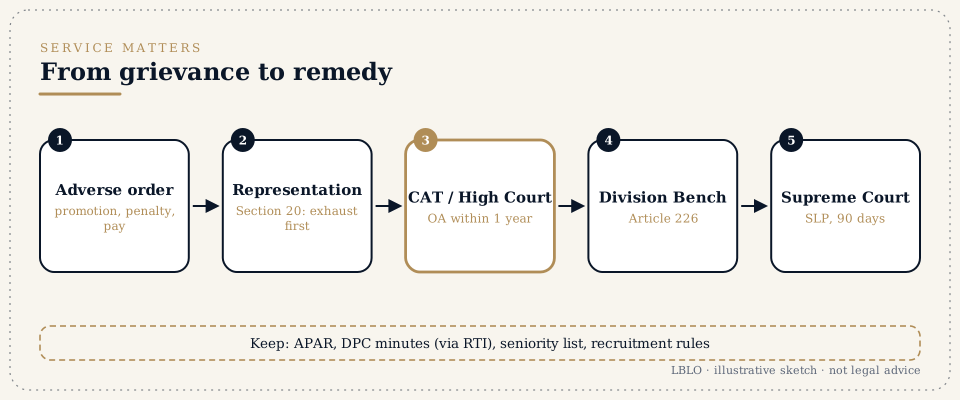
First within the department: an appeal against suspension or a pension order under Rule 23 of the CCS (CCA) Rules within 45 days, or a representation for a review DPC or release of dues. Then, for central government servants, an original application before the Central Administrative Tribunal under Section 19 of the Administrative Tribunals Act, 1985, ordinarily within one year of the final order or of six months passing without one. The Tribunal's order can be challenged before a Division Bench of the High Court, and from there in the Supreme Court.
These answers are educational summaries; they are not legal advice on any individual matter.
A serious question deserves a read brief.
Conferences are by appointment at G-46, Basement, Greater Kailash III, New Delhi. The principal reads the correspondence.
This page gives general information about the work of Lokesh Bhardwaj Law Offices, as permitted under the Bar Council of India Rules. It is not legal advice, and it does not create an advocate-client relationship. LBLO acts in a matter only on an engagement agreed in writing.
Law stated as at 16/11/2026.