
Employment and the Labour Codes: Wages, Termination, Gratuity, PF, POSH and Where to Go
Since 21/11/2025 most of India's central labour law sits in four Codes. This page explains what they require of employers, what they give employees, and where a dispute goes.
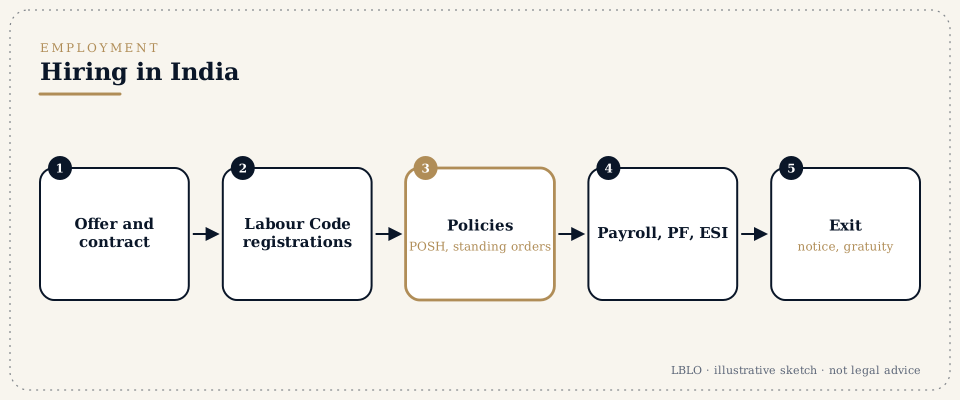
In brief
- Four Codes, one date. The Code on Wages, 2019, the Industrial Relations Code, 2020, the Code on Social Security, 2020 and the Occupational Safety, Health and Working Conditions Code, 2020 came into force on 21/11/2025. They consolidate 29 central labour laws.
- Rules. The Central Government notified its rules under all four Codes on 08/05/2026. Each State makes its own rules for establishments for which it is the appropriate Government, so the State's rules must be checked as well.
- Wages. Monthly wages are due before the seventh day of the next month, and dues on resignation, dismissal or retrenchment within two working days (Code on Wages, Section 17). A wage claim can be filed within three years before the authority under Section 45, which can add compensation of up to ten times the claim.
- Termination. A "worker" with one year's continuous service cannot be retrenched without one month's written notice or pay in lieu and compensation of fifteen days' average pay for every completed year (Industrial Relations Code, Section 70). Managerial employees rely mainly on their contract.
- Gratuity. Payable after five years' continuous service, at fifteen days' wages for each completed year; a fixed-term employee qualifies after one year, pro rata (Code on Social Security, Section 53).
- Provident fund. The provident fund provisions apply to establishments with 20 or more employees, and the wage ceiling for mandatory coverage is Rs. 25,000 a month from 17/09/2026.
- POSH. An employer with ten or more workers must have an Internal Committee; complaints are made within three months and the inquiry is completed within ninety days.
Terms you will hear
- Worker
- Under Section 2(zr) of the Industrial Relations Code, a person employed to do manual, skilled, technical, operational, clerical or supervisory work, but not a person employed mainly in a managerial or administrative capacity, or a supervisor drawing wages above Rs. 18,000 a month (or the amount notified).
- Wages
- The Codes define wages to include basic pay, dearness allowance and retaining allowance. If excluded items such as allowances exceed one-half of total remuneration, the excess is added back to wages, which raises gratuity and contributions.
- Fixed-term employment
- Engagement on a written contract for a fixed period, with the same hours, wages and benefits as a permanent worker doing similar work (Section 2(o), Industrial Relations Code). Its expiry is not retrenchment.
- Retrenchment
- Termination for any reason other than punishment, but not voluntary retirement, superannuation, non-renewal or expiry of a contract, end of fixed-term employment, or continued ill-health (Section 2(zh)).
- Standing orders
- Service rules on classification, hours, leave, misconduct and termination, required in industrial establishments with 300 or more workers (Section 28). Model standing orders were notified with the Central Rules in 2026.
- Worker re-skilling fund
- A fund to which an employer contributes fifteen days' wages for each worker it retrenches (Section 83, Industrial Relations Code).
- Inspector-cum-facilitator
- The officer who replaces the old labour inspector under the Codes, with a duty to advise employers as well as to inspect.
- Internal Committee
- The committee every employer with ten or more workers must constitute under the POSH Act, 2013 to inquire into complaints of sexual harassment.
In detail
The four Labour Codes
What changed on 21/11/2025
The Central Government brought all four Codes into force on 21/11/2025 by notifications S.O. 5319(E) to 5322(E). The Industrial Relations Code replaced the Industrial Disputes Act, 1947, the Trade Unions Act, 1926 and the Industrial Employment (Standing Orders) Act, 1946; the Code on Social Security absorbed nine laws, including those on provident fund, employees' state insurance, gratuity and maternity benefit; the Occupational Safety, Health and Working Conditions Code (the OSH Code) absorbed the factories and contract labour laws.
The Central Government notified its rules under all four Codes on 08/05/2026 (G.S.R. 342(E) to 345(E)), together with model standing orders and the notification setting up the worker re-skilling fund. A corrigendum of 15/07/2026 renamed the wage rules the Wages (Central) Rules, 2026. States make their own rules for the establishments for which they are the appropriate Government, and several published only drafts in 2025 and 2026. Before relying on a form, a register or a deadline, the rules of the relevant State must be checked.
What an employer must now do
- Register the establishment. An establishment to which the OSH Code applies applies electronically for registration within sixty days of the Code becoming applicable to it (Section 3, OSH Code). The State shops and establishments law continues alongside the Codes. In Delhi, the Delhi Shops and Establishments (Amendment) Act, 2026 confines the 1954 Act to establishments with 20 or more employees once it is brought into force; reports differ on whether it has been, so the current position should be checked.
- Issue appointment letters. Every employee must receive a letter of appointment in the prescribed form (Section 6(1)(f), OSH Code).
- Restructure pay. Because of the one-half rule in the definition of wages, a pay structure built on a low basic salary and large allowances now produces higher gratuity, contributions and retrenchment compensation.
- Hours and overtime. A worker may not be required to work more than eight hours in a day, and overtime is paid at twice the ordinary rate (Sections 25 and 27, OSH Code), subject to the rules on spread-over and weekly limits.
- Health checks. The employer provides the free annual health examination the rules prescribe for the class of employees concerned (Section 6(1)(c), OSH Code).
Each Code repeals the laws it replaces but saves what was done under them, so a termination or default that occurred before 21/11/2025 is ordinarily decided under the law then in force.
Termination, retrenchment and the Industrial Relations Code
First question: worker or manager
The protection depends on the category. A person employed mainly in a managerial or administrative capacity, or a supervisor earning above the notified threshold, is not a "worker" under Section 2(zr). Such a person's rights on termination come from the contract, the State shops and establishments law where it applies, and the civil courts. A worker has the statutory protection described below and access to the conciliation officer and the Industrial Tribunal.
Retrenchment
A worker with not less than one year of continuous service may be retrenched only if three conditions are met (Section 70):
- one month's written notice stating the reasons, or wages for the notice period in lieu;
- compensation at the time of retrenchment equal to fifteen days' average pay for every completed year of continuous service or any part of a year above six months;
- notice to the appropriate Government or the authority it specifies.
The employer must ordinarily follow "last come, first go" within the category (Section 71), must offer re-employment to retrenched workers if it hires within one year (Section 72), and must contribute fifteen days' wages per retrenched worker to the worker re-skilling fund (Section 83).
Larger establishments and closures
In a factory, mine or plantation with 300 or more workers (or a higher number the appropriate Government notifies), lay-off, retrenchment and closure need the prior permission of the appropriate Government (Chapter X, Sections 77 to 82). Outside Chapter X, an employer that intends to close an undertaking with fifty or more workers must give the Government sixty days' notice (Section 74), and workers with one year's service are entitled to notice and compensation as on retrenchment (Section 75).
Dismissal for misconduct
Dismissal as a punishment is not retrenchment, but it must follow the standing orders or service rules and a fair domestic inquiry. Where a worker is suspended pending inquiry, the inquiry should ordinarily be completed within ninety days, and subsistence allowance is paid at fifty per cent of wages for the first ninety days and seventy-five per cent after that, unless the delay is the worker's own doing (Section 38). Dismissal by victimisation, on trumped-up charges or in disregard of natural justice is an unfair labour practice (Second Schedule).
How a dismissed worker challenges it
A dispute over the discharge, dismissal, retrenchment or termination of an individual worker is an industrial dispute even if no union takes it up (Sections 2(q) and 4(9)). The worker applies for conciliation and, if forty-five days pass without settlement, may apply directly to the Industrial Tribunal (Section 4(10)). That application must be made within two years of the termination (Section 4(11)). The Tribunal can order reinstatement, back wages or compensation.
Wages, gratuity, PF and ESI
Wages and bonus
- When wages are due. Daily wages at the end of the shift, weekly wages before the weekly holiday, and monthly wages before the expiry of the seventh day of the following month. On removal, dismissal, retrenchment, resignation or closure, wages are paid within two working days (Section 17).
- Deductions. No deduction is allowed except those the Code authorises, and total authorised deductions in a wage period may not exceed fifty per cent of the wages (Section 18).
- Minimum and floor wages. The Central Government fixes a floor wage, and no State minimum wage may be below it (Section 9).
- Bonus. An employee within the wage limit the Government notifies who has worked at least thirty days in the accounting year gets a minimum bonus of 8.33 per cent of wages or Rs. 100, whichever is higher, and up to twenty per cent where there is allocable surplus (Section 26).
Recovering unpaid wages
The claim goes to the authority appointed under Section 45 of the Code on Wages. It may be filed by the employee, a registered union of which the employee is a member, or the Inspector-cum-facilitator, within three years from the date the claim arises; a later claim may be entertained on sufficient cause. The authority may award compensation of up to ten times the amount determined, should try to decide within three months, and recovers its order as arrears of land revenue. An appeal lies to the appellate authority within ninety days, extendable for sufficient cause (Section 49). The Code covers managers as well as workers.
Gratuity
Gratuity is payable on termination of employment after at least five years' continuous service, whether by superannuation, retirement, resignation, death or disablement (Section 53(1), Code on Social Security). Five years are not needed on death, disablement or the end of fixed-term employment, and a fixed-term employee qualifies after one year. The amount is fifteen days' wages, at the rate last drawn, for each completed year of service or part above six months; for a monthly-rated employee, fifteen days' wages are the monthly wage divided by twenty-six and multiplied by fifteen. The total is subject to the ceiling the Central Government notifies (Section 53(3)), and better terms under a contract or award prevail (Section 53(5)). Gratuity may be forfeited only on the grounds in Section 53(6): to the extent of loss caused by the employee's wilful act or negligence, or wholly or partly for violence or an offence involving moral turpitude committed in the course of employment.
Provident fund
The provident fund provisions in Chapter III of the Code on Social Security apply to every establishment with 20 or more employees, whatever its industry. By a notification of 17/09/2026 the wage ceiling for mandatory coverage was raised from Rs. 15,000 to Rs. 25,000 a month; the standard contribution remains twelve per cent of wages from each of the employer and the employee. Dues are determined by an officer of the Social Security Organisation after inquiry, and an employer's appeal against a determination or against damages goes to the Industrial Tribunal, which will not hear it unless twenty-five per cent of the amount determined is deposited (Section 23).
Employees' state insurance and other benefits
ESI coverage now extends across India rather than to notified areas only. It applies to establishments with ten or more employees, can be adopted voluntarily by smaller ones, and applies even to a single worker in hazardous work. The Code also covers maternity benefit (up to twenty-six weeks for a woman who has worked eighty days in the preceding twelve months), a creche in establishments with fifty or more employees, compensation for accidents while commuting to or from work, and social security schemes for gig and platform workers.
POSH at the workplace
The Sexual Harassment of Women at Workplace (Prevention, Prohibition and Redressal) Act, 2013 was not touched by the Labour Codes and applies to every employer, public or private, whatever the number of employees. The Office's POSH explainer sets out the employer's duties step by step; in outline:
- an Internal Committee at each office or unit with ten or more workers, with a senior woman as Presiding Officer, at least two employee members, an external member, and at least one-half women (Section 4); smaller workplaces use the Local Committee of the District Officer (Section 6);
- a complaint within three months of the incident, or of the last incident in a series, extendable by three months for recorded reasons (Section 9);
- conciliation only at the woman's request and never on a monetary basis (Section 10);
- the inquiry completed within ninety days (Section 11(4)), the report to the employer within ten days, and action by the employer within sixty days (Section 13);
- confidentiality of the parties and the proceedings (Section 16), and an appeal within ninety days (Section 18);
- an annual report by the Committee and disclosure in the employer's own annual report (Sections 21 and 22), with a fine of up to Rs. 50,000 for non-compliance, doubled on a repeat conviction (Section 26).
Most challenges to POSH outcomes turn on procedure: a Committee not properly constituted, no copy of the complaint to the respondent, or findings not based on the evidence.
Employment contracts, bonds and non-competes
What a good appointment letter covers
Role and place of work; pay broken into the components the Codes define; hours and leave; probation; notice on either side; confidentiality; assignment of intellectual property; and the policies that apply. A foreign template used without Indian terms often causes later disputes.
Notice periods and resignation
A court will not compel a person to keep working, because contracts of personal service are not specifically enforced (Specific Relief Act, 1963). The employer's remedy for an unserved notice period is the notice pay the contract provides; it cannot withhold earned wages, gratuity or provident fund as a penalty.
Service bonds
A clause requiring an employee to serve for a minimum period, or to repay a sum if he or she leaves earlier, operates during employment and is not a restraint after it. Courts generally enforce it to the extent of reasonable compensation for the employer's actual loss, such as the cost of training, and reduce a sum that is a penalty (Section 74, Indian Contract Act, 1872).
Non-compete and non-solicit clauses
Section 27 of the Indian Contract Act, 1872 makes void every agreement by which anyone is restrained from exercising a lawful profession, trade or business, with one exception for the seller of the goodwill of a business. Indian courts therefore do not enforce a bar on joining a competitor after employment ends, however short or local. A restriction during employment, including paid garden leave, is treated differently. What survives the exit is the duty not to use or disclose the former employer's trade secrets and confidential information, which a court can protect by injunction, and, depending on the facts, a clause against soliciting clients or staff.
Where a dispute goes
- Grievance Redressal Committee. Every industrial establishment with 20 or more workers must have one. An individual grievance is filed within one year, the Committee aims to finish within thirty days, and a dissatisfied worker may seek conciliation within sixty days of its decision (Section 4, Industrial Relations Code).
- Conciliation officer. Conciliation is the first step for an industrial dispute. The officer reports within forty-five days of starting, and cannot take up a dispute more than two years after it arose (Section 53).
- Industrial Tribunal. A party may apply to the Tribunal within ninety days of receiving the conciliation officer's failure report (Section 53(6)); an individual worker may apply directly as explained above. No Government reference is needed, except for the National Industrial Tribunal.
- Wage authority. Unpaid wages, bonus and other dues under the Code on Wages, with appeal to the appellate authority.
- Social security authorities. Provident fund grievances to the Social Security Organisation, with the employer's appeal to the Industrial Tribunal; gratuity claims to the competent authority under the Code on Social Security.
- POSH. The Internal or Local Committee, with the appeal under Section 18.
- Civil court. Managerial employees' claims for damages, notice pay and dues under the contract, and employers' suits on confidentiality, bonds and solicitation.
- Public employers. Central Government employees go to the Central Administrative Tribunal; employees of other public bodies may need a writ petition. The Office's service matters page covers these.
In each forum the documents decide most cases: the appointment letter, pay slips, the provident fund passbook and the termination correspondence.
Questions people ask
Are the new Labour Codes in force now?
Yes. All four Labour Codes, the Code on Wages, 2019, the Industrial Relations Code, 2020, the Code on Social Security, 2020 and the Occupational Safety, Health and Working Conditions Code, 2020, came into force on 21/11/2025. The Central Government notified its rules under them on 08/05/2026. States make their own rules for the establishments under their control, and some State rules were still in draft during 2026, so the forms, registers and some deadlines depend on the State. Events that happened before 21/11/2025 are generally governed by the old Acts, which the Codes save for that purpose.
My employer has not paid my salary for two months. What can I do?
Send a written demand first and keep proof of it. If salary is still unpaid, file a claim before the authority appointed under Section 45 of the Code on Wages, 2019, within three years from the date the claim arose. The Code covers employees generally, managers included. The authority can add compensation of up to ten times the amount due, aims to decide within three months, and its order is recovered like arrears of land revenue. Monthly wages are due before the seventh day of the next month. Keep your appointment letter, salary slips and bank statements, and the emails about the delay.
Can a company terminate me without notice?
It depends on whether you are a worker or a managerial employee. A worker with one year's continuous service cannot be retrenched without one month's written notice or pay in lieu, compensation of fifteen days' average pay per completed year, and notice to the Government (Section 70, Industrial Relations Code, 2020). Dismissal for misconduct needs a fair inquiry under the standing orders or service rules. A manager's rights come mainly from the contract and, where it applies, the State shops and establishments law, and are enforced in a civil court. Termination without notice or pay in lieu is a breach in either case.
How is gratuity calculated, and when am I eligible?
Under Section 53 of the Code on Social Security, 2020, gratuity is payable after at least five years' continuous service, at fifteen days' wages for each completed year or part above six months, at the wage last drawn. For a monthly-rated employee, take the monthly wage, divide by twenty-six and multiply by fifteen, then multiply by the years. The five-year condition does not apply on death or disablement, and a fixed-term employee qualifies after one year on a pro rata basis. The amount is capped at the ceiling the Central Government notifies. Better terms in your contract prevail.
Is PF compulsory for my company, and what changed in 2026?
The provident fund provisions of the Code on Social Security, 2020 apply to every establishment with 20 or more employees, whatever the industry. By a notification of 17/09/2026, the wage ceiling for mandatory coverage was raised from Rs. 15,000 to Rs. 25,000 a month, so employees earning up to that amount must now be enrolled, subject to the scheme's conditions. The standard contribution remains twelve per cent of wages from both employer and employee. An employer that disputes a determination of dues appeals to the Industrial Tribunal after depositing twenty-five per cent of the amount determined.
Is a non-compete clause in my employment contract enforceable after I leave?
Generally no. Section 27 of the Indian Contract Act, 1872 makes void any agreement that restrains a person from exercising a lawful profession, trade or business, and the only exception in the section concerns the sale of goodwill. Courts apply it to post-employment bars on joining a competitor or starting a rival business. Restrictions during employment, including paid garden leave, are treated differently. What does survive is your duty not to use or disclose the former employer's confidential information and trade secrets. Non-solicitation clauses are decided on their facts, so check what you agreed and what you took with you.
Do I have to pay the bond amount if I leave before the bond period?
Possibly, but only a reasonable amount. A minimum-service clause operates while you are employed, so it is not a restraint of trade under Section 27 of the Indian Contract Act, 1872. Under Section 74 of the same Act, the figure written in the bond is a ceiling, not an automatic debt: the employer can recover reasonable compensation for its actual loss, such as training or recruitment costs, and a court can reduce a sum that is out of proportion. The employer cannot force you to keep working or withhold earned salary as a penalty. Ask for the costs in writing and respond with documents.
Does a small office need a POSH committee?
Every employer must comply with the POSH Act, 2013. Where an office or unit has ten or more workers, the employer must constitute an Internal Committee under Section 4, with a senior woman as Presiding Officer, at least two employee members and one external member, and at least half its members women. Where there are fewer than ten workers, complaints go to the Local Committee constituted by the District Officer under Section 6. The employer must still have a policy, display the consequences of harassment and run awareness sessions. Non-compliance is punishable with a fine of up to Rs. 50,000 under Section 26.
Where does a dismissed worker file a case under the new law?
The dispute starts with an application for conciliation to the conciliation officer. If it is not settled within forty-five days of that application, the worker may apply directly to the Industrial Tribunal under Section 4(10) of the Industrial Relations Code, 2020, without waiting for a Government reference. The application to the Tribunal must be made within two years of the dismissal or termination (Section 4(11)). Where the establishment has a Grievance Redressal Committee, other individual grievances can be taken there first. A managerial employee, who is not a worker, sues in the civil court on the contract instead.
What is fixed-term employment, and does it give the same benefits?
Fixed-term employment is engagement on a written contract for a fixed period under Section 2(o) of the Industrial Relations Code, 2020. The worker's hours, wages, allowances and other benefits must not be less than those of a permanent worker doing the same or similar work, statutory benefits are available proportionately even if the period is shorter than the usual qualifying period, and gratuity is payable after one year. When the term ends, the termination is not retrenchment, so retrenchment compensation is not payable. Keeping workers as temporaries for years to deprive them of permanent status is listed as an unfair labour practice in the Second Schedule.
These answers are educational summaries; they are not legal advice on any individual matter.
A serious question deserves a read brief.
Conferences are by appointment at G-46, Basement, Greater Kailash III, New Delhi. The principal reads the correspondence.
This page gives general information about the work of Lokesh Bhardwaj Law Offices, as permitted under the Bar Council of India Rules. It is not legal advice, and it does not create an advocate-client relationship. LBLO acts in a matter only on an engagement agreed in writing.
Law stated as at 16/11/2026.