
Employing People in India: The Labour Codes, Policies and POSH
India's labour law changed in November 2025. This page explains what a foreign company must have in place to hire in India.
In brief
- The new framework. Four Labour Codes came into force on 21/11/2025. They replace 29 central labour laws:
- the Code on Wages, 2019;
- the Industrial Relations Code, 2020;
- the Code on Social Security, 2020;
- the Occupational Safety, Health and Working Conditions Code, 2020.
Central rules under all four Codes were notified on 08/05/2026. Each State makes its own rules under the Codes, so the State's current rules are checked for each office. State laws on shops and establishments also continue to apply.
- Documents every employer needs:
- appointment letters;
- an employment agreement or terms;
- workplace policies, including a harassment policy under the POSH law;
- registers and returns under the Codes.
- Social security. Provident fund and employees' state insurance contributions apply where the thresholds are met. Gratuity is payable on leaving after the qualifying service.
- Workplace harassment. An employer with ten or more employees must constitute an Internal Committee under the POSH Act and have a policy.
- Termination. Rights on termination depend on the employee's category and the Codes. Notice, payment in lieu, and the employee's dues are worked out case by case.
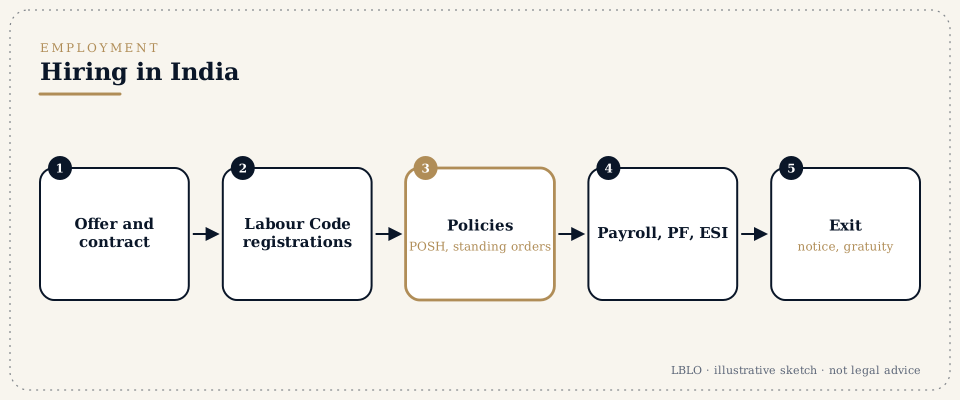
- The steps, in short:
- registrations;
- appointment letter and employment terms;
- policies;
- payroll and social-security set-up with the CA;
- Internal Committee;
- annual review.
- Keep ready:
- the proposed roles and pay structure;
- the group's global policies;
- office locations;
- the number of employees and contract workers.
Terms you will hear
- Labour Codes
- the four codes in force from 21/11/2025, covering wages, industrial relations, social security and working conditions.
- Worker and employee
- the categories under the codes, which decide which protections apply.
- Wages definition
- what counts as wages for provident fund, gratuity and other contributions.
- Fixed-term employment
- employment for a fixed period, with parity in benefits.
- Standing orders
- the service rules for larger establishments.
- Gratuity
- a retirement or termination benefit.
- Non-compete clauses
- post-employment restraints are generally unenforceable in India. Confidentiality and non-solicit clauses are treated differently.
- POSH Internal Committee
- mandatory at 10 or more employees.
In detail
Step 1: Registration
The establishment registers under:
- the applicable State shops and establishments law;
- the relevant Codes;
- social-security schemes, once the thresholds are met.
Step 2: Employment terms
The appointment letter and terms cover:
- role and place of work;
- pay, broken into the components the Codes define;
- working hours and leave;
- confidentiality and intellectual property assignment;
- restraint during employment;
- notice and termination.
The definition of "wages" in the Codes affects how gratuity, bonus and social security contributions are calculated. This is why pay structure needs review.
Step 3: Policies
The minimum set of policies:
- a code of conduct;
- a POSH policy;
- leave;
- data protection;
- information security;
- grievances;
- whistle-blowing where relevant.
Global policies are adapted to Indian requirements, not copied as they are.
Step 4: Internal Committee under the POSH Act
The Committee is constituted as the Act requires, including an external member. Complaints are inquired into within the statutory timelines, and an annual report is filed.
Step 5: Contractors and secondees
Contract labour and staffing arrangements need agreements that allocate compliance responsibility. Employees seconded from the parent raise questions on visas, social security and tax that are settled before arrival.
Step 6: Exits
Resignations and terminations are handled with the correct notice, full and final settlement, return of property and confidential information, and documentation.
Common mistakes
- Using a global offer letter without Indian terms.
- Pay structures that understate "wages" under the Codes.
- No Internal Committee, or one not constituted as the law requires.
- Treating long-term contractors as outside the law.
Questions people ask
Do we need an Indian entity to hire in India?
Usually yes, to employ directly. Some companies use staffing or "employer of record" arrangements, which need careful contracts.
Is there a probation period?
Probation is a matter of contract, within the limits of the law.
Can we include a non-compete after employment ends?
Restraints after employment are generally difficult to enforce in India. Confidentiality and non-solicitation are treated differently.
These answers are educational summaries; they are not legal advice on any individual matter.
A serious question deserves a read brief.
Conferences are by appointment at G-46, Basement, Greater Kailash III, New Delhi. The principal reads the correspondence.
This page gives general information about the work of Lokesh Bhardwaj Law Offices, as permitted under the Bar Council of India Rules. It is not legal advice, and it does not create an advocate-client relationship. LBLO acts in a matter only on an engagement agreed in writing.
Law stated as at 14/11/2026.