
Choosing an Entity and Setting Up in India
The first legal decision for a foreign business is the form its Indian presence will take. This page compares the options and sets out the steps for each.
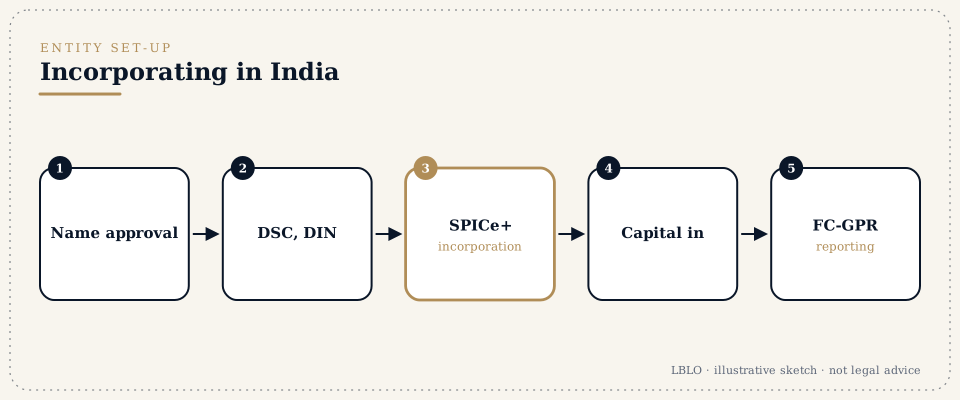
In brief
- The main options:
- Wholly owned subsidiary. A private limited company owned by the foreign parent. This is the most common choice.
- Joint venture company. An Indian company owned with an Indian partner.
- Limited liability partnership (LLP). Foreign investment is allowed where the sector permits it.
- Branch office. An extension of the foreign company. It can carry on only the activities that are permitted.
- Liaison office. Representation only; it earns no income in India.
- Project office. For executing a specific contract in India.
- Approvals.
- A subsidiary or LLP in a sector open under the automatic route needs no prior approval for the investment.
- Branch, liaison and project offices need approval under the Reserve Bank of India's regulations, usually given through an authorised dealer bank. Applicants from some countries, and offices in some sectors, need the RBI's prior approval in consultation with the Government.
- Key requirements for a company:
- at least one director must stay in India for a total of 182 days or more during the financial year (Section 149(3) of the Companies Act, 2013; for a newly incorporated company the requirement applies proportionately);
- a registered office in India;
- incorporation through the MCA's integrated SPICe+ form.
- Reporting. Shares issued to the foreign parent must be reported to the RBI in Form FC-GPR within 30 days of allotment. The company then files annual returns under company law and FEMA.
- The steps, in short:
- Choose the structure.
- Check FDI eligibility.
- Prepare the parent's documents, notarised and apostilled.
- Obtain director identification numbers and digital signatures.
- Reserve the name and incorporate.
- Open a bank account and bring in the capital.
- Report the investment.
- Complete registrations: GST, shops and establishments, and the labour registrations.
- Keep ready:
- the parent's certificate of incorporation and constitutional documents;
- a board resolution;
- identity and address proof of the proposed directors and shareholders' representatives;
- details of the proposed Indian office.
Terms you will hear
- SPICe+
- the integrated incorporation form on the MCA portal.
- DSC and DIN
- the digital signature certificate, and the director identification number.
- MOA and AOA
- the memorandum and articles of association.
- Authorised and paid-up capital
- the maximum the company may issue, and what it has issued.
- FC-GPR reporting
- the reporting of a foreign investment after shares are allotted.
- Downstream investment
- an investment by a foreign-owned Indian company into another Indian company.
- LLP
- a limited liability partnership. Foreign investment is allowed in some sectors.
In detail
Step 1: Compare the structures
| Structure | Can it earn income in India? | Approval | Liability |
|---|---|---|---|
| Subsidiary (private limited company) | Yes, any lawful business | Automatic route in most sectors | Limited to the subsidiary |
| LLP | Yes | Allowed where the sector permits FDI | Limited |
| Branch office | Only permitted activities | Under RBI regulations, through an authorised dealer bank; RBI with the Government in some cases | Parent directly liable |
| Liaison office | No | Under RBI regulations, through an authorised dealer bank; RBI with the Government in some cases | Parent |
| Project office | Only for the contract | As per the regulations | Parent |
Branch, liaison and project offices are governed by the Foreign Exchange Management (Establishment in India of a Branch Office or a Liaison Office or a Project Office or any other place of business) Regulations, 2016 and the RBI's Master Direction. The RBI published draft replacement regulations in October 2025. As at 14/11/2026 they had not been notified, and the 2016 Regulations continue to apply. Check the position again before filing.
Step 2: Check eligibility
Confirm three things:
- the sectoral position;
- whether any investor has beneficial ownership from a land-border country;
- any conditions that apply, such as minimum capitalisation or performance conditions.
Step 3: Prepare documents abroad
Documents executed outside India are notarised, then apostilled or legalised, depending on the country. Signatories need digital signature certificates and director identification numbers. The name is checked against existing companies and registered trade marks.
Step 4: Incorporate
SPICe+ combines several steps in one filing: name reservation, incorporation, director numbers, PAN and TAN, and a number of registrations. The articles of association should reflect the parent's control and reserved matters.
Step 5: Capital and reporting
The capital is received through banking channels. Shares are issued at a price that complies with the pricing rules. The allotment is reported in Form FC-GPR within 30 days. Annual filings follow, including the foreign liabilities and assets return.
Step 6: Registrations and first compliance
- GST registration where required;
- shops and establishments registration in the State;
- labour registrations;
- appointment of the auditor;
- the first board meeting.
Common mistakes
- Choosing a branch where a subsidiary is needed, or the other way round.
- Not checking indirect ownership from a land-border country.
- Missing the FC-GPR deadline.
- Appointing a resident director who does not actually meet the residence test.
How LBLO handles set-up
LBLO advises on the structure and the FDI position, drafts the articles of association and shareholder or joint venture agreements, and coordinates with the company secretary and chartered accountant who handle filings and accounts.
Questions people ask
How long does incorporation take?
Once documents are in order, incorporation itself is usually quick. Preparing and apostilling documents abroad often takes longer.
Does the resident director have to be an Indian citizen?
No. The test is residence in India for the required period, not nationality.
Can a liaison office sign contracts or earn fees?
No. It may only represent the parent and act as a communication channel.
These answers are educational summaries; they are not legal advice on any individual matter.
A serious question deserves a read brief.
Conferences are by appointment at G-46, Basement, Greater Kailash III, New Delhi. The principal reads the correspondence.
This page gives general information about the work of Lokesh Bhardwaj Law Offices, as permitted under the Bar Council of India Rules. It is not legal advice, and it does not create an advocate-client relationship. LBLO acts in a matter only on an engagement agreed in writing.
Law stated as at 14/11/2026.