
Agreements: From First Draft to Signature
LBLO drafts, reviews and negotiates commercial agreements for businesses of every size, from single-founder companies to groups operating across several jurisdictions.
In brief
- Scope. LBLO drafts, reviews and negotiates commercial agreements for businesses of every size, from single-founder companies to groups operating across several jurisdictions. The work is scaled to the value and complexity of the transaction.
- Clauses to look at closely:
- how disputes are to be resolved, and where;
- limitation of liability and indemnities;
- termination;
- interest on late payment;
- stamp duty;
- any steps a party must take before going to court;
- intellectual property;
- confidentiality;
- data protection;
- anti-bribery;
- force majeure.
- Governing law. Parties can choose the law, but some matters are governed by Indian law regardless of the choice. These include property in India, stamp duty, and certain regulatory requirements.
- Stamp duty. Agreements executed in India or brought into India must carry the stamp duty that the relevant State's law prescribes. An agreement that is not duly stamped cannot be relied on in evidence until the duty and any penalty are paid. Pay stamp duty at signing.
- Dispute resolution:
- choose arbitration or courts clearly;
- name the seat and the institution;
- think about where the other side's assets are. An award made in a New York Convention country notified by India is enforced through a separate procedure (see enforcing foreign judgments and arbitral awards in India).
- Indian commercial courts. Commercial disputes of the specified value fixed by the Commercial Courts Act, 2015 go to the commercial courts. Pre-institution mediation is required unless urgent interim relief is genuinely needed.
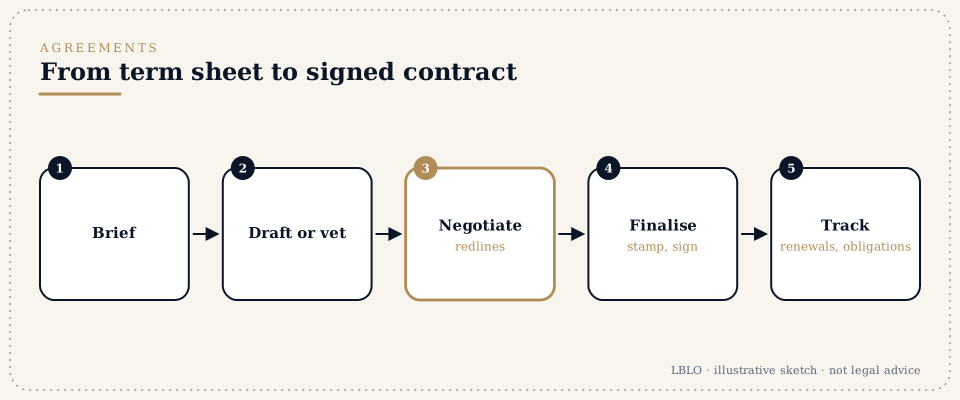
- The steps, in short:
- term sheet;
- first draft or review of the other side's draft;
- issues list;
- negotiation;
- final text;
- stamping and signing;
- a register of obligations.
- Keep ready:
- the commercial terms;
- the group's standard templates;
- any regulatory licences relevant to the deal;
- details of the Indian counterparty.
Terms you will hear
- Stamp duty
- a State levy on documents. Unstamped documents face admissibility problems.
- Governing law and seat of arbitration
- the law that decides the contract, and where the arbitration sits.
- Section 12A mediation
- compulsory before most commercial suits.
- Liquidated damages
- a pre-agreed sum for breach, recoverable as reasonable compensation.
- Force majeure
- events excusing performance.
- Limitation of liability and indemnity
- the cap on claims, and the promise to cover specified losses.
- E-signature
- valid for most contracts under the IT Act. Some documents need physical signing or registration.
In detail
1. The work, from first draft to signature
- Understanding the deal: what each side wants, what is agreed and what is still open.
- Issues list: the legal points that need a decision, in order of importance.
- Draft or review: a draft, or a marked-up copy of the other side's draft, with each change explained.
- Negotiation: calls and meetings with the other side or its lawyers, on the client's instructions.
- Final version: a clean final text, the correct stamp duty, the manner of signing, and registration where the law requires it.
- After signing: a short note of the dates and obligations the client needs to track.
2. A single agreement, or all of a company's contracts
The scope depends on the transaction. It may be a single agreement, such as a shareholders' agreement, lease, franchise, supply or service agreement, or a continuing arrangement for all of a company's regular contracts. Where a company has its own lawyers abroad, LBLO reviews the company's standard agreements under Indian law, adds the terms Indian law requires, and works alongside those lawyers. A continuing arrangement is usually set up as a retainer; the other work LBLO takes on for companies, law firms and clients outside India is described on Working With Lokesh Bhardwaj Law Offices.
3. Fit the group template to India
Global templates are reviewed for points of Indian law, including:
- whether restraint clauses after termination will be enforced;
- how liquidated damages and penalties are treated;
- payment terms under foreign exchange rules;
- tax withholding;
- language on regulatory approvals.
Foreign companies setting up in India will find the related points on Doing Business in India.
4. Choose the forum with enforcement in mind
The best clause is the one that can be enforced against the counterparty's assets.
- Where assets are in India, a seat in India or a notified Convention country gives a clear route.
- A court judgment from a country that is not a "reciprocating territory" needs a fresh suit in India (see enforcing foreign judgments and arbitral awards in India).
5. Negotiate
The issues list sets out the legal points that need decisions, in order of risk. LBLO can take part in negotiation with the counterparty or its lawyers, on the client's instructions, alongside the client's foreign counsel where there is one.
6. Stamp and sign
The stamp duty depends on the State and the type of instrument. E-stamping is available in many States. Execution formalities are planned in advance:
- who signs;
- under what board authority;
- whether a company seal or notarisation is required.
7. After signing
A register of key dates and obligations keeps renewals, notice periods and payment milestones from being missed.
8. Common mistakes
- Signing an unstamped agreement and discovering the problem only in a dispute.
- Choosing a foreign court whose judgments cannot be directly executed in India.
- Restraint and non-compete clauses that will not be enforced.
- No clear authority for the Indian signatory.
Questions people ask
Can LBLO negotiate an agreement for us?
Yes. On your instructions, LBLO can take part in negotiation calls and meetings and exchange drafts with the other side or its lawyers.
Is this work only for large companies?
No. LBLO drafts, reviews and negotiates commercial agreements for businesses of every size, from single-founder companies to groups operating across several jurisdictions. The scope is set by the matter, whether a single agreement for a founder or regular contract work for a larger company.
Is an email agreement binding in India?
It can be, if the terms are agreed and the requirements of the Contract Act are met. Stamp duty and proof can still cause difficulty.
Can we choose English law for a contract with an Indian party?
Generally yes, for the contract itself. Some matters are still governed by Indian law.
Should we arbitrate in Singapore or in India?
It depends on the counterparty's assets, the cost and the courts that will supervise. Both are common.
These answers are educational summaries; they are not legal advice on any individual matter.
A serious question deserves a read brief.
Conferences are by appointment at G-46, Basement, Greater Kailash III, New Delhi. The principal reads the correspondence.
This page gives general information about the work of Lokesh Bhardwaj Law Offices, as permitted under the Bar Council of India Rules. It is not legal advice, and it does not create an advocate-client relationship. LBLO acts in a matter only on an engagement agreed in writing.
Last reviewed: 14/11/2026. Lokesh Bhardwaj Law Offices, New Delhi.
Law stated as at 14/11/2026.