
Doing Business in India: Setting Up and Operating as a Foreign Company
Companies from Singapore, the United States, Japan, Europe, the UAE and elsewhere set up and expand in India every year. This page sets out the legal journey in order, and links to a detailed page on each stage.
In brief
- India receives large and growing foreign investment. FDI equity inflows were US$58.85 billion in 2025-26, according to DPIIT. The largest sources were Singapore, the United States, Mauritius, Japan and the Netherlands.
- Most sectors allow 100% foreign ownership without prior government approval (the "automatic route"). Some sectors, and investors from countries that share a land border with India, need government approval.
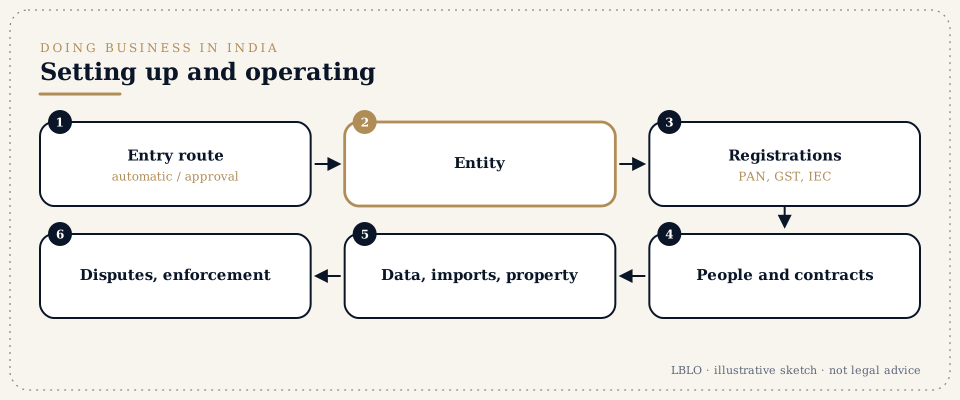
- The legal journey has eight stages. Each is covered in the guides in this series:
- Choosing how to enter: subsidiary, LLP, branch, liaison or project office, or joint venture.
- Setting up and reporting the investment.
- Contracts with Indian customers, suppliers and partners.
- Hiring and employing people.
- Handling personal data.
- Importing goods.
- Offices, plants and land.
- When something goes wrong: disputes, and enforcing judgments and awards in India.
- The foreign company's own lawyers can advise on their country's law, but not on Indian law. In India, advice on Indian law and appearance in Indian courts are the practice of law, reserved to advocates enrolled in India, so an Indian advocate is needed for that.
- What LBLO does:
- acts as Indian counsel to the company, or alongside its foreign lawyers;
- covers entry, contracts, employment, data, customs, property and disputes;
- works with the company's chartered accountant and company secretary for the tax, accounting and filing work that is theirs.
- How an engagement starts: a written description of the plan, a conflict check, and an engagement letter fixing the scope, the responsible advocate and the fees. Most of the work can be done by video meeting and secure document exchange.
Terms you will hear
- FDI, automatic route, approval route
- foreign investment, with or without prior approval.
- Liaison office, branch office, project office
- forms of presence without incorporating a company.
- Wholly owned subsidiary, joint venture
- a company owned entirely by the foreign parent, or shared with Indian partners.
- Resident director
- a director who meets the residence requirement, needed on every company's board.
- GSTIN, PAN, TAN, IEC
- tax and import-export registrations.
- Transfer pricing
- pricing rules for transactions between related companies.
The guides in this series
- Choosing an Entity and Setting Up in IndiaSubsidiary, joint venture, LLP, branch, liaison or project office; the resident director, incorporation and reporting the investment.
- Agreements: Commercial Contracts with Indian PartiesDrafting, review and negotiation of contracts with Indian customers, suppliers, distributors and partners, and the clauses that matter on a dispute.
- Employing People in IndiaThe four Labour Codes, employment terms, policies, the POSH Internal Committee, contractors, secondees and exits.
- Personal Data under India's DPDP ActWhat the Digital Personal Data Protection Act, 2023 and the DPDP Rules, 2025 require of a foreign company.
- Importing Goods into IndiaClassification, valuation, certification, the bill of entry, and the response to a seizure or show cause notice.
- Offices, Plants and LandLeasing or buying property for a foreign-owned business: title, land use, stamp duty and registration.
- Enforcing Foreign Judgments and Arbitral Awards in IndiaExecuting a decree from a reciprocating territory, a suit on other foreign judgments, and enforcing a New York Convention award.
- Legal Support for Law Firms in India and AbroadHow LBLO works with a foreign company's own lawyers, and Indian counsel for law firms outside India.
Lokesh Bhardwaj Law Offices (LBLO) advises foreign companies and investors on entering India, on the compliance that follows, and on disputes before Indian courts, tribunals and arbitral tribunals. Instructions are taken in writing from the company or its lawyers abroad, conflicts are checked first, and each engagement is recorded in a letter before work begins.
Who this is for
Companies entering India
Choosing between a liaison, branch or project office and a subsidiary or LLP, and completing the approvals and registrations that follow.
Investors holding Indian equity
Foreign direct investment, pricing, reporting to the Reserve Bank, downstream investment and an eventual exit with repatriation of proceeds.
Parties in a dispute with an Indian counterparty
Enforcing a foreign judgment or award in India, seeking interim relief, or defending a commercial suit or arbitration here.
In detail: the legal journey, stage by stage
Stage 1: Decide what the Indian business will do
The structure follows the activity. Consider:
- whether the business will sell in India, manufacture, provide services from India to the group, or only represent the parent;
- whether it will employ people and hold property.
Answer these first. The choice of entity comes next.
Stage 2: Check the FDI position
Two questions decide whether government approval is needed:
- The sector. Some sectors cap foreign ownership or require approval.
- The investor's country. Investors from countries sharing a land border with India have needed government approval since Press Note 3 of 2020, now read with Press Note 2 (2026 Series), which defines beneficial ownership for this purpose.
Both are checked against the current Consolidated FDI Policy and the Foreign Exchange Management (Non-debt Instruments) Rules, 2019.
Stage 3: Choose and set up the entity
See Choosing an entity and setting up in India.
Stage 4: Put the contracts in place
These are the contracts with customers, distributors, suppliers, landlords and group companies. Intra-group agreements matter for tax and for the regulators. See Commercial contracts with Indian parties.
Stage 5: Hire
India's labour law changed with the four Labour Codes, which came into force on 21/11/2025. See Employing people in India.
Stage 6: Data, imports and property
See Personal data under India's DPDP Act, Importing goods into India and Offices, plants and land.
Stage 7: Plan for disputes
Choose the governing law and the forum at the contract stage. Know in advance how a foreign judgment or award would be enforced in India. See Enforcing foreign judgments and arbitral awards in India.
What the Office takes on
Entry route advice
Liaison, branch or project office under the FEMA regulations of 2016, or a wholly owned subsidiary, joint venture or LLP. See Corporate & Compliance.
Incorporation and Companies Act compliance
Subsidiary set-up, a resident director under Section 149(3), registration of a foreign company's place of business under Section 380 within 30 days.
FDI structuring
Automatic and government routes, sectoral caps and conditions under Schedule I of the Non-debt Instruments Rules, 2019, and the land-border approval requirement.
FEMA reporting
Forms FC-GPR, FC-TRS and DI, the annual FLA return, late submission fees and compounding under Section 15 of the Act.
External commercial borrowings
Eligibility, the automatic-route ceiling and minimum maturity under the Reserve Bank's ECB framework, and the loan registration that follows.
Registrations
PAN and TAN under the Income-tax Act, GST registration under Sections 22 and 24 of the CGST Act, 2017, and Shops and Establishments registration in Delhi.
Employment and POSH
Employment contracts, an Internal Committee under Section 4 of the POSH Act, 2013, and compliance with the four labour codes in force since 21/11/2025.
Contracts under Indian law
Governing law, arbitration seat and institution, stamping and enforceability of the clauses that matter when things go wrong.
Foreign judgments
Execution under Section 44A of the Code of Civil Procedure, 1908, or a suit on the judgment where the country is not a reciprocating territory.
Foreign arbitral awards
Enforcement under Part II of the Arbitration and Conciliation Act, 1996, and resisting enforcement where the Section 48 grounds exist. See Arbitration.
Interim relief and commercial courts
Section 9 applications in support of foreign-seated arbitrations, and suits and injunctions before the commercial courts and the Delhi High Court.
Exit and repatriation
Sale of shares at or above fair value, FC-TRS reporting, tax clearance and remittance of proceeds; winding up of offices with the bank's approval.
How it works from abroad
Written instructions
An email or letter from the company or its lawyers abroad, with the facts and the documents in hand. The names of all parties and group entities are checked against the Office's records for conflicts, and the result is confirmed in writing.
Engagement letter
The letter names the client, the instructing firm where there is one, the person entitled to give instructions, the scope, the fee and the manner of exchanging documents.
Written advice or plan
For an entry or compliance matter, a note setting out the route, the approvals, the filings and the calendar. For a dispute, a strategy memo on forum, limitation, relief and likely course.
Execution in India
Filings through the authorised dealer bank, the Ministry of Corporate Affairs portal or the court registry. In litigation LBLO is counsel of record, and the instructing firm receives a note after each hearing.
Ongoing compliance or closure
A compliance calendar for the Indian entity, annual filings and reporting to the Reserve Bank; or, at the end of a dispute, execution of the decree and remittance of what is recovered.
Documents you will need
- Certificate of incorporation and charter documents of the foreign entity, apostilled or consularised
- Board resolution authorising the Indian establishment, investment or litigation and naming the signatory
- Audited accounts for the preceding years where a liaison or branch office is proposed
- Ownership chart up to the ultimate beneficial owners
- Identity and address proof of directors and the authorised signatory
- Business plan and sector of the proposed Indian activity
- For disputes: the contract, the arbitration clause, and all notices exchanged
- Certified copy of the foreign judgment or award, with proof of service and, for a decree, the certificate of satisfaction
- Power of attorney in favour of Indian counsel, attested abroad
- Existing Indian registrations, if any: PAN, GST, FEMA filings, Form FC-GPR acknowledgements
The list is adjusted to the matter. Apostille or consular attestation is arranged before documents are sent, as the Indian authorities will not accept them otherwise.
Frequently asked questions
Should a foreign company open a liaison office, a branch office or a subsidiary?
A liaison office may only represent the parent and may not earn income in India. Under the Foreign Exchange Management (Establishment in India of a branch office or a liaison office or a project office or any other place of business) Regulations, 2016, it needs a three-year profit record and a net worth of at least USD 50,000; approval runs for three years at a time. A branch office may trade and bill, and needs a five-year record and USD 100,000. A project office is tied to one contract. Applications go in Form FNC through an authorised dealer bank. A Companies Act, 2013 subsidiary suits a business operating at scale.
When does foreign investment need prior approval of the Government?
Most sectors are open under the automatic route, up to the sectoral cap in Schedule I of the Foreign Exchange Management (Non-debt Instruments) Rules, 2019, without approval. The government route covers the sectors and thresholds listed there, such as multi-brand retail and parts of defence and media. Since Press Note 3 of 2020, an investor from a country sharing a land border with India, or whose beneficial owner is from such a country, needs prior approval. Press Note 2 (2026 Series), dated 15/03/2026, and the amendment of the Non-debt Instruments Rules notified in May 2026 determine beneficial ownership by the criteria in Rule 9(3) of the Prevention of Money-laundering (Maintenance of Records) Rules, 2005.
What reporting follows an investment into an Indian company?
Under the Foreign Exchange Management (Mode of Payment and Reporting of Non-Debt Instruments) Regulations, 2019, the company must allot shares within 60 days of receiving the money and report the allotment in Form FC-GPR within 30 days of issue. A transfer between a resident and a non-resident is reported in Form FC-TRS within 60 days of the transfer or receipt of consideration, whichever is earlier. Downstream investment by an Indian company owned or controlled from abroad is reported in Form DI within 30 days. The annual return on Foreign Liabilities and Assets is due by 15 July, unless extended. Delays attract a late submission fee; breaches may be compounded.
Are there pricing rules on entry and exit?
Yes. Rule 21 of the Foreign Exchange Management (Non-debt Instruments) Rules, 2019 sets the pricing guidelines. For an unlisted company, shares issued to or bought by a non-resident must be priced at not less than the fair value worked out by an internationally accepted pricing methodology on an arm's length basis, certified by a chartered accountant, a SEBI-registered merchant banker or a practising cost accountant. For a listed company the SEBI pricing norms apply. On exit, a sale by a non-resident to a resident may not exceed that fair value, so the floor on entry becomes a ceiling on exit. A valuation report is part of every entry and exit.
Can a judgment from a court abroad be enforced in India?
A money decree of a superior court in a notified reciprocating territory is executed directly under Section 44A of the Code of Civil Procedure, 1908, by filing a certified copy, with a certificate of the extent to which it has been satisfied, in the District Court. The United Kingdom, Singapore, Hong Kong, Malaysia, New Zealand, Bangladesh and the United Arab Emirates are among the notified territories. From other countries, a fresh suit is filed on the judgment within three years under Article 101 of the Schedule to the Limitation Act, 1963. Either way the debtor may raise the Section 13 objections: want of jurisdiction, fraud or denial of natural justice.
How is a foreign arbitral award enforced, and can interim relief be obtained in India for a foreign-seated arbitration?
A New York Convention award from a notified country is enforced under Sections 44 to 52 in Part II of the Arbitration and Conciliation Act, 1996. The applicant files the award and the arbitration agreement before the High Court under Section 47; refusal is possible only on the grounds in Section 48, and under Section 49 the award is then deemed a decree. Limitation is three years under Article 137 of the Limitation Act, 1963. Since the Amendment Act of 2015, the proviso to Section 2(2) applies Section 9 to arbitrations seated outside India unless the parties agreed otherwise, so assets in India can be secured while the arbitration proceeds.
What employment compliance applies once staff are hired in India?
Written employment contracts governed by Indian law, registration under the Delhi Shops and Establishments Act, 1954 for a Delhi office, and enrolment with the provident fund and employees' state insurance schemes where the thresholds are met. Every workplace with ten or more employees must constitute an Internal Committee under Section 4 of the Sexual Harassment of Women at Workplace (Prevention, Prohibition and Redressal) Act, 2013, adopt a policy and file an annual report. The four labour codes on wages, industrial relations, social security and occupational safety came into force on 21/11/2025 and replace most earlier central labour statutes; contracts, wage structures and registers should be checked against them.
How does LBLO work with a company's lawyers abroad?
LBLO acts as Indian counsel on written instructions. Under the Advocates Act, 1961, only enrolled advocates may practise Indian law or appear in Indian courts, and foreign lawyers may not advise on Indian law. The foreign firm continues to advise on its own law and coordinates with the Office. Under the Bar Council of India Rules, an advocate may not share fees with a non-advocate, so LBLO's fee is agreed with the client in the engagement letter.
Can a foreign company own 100% of an Indian company?
In most sectors, yes, under the automatic route. Some sectors have caps or need approval.
Do we need an Indian partner?
Not as a rule. Some sectors and some business models make an Indian partner useful or necessary.
These answers are educational summaries; they are not legal advice on any individual matter.
Indian counsel on written instructions.
Write with the facts, the documents and the names of the parties for a conflict check. Conferences are by video, or by appointment at G-46, Basement, Greater Kailash III, New Delhi.
This page is an educational summary of the law as at 14/11/2026. It is not legal advice.
This page gives general information about the work of Lokesh Bhardwaj Law Offices, as permitted under the Bar Council of India Rules. It is not legal advice, and it does not create an advocate-client relationship. LBLO acts in a matter only on an engagement agreed in writing.
Law stated as at 14/11/2026.