
Legal Support for Law Firms in India and Abroad
Indian counsel for firms and companies outside India, on written instructions.
Lokesh Bhardwaj Law Offices (LBLO) is a litigation and advisory practice in New Delhi. The Office acts as Indian counsel for law firms and companies outside India, and takes instructions from other firms and in-house teams on matters before the courts and tribunals in Delhi. Instructions are taken in writing; conflicts are checked first. The work is typically an opinion on Indian law, local diligence, service of process, the enforcement in India of a foreign judgment or arbitral award, or an appearance before a court or tribunal in Delhi.
Each engagement is recorded in a letter that names the client, the instructing firm where there is one, the scope of the work and the fee, which is agreed in advance. LBLO is counsel of record in any Indian proceeding and answers to the court for its conduct. Advice on Indian law is given by the Office's advocates; the instructing firm continues to advise its client on the law of its own jurisdiction. Fees are not shared with non-advocates.
Terms you will hear
- Fly-in fly-out
- foreign lawyers advising on foreign or international law during short visits to India, without registration, for not more than 60 days in any 12 months and on a declaration to the BCI.
- Registration with the BCI
- required for foreign lawyers and firms to practise foreign and international law in India, other than on a fly-in fly-out basis.
- Fee-sharing restriction
- Indian advocates may not share fees with non-advocates.
- Local counsel
- an Indian advocate who appears in Indian courts and advises on Indian law.
- Legal process support
- research, review and drafting support for an instructing firm, prepared and checked by LBLO's advocates.
- Conflict check
- done before every engagement.
What the Office takes on
- Opinions on Indian Law
- Local Due Diligence & Searches
- Service of Process in India
- Execution of Foreign Decrees
- Suits on Foreign Judgments
- Enforcement of Foreign Arbitral Awards
- Interim Relief in Foreign-seated Arbitration
- Appearances before Delhi Courts & Tribunals, and Matters before Other High Courts & Forums across India
- Customs, Tax & Regulatory Proceedings in Delhi
- Research & Drafting Support
- Affidavits & Indian-law Evidence for Foreign Proceedings
How the work is conducted
Instructions are taken in writing, by email or letter, from the client directly or through its lawyers abroad. Before any substantive work begins, the names of the parties and related entities are checked against the Office's records for conflicts, and the result is confirmed in writing. The engagement letter then records the client, the person entitled to give instructions, the scope, the fee agreed in advance, and how documents will be exchanged. Where the matter is before an Indian court or tribunal, LBLO is counsel of record: the vakalatnama is in the Office's name, pleadings are settled and signed by its advocates, and the Office reports on each hearing to the instructing firm or the in-house team. The foreign firm advises its client on its own law and coordinates with the Office. It does not practise Indian law through LBLO, and LBLO does not share fees with non-advocates.
Outsourced legal work in India, in plain terms
Legal process outsourcing (LPO) means sending legal work to an outside team instead of doing it in-house. Outside India, the term often describes companies that employ law graduates to review documents in bulk.
In India, legal advice and representation given to a client is the practice of law and is reserved to advocates. This covers court work and equally work done outside court, such as advising on an agreement or giving a legal opinion. The Supreme Court has held that the practice of law includes giving opinions, drafting instruments and taking part in conferences involving legal discussion, and that only advocates enrolled with a Bar Council are entitled to practise law, except as another law provides (Bar Council of India v. A.K. Balaji, 2018 INSC 235, paras 39 and 40).
LBLO's outsourced work is therefore done by advocates, as legal work. The client receives work that an advocate has prepared and checked, and for which the advocate is responsible. The other work LBLO takes on for companies and for clients outside India is described on Working With Lokesh Bhardwaj Law Offices.
Legal support for law firms
For law firms in India and abroad, LBLO undertakes:
- Drafting: petitions, appeals, replies, applications, written submissions, legal notices, and the summary of facts and dates that courts require.
- Research: notes on Indian law, with each judgment checked against its full text before it is cited.
- Court files:
- compiling, indexing, numbering and labelling the documents filed with a case;
- preparing typed copies of pages that cannot be read;
- checking a filing against the Delhi High Court registry's list of common objections.
- Indian-law opinions: whether an agreement can be enforced in India, stamp duty, time limits for claims, which court has jurisdiction, and regulatory questions.
- Due diligence: the Indian part of a transaction, including searches of court records, company filings, licences and property title.
- Indian court cases: status reports in English, translation of Hindi records, briefing notes, and appearance before Indian courts and tribunals where LBLO is engaged to appear.
- Enforcement in India: enforcing court decrees and arbitral awards, including those obtained abroad, where Indian law allows.
Before any document is opened, LBLO checks that it is not already acting for anyone on the other side. Each engagement records which advocate is responsible and who signs the work.
Indian counsel for foreign law firms
Under the Bar Council of India Rules for Registration and Regulation of Foreign Lawyers and Foreign Law Firms in India, 2022, as amended on 13/05/2025, a registered foreign lawyer may practise foreign law and international law in India, in non-litigious matters and on a basis of reciprocity, but may not advise on Indian law or appear before Indian courts, tribunals or statutory authorities (see the questions below). Every Indian-law question in a matter therefore needs an Indian advocate. Examples:
- whether an Indian contract can be enforced;
- an Indian regulatory approval;
- an Indian property title;
- Indian proceedings.
For foreign firms, LBLO prepares Indian-law opinions and memos, reviews documents under Indian law, carries out due diligence on the Indian party or asset, conducts Indian court proceedings and enforcement in India, and sends status reports in English. LBLO advises on Indian law only.
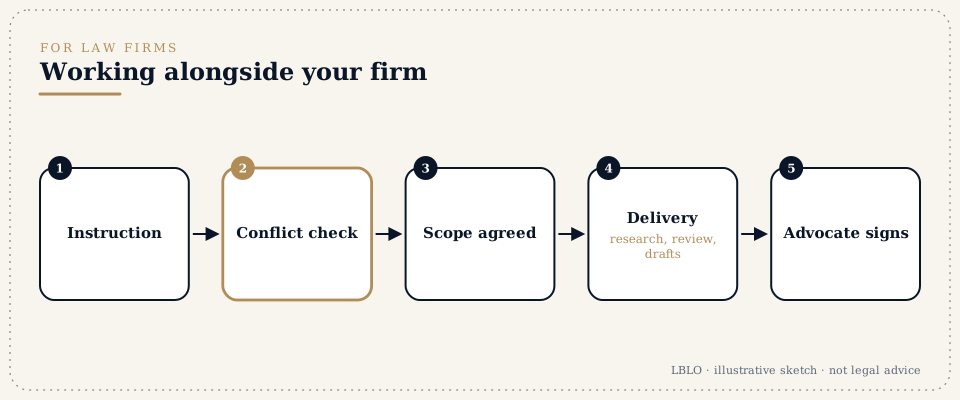
Working with a foreign firm, step by step
- The question. The foreign firm describes the matter, the Indian-law questions, the deadline and the documents. Where the question is wide, LBLO proposes a scope.
- Conflict check and engagement. Before any document is opened, LBLO checks the parties against its existing matters. The engagement letter records who the client is (the foreign firm, or its client), the scope, confidentiality and data handling, the timeline and fees.
- Work and review. The work is prepared by an advocate and checked by a second advocate. Each authority cited is checked against the text of the judgment before it is relied on.
- Delivery. The opinion or memo is delivered in English, with the points needing the client's decision set out clearly. Calls are arranged at times that suit the foreign firm's time zone.
- Proceedings. Where Indian proceedings are needed, LBLO acts as advocate on record or briefs counsel. It keeps the foreign firm informed after each hearing.
Frequently asked questions
Can a judgment from a court abroad be enforced in India?
If it is a money decree of a superior court in a country the Central Government has notified as a reciprocating territory, yes. Under Section 44A of the Code of Civil Procedure, 1908, a certified copy of the decree, with a certificate from that court of the extent to which it has been satisfied, is filed in the District Court and executed as if that court had passed it. Only decrees for a sum of money qualify; sums payable as taxes, fines or penalties, and arbitral awards, are excluded. The judgment debtor may resist execution on any ground in Section 13, such as want of jurisdiction, fraud or a breach of natural justice.
What if the judgment is from a country that is not a reciprocating territory?
It cannot be executed directly. The judgment creditor files a fresh suit in India on the foreign judgment, or on the original cause of action. Under Section 13 of the Code of Civil Procedure, 1908, the foreign judgment is conclusive on any matter it directly decided between the same parties, unless it falls within one of the exceptions in that section, and under Section 14 the court presumes, on production of a certified copy, that it was pronounced by a court of competent jurisdiction. Article 101 of the Schedule to the Limitation Act, 1963 provides three years for a suit upon a judgment, including a foreign judgment, so time should be checked early.
How is a foreign arbitral award enforced in India?
An award made in a country that is a party to the New York Convention and notified by the Central Government is enforced under Part II, Chapter I of the Arbitration and Conciliation Act, 1996, which runs from Section 44 to Section 52. Under Section 47 the applicant produces the award and the arbitration agreement before the High Court with jurisdiction. Enforcement may be refused only on the limited grounds in Section 48, such as want of proper notice, excess of jurisdiction or public policy. Section 49 then deems the award a decree of that court. In Government of India v. Vedanta Ltd. (2020), the Supreme Court applied the three-year period in Article 137 of the Limitation Act, 1963.
Can a foreign lawyer advise or appear in India?
Only advocates enrolled under the Advocates Act, 1961 may practise Indian law: Section 29 recognises advocates as the only class entitled to practise law, and Section 33 bars others from practising in courts and before authorities. The Bar Council of India Rules for Registration and Regulation of Foreign Lawyers and Foreign Law Firms in India, 2022, as amended in 2025, allow a registered foreign lawyer or firm to advise on foreign law, international law and international arbitration, on a non-litigious basis and subject to reciprocity. An unregistered foreign lawyer may visit briefly to advise on foreign law, on a declaration to the Bar Council. None of this permits advice on Indian law or appearance before Indian courts or tribunals.
How are court papers from abroad served on a party in India?
India is a party to the Hague Convention on the Service Abroad of Judicial and Extrajudicial Documents of 1965. Requests from courts in other member countries go to the Central Authority, the Department of Legal Affairs in the Ministry of Law and Justice, which sends them to the court in India within whose area the party is to be served. Under Section 29 of the Code of Civil Procedure, 1908, summonses issued by such foreign courts are served as if issued by an Indian court. India has objected to the alternative channels under Article 10 of the Convention, including service by post, so the Central Authority route is the one to plan for, and it takes time.
Can a court in India grant interim relief in an arbitration seated abroad?
Yes, unless the parties have agreed otherwise. The proviso to Section 2(2) of the Arbitration and Conciliation Act, 1996, inserted by the amendment of 2015, applies Section 9 to an international commercial arbitration even where the place of arbitration is outside India, subject to an agreement to the contrary. An Indian court can therefore be asked for interim measures, such as securing the amount in dispute or preserving assets located in India, before, during or after the arbitral proceedings. Courts have generally required an exclusion of Section 9 to be clear from the agreement; a foreign seat and governing law alone have not always been treated as enough.
Can the Office work under our firm's name, or share fees with us?
No. The Advocates Act, 1961, and the standards of professional conduct framed by the Bar Council of India under Section 49(1)(c) of that Act, govern how an Indian advocate accepts instructions, conducts a matter and is paid. In an Indian proceeding LBLO appears in its own name as counsel of record, on a vakalatnama signed by the client, and is answerable to the court. The engagement letter records the fee agreed in advance, payable to the Office. LBLO does not share fees with non-advocates, and it does not lend its name or its enrolment to work done by others.
Is legal process outsourcing lawful in India?
Yes, within limits. Support work, such as typing, transcription and formatting, can be outsourced to anyone. Work that is in substance the practice of law is different. In Bar Council of India v. A.K. Balaji, 2018 INSC 235, the Supreme Court held that the practice of law "includes litigation as well as non litigation" (para 39). It also held that the label given to an outsourcing service is not conclusive: if the service in substance amounts to the practice of law, the Advocates Act, 1961 applies (para 46). LBLO's outsourced legal work is done by advocates.
Can our firm advise our client on Indian law if one of our partners is Indian?
That depends on whether the partner is enrolled as an advocate in India and on the BCI rules on registration. The safer course is to take Indian-law advice from an enrolled Indian advocate.
Who is LBLO's client: our firm, or our client?
The engagement letter records this, along with confidentiality and how instructions are given.
How is confidentiality handled?
Each matter is kept separate. Access is limited to the team on it, and documents are exchanged by secure means.
These answers are educational summaries; they are not legal advice on any individual matter.
Written instructions, checked first.
Instructions and documents may be sent by email; conferences are by appointment at G-46, Basement, Greater Kailash III, New Delhi, or by video. The principal reads the correspondence.