
Income-Tax and GST Disputes: Notices, Appeals and the GST Appellate Tribunal
Most tax disputes are won or lost at the notice stage.
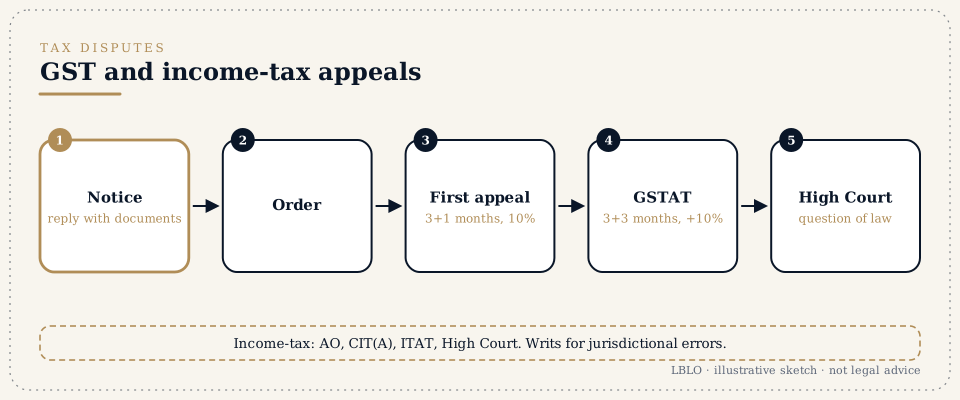
In brief
- Most tax disputes are won or lost at the notice stage. A detailed reply with documents builds the record every appellate forum will read.
- GST appeals:
- First appeal lies to the Appellate Authority within three months of the date the order is communicated, extendable by one month (Section 107). It needs payment in full of the amount admitted and a pre-deposit of 10% of the remaining tax in dispute, up to Rs. 20 crore (Section 107(6)).
- Second appeal lies to the GST Appellate Tribunal (GSTAT) within three months of the date the appellate order is communicated, extendable by three (Section 112), with a further pre-deposit of 10% of the remaining tax in dispute, up to Rs. 20 crore (Section 112(8)). For orders communicated before 01/05/2026 a later notified date applied; see the GST limitation page. GSTAT appeals are filed online.
- Income-tax appeals generally run from the Assessing Officer to the Joint Commissioner (Appeals) or Commissioner (Appeals) (Sections 356 and 357 of the Income-tax Act, 2025; earlier Sections 246 and 246A of the 1961 Act), then the Income Tax Appellate Tribunal (Section 362; earlier Section 253), then the High Court on a substantial question of law (Section 365; earlier Section 260A). The Income-tax Act, 2025 governs from 01/04/2026. Proceedings for tax years beginning before 01/04/2026, including notices, reassessment and appeals, continue under the Income-tax Act, 1961 (Section 536 of the 2025 Act).
- Writs in the High Court are available where an action is without jurisdiction, in breach of natural justice, or where a statutory remedy is not efficacious. Examples are a reassessment notice issued without the statutory conditions (Sections 280 and 281 of the 2025 Act; earlier Sections 148 and 148A), and an order passed without a hearing.
- Customs duty and refund disputes have their own route (see the regulatory writs page), including advance rulings before the Customs Authority for Advance Rulings (CAAR).
Terms you will hear
- Show cause notice (SCN), DRC-01, ASMT-10
- a show cause notice proposes tax, interest and penalty; FORM GST DRC-01 is the summary of it issued on the portal (Rule 142(1), CGST Rules); FORM GST ASMT-10 sets out discrepancies found on scrutiny of returns (Rule 99).
- Input tax credit (ITC)
- credit for GST paid on inputs. Its denial is the most common GST dispute.
- Pre-deposit
- the amount to be paid before an appeal can be filed. Paying it stays recovery of the balance.
- Assessment, reassessment, scrutiny
- the income-tax processes that examine a return.
- Faceless assessment
- assessment conducted online through the income-tax portal, without the assessee dealing with an identified officer in person.
- Demand and stay of demand
- the tax raised, and the order staying its recovery pending appeal.
- Penalty and prosecution
- separate consequences. Each has its own defences.
- Advance ruling
- a binding ruling on a proposed transaction.
In detail
1. Responding to a notice.
Read the notice for:
- the period covered;
- the provision invoked;
- the amount;
- the deadline.
Ask for documents relied on. Seek a personal hearing. File a point-by-point reply with a reconciliation and documents. Keep proof of submission.
2. GST appeals.
Every appeal needs:
- the order;
- the grounds;
- the pre-deposit;
- a condonation application where late.
The GSTAT has a Principal Bench at New Delhi and State Benches across India; appeals are filed and followed on its online portal. An order of a State Bench can be taken to the High Court within 180 days of its receipt, on a substantial question of law only (Section 117). An order of the Principal Bench goes to the Supreme Court (Section 118).
3. Income-tax appeals.
- Commissioner (Appeals): hears facts and law. The appeal is filed within 30 days of service of the notice of demand (Section 358).
- ITAT: the last fact-finding forum. The appeal is filed within two months from the end of the month in which the order is communicated (Section 362).
- High Court: within 120 days of receipt of the ITAT's order, on a substantial question of law only (Section 365). How to count each period is on the income-tax limitation page.
- Stay of demand: where there is a strong case, a stay is sought from the Assessing Officer and then from the higher authorities.
4. Writs.
Reassessment notices, orders passed without considering replies, and attachments of bank accounts are common subjects of writ petitions in the Delhi High Court.
5. Records.
Keep a ledger reconciliation for each GSTIN, the vendor compliance records (for ITC), and copies of every portal submission with its acknowledgement.
Questions people ask
My supplier did not pay GST, and my ITC is being denied. Is that lawful?
It depends on the facts and what you can show: tax invoice, receipt of goods, payment and your returns. This is heavily litigated. A documented reply is essential.
Must I pay 10% to appeal?
Yes. For the first GST appeal you pay the amount you admit and 10% of the remaining tax in dispute, up to Rs. 20 crore; for the GSTAT, a further 10%, also up to Rs. 20 crore. Once paid, recovery of the balance is deemed stayed (Sections 107(7) and 112(9)). Orders under Section 129(3), on detention of goods in transit, have their own pre-deposit rule.
Can I go directly to the High Court?
Where the action is without jurisdiction or in breach of natural justice, yes. Otherwise the court will usually direct you to the appeal.
The deadline in the notice has passed. Is all lost?
No. Reply at once and ask for a hearing. If an order has been passed, consider the appeal with a condonation application.
Is a tax consultant or an advocate better for this?
For replies and appeals, both work together. Writs and High Court appeals are filed and argued by an advocate.
These answers are educational summaries; they are not legal advice on any individual matter.
A serious question deserves a read brief.
Conferences are by appointment at G-46, Basement, Greater Kailash III, New Delhi. The principal reads the correspondence.
This page gives general information about the work of Lokesh Bhardwaj Law Offices, as permitted under the Bar Council of India Rules. It is not legal advice, and it does not create an advocate-client relationship. LBLO acts in a matter only on an engagement agreed in writing.
Law stated as at 15/11/2026.