
Enforcing an Arbitral Award or a Court Decree
An arbitral award or a court decree says what the losing party must pay or do.
In brief
- What it is. An arbitral award or a court decree says what the losing party must pay or do. If it does not comply, the winner (the "decree holder") must ask a court to enforce it. This is called execution.
- Who it concerns. Companies and individuals who hold an award or decree and have not been paid. It also concerns the other side, who may have grounds to resist.
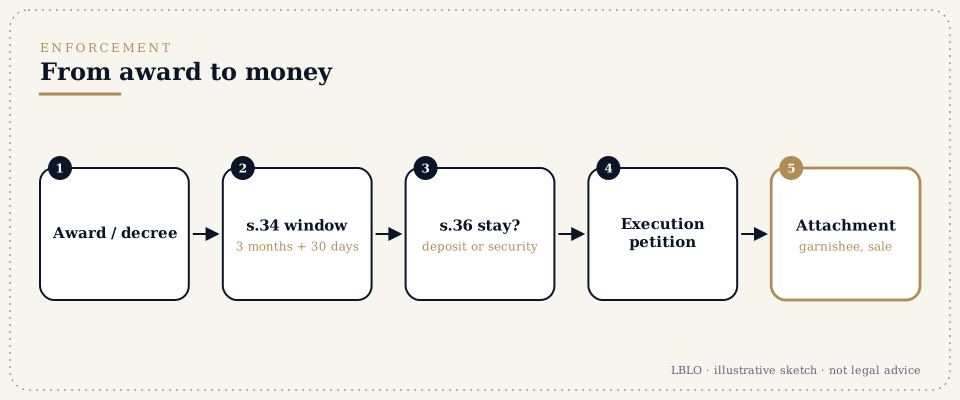
- The basic rule for awards made in India. The losing party gets three months from receiving the award to apply to set it aside. The court can allow 30 more days for sufficient cause, but no more.
- Once that time is over, or the challenge is dismissed, the award can be enforced like a court decree.
- A challenge does not stop enforcement by itself. The losing party must apply separately for a stay, and the court can put conditions on it, such as a deposit of money.
- Foreign awards from countries India recognises can also be enforced in India through a separate procedure.
- The steps, in short:
- check the award and the time limits;
- trace the other side's assets;
- file the execution petition;
- ask for disclosure of assets on affidavit;
- attach bank accounts, property and receivables;
- have the property sold or the money paid over.
- Keep ready:
- the award or decree;
- proof of the date it was received;
- the agreement;
- any order on a challenge;
- everything you know about the other side's bank accounts, property, customers and group companies.
Terms you will hear
- Award holder and award debtor
- the winner and the loser of the arbitration.
- Seat
- the legal home of the arbitration. It decides which court supervises.
- Section 34 challenge
- the application to set an award aside. It must be filed within three months, plus 30 days at most.
- Section 36 stay
- filing a challenge does not stay the award automatically. A stay needs an order, usually on deposit or security.
- Execution petition
- the proceeding to enforce an award as if it were a decree.
- Garnishee order
- an order directing a third party, such as a bank, to pay money owed to the debtor.
- Attachment and sale
- freezing, then selling, the debtor's property.
- Disclosure affidavit
- a debtor's sworn statement of its assets, which the court can order.
In detail
Step 1: Confirm that the award can be enforced
The first question is timing. Under the Arbitration and Conciliation Act, 1996, a challenge to an Indian award must be filed within three months of receiving it. The court may allow a further 30 days if sufficient cause is shown, and not beyond that.
Once that period ends without a challenge, or a challenge is dismissed, the award becomes enforceable under the Code of Civil Procedure, 1908, as if it were a court decree. Filing a challenge does not, on its own, make the award unenforceable. The losing party must apply separately for a stay, and the court decides whether to grant one and on what terms. A money award is commonly stayed only on deposit or security.
For a foreign award, the Act has a separate procedure under which the Indian court first decides whether the award can be enforced in India. The grounds on which enforcement can be refused are limited.
Step 2: Trace the assets before filing
An execution petition is only as good as the assets it can reach. Before filing, LBLO collects whatever is publicly available:
- company filings with the Ministry of Corporate Affairs, including charges registered on assets;
- property records;
- court records of other cases;
- known bank relationships;
- the debtor's customers and contracts;
- group companies.
Step 3: File the execution petition
The petition goes to the court that has jurisdiction over the assets or the debtor. It sets out the amount due with interest as awarded, and the assets to be proceeded against.
Step 4: Disclosure of assets on affidavit
Where the assets are not fully known, the court can direct the judgment debtor to disclose its assets on affidavit. A false or incomplete affidavit has serious consequences of its own. This step often produces payment.
Step 5: Attachment and sale
The court can:
- attach bank accounts, immovable property, shares and money owed to the debtor by third parties ("garnishee" orders);
- have attached property sold;
- in appropriate cases, order arrest or detention of the person responsible.
Each step needs its own application and hearing.
Step 6: Payment, and closing the record
Money deposited in court or recovered from third parties is released to the decree holder. The record of satisfaction is then entered.
Common mistakes
- Waiting too long to start, which gives assets time to be moved.
- Filing without an asset map, so the petition has nothing to bite on.
- Ignoring group companies and related parties to whom assets may have been shifted.
- Not opposing a stay application firmly, or not insisting on a deposit as a condition of any stay.
How LBLO handles enforcement
- Each stage is planned in advance: asset tracing, filing, disclosure, attachment and sale.
- The engagement letter agrees the work stage by stage.
- The client is told after every hearing what was ordered and what comes next.
- Where the debtor is resisting a challenge to the award at the same time, both proceedings are run together.
Questions people ask
The other side has challenged the award. Can I still enforce it?
The challenge alone does not stop enforcement. The other side must obtain a stay from the court, which can impose conditions such as depositing the awarded amount.
I have a foreign award. Can it be enforced in India?
If the award is from a country that India recognises for this purpose, the Indian court first decides whether it is enforceable. Once that is decided, it is enforced like a decree.
How long does execution take?
It depends on how quickly the assets are found and how strongly the debtor resists. Disclosure on affidavit and attachment of bank accounts usually move faster than sale of immovable property.
Can I recover from the debtor's directors personally?
Ordinarily an award binds only the parties to it. Proceeding against directors or group companies needs specific grounds, and this is assessed on the facts.
These answers are educational summaries; they are not legal advice on any individual matter.
A serious question deserves a read brief.
Conferences are by appointment at G-46, Basement, Greater Kailash III, New Delhi. The principal reads the correspondence.
This page gives general information about the work of Lokesh Bhardwaj Law Offices, as permitted under the Bar Council of India Rules. It is not legal advice, and it does not create an advocate-client relationship. LBLO acts in a matter only on an engagement agreed in writing.
Last reviewed: 14/11/2026. Lokesh Bhardwaj Law Offices.
Law stated as at 14/11/2026.