
Insolvency Before NCLT and NCLAT: Creditors, Promoters and Bidders
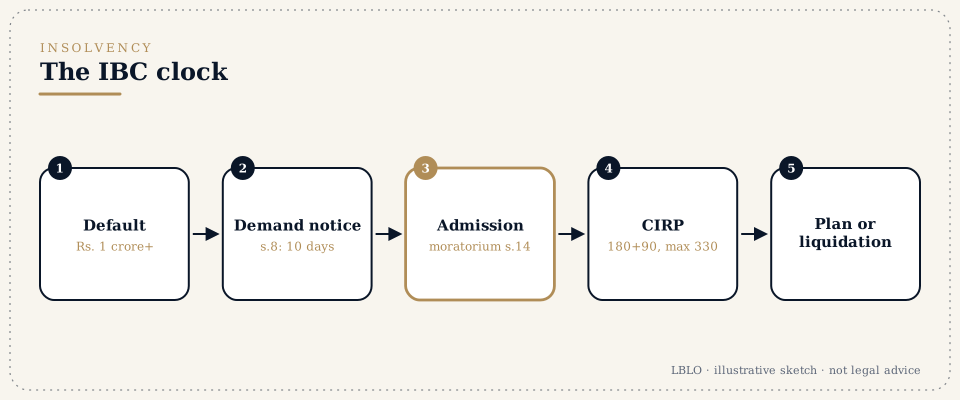
When a company defaults on a debt of Rs. 1 crore or more, a creditor can apply to the National Company Law Tribunal (NCLT) to start a corporate insolvency resolution process (CIRP).
In brief
- What it is. When a company defaults on a debt of Rs. 1 crore or more, a creditor can apply to the National Company Law Tribunal (NCLT) to start a corporate insolvency resolution process (CIRP).
- Two kinds of creditor:
- Financial creditors (banks, lenders, bondholders) can apply directly on default.
- Operational creditors (suppliers, service providers, employees) must first send a demand notice. If the company does not pay, or raise a genuine existing dispute, within 10 days, they can apply.
- On admission:
- a moratorium begins: suits, recovery and enforcement against the company stop;
- an interim resolution professional takes over management;
- the committee of creditors decides the company's future.
- Time limit. The process is to be completed within 180 days, extendable by 90 days, with an outer limit of 330 days including time spent in litigation. If no resolution plan is approved, the company goes into liquidation.
- Appeal. Orders of the NCLT can be appealed to the NCLAT, and then to the Supreme Court.
- Who it concerns:
- creditors filing petitions and claims;
- companies and promoters defending petitions;
- resolution applicants (bidders).
- Keep ready:
- loan or supply agreements;
- invoices and ledgers;
- the demand notice and the reply;
- proof of default;
- for a defence, proof of a dispute that existed before the notice.
Terms you will hear
- Corporate debtor, financial creditor, operational creditor
- the company, its lenders, and its suppliers or employees.
- Default threshold
- the minimum default for starting the process, Rs. 1 crore.
- Section 8 demand notice
- the operational creditor's notice. The debtor has 10 days to pay or show a pre-existing dispute.
- Admission, moratorium (Section 14)
- the start of the process, and the freeze on suits and recovery.
- IRP and RP
- the interim resolution professional and the resolution professional, who run the company during the process.
- Committee of Creditors (CoC)
- the financial creditors who vote on the plan.
- Resolution plan and resolution applicant
- the bid to revive the company, and the bidder.
- 180 plus 90 days, 330 days
- the process timeline and its outer limit.
- Liquidation
- sale of assets if no plan is approved.
In detail
Step 1: Is the IBC the right route?
- Threshold. The minimum default is Rs. 1 crore.
- What the IBC is for. It is a resolution process, not a recovery suit. Once a company is admitted, all creditors are affected.
- The alternatives. A creditor who only wants payment may do better with a commercial suit or arbitration. Insolvency is the right tool where the company is genuinely unable to pay, or where a credible petition is likely to produce settlement.
Step 2: The application
- Financial creditor (Section 7). Proof of the financial debt and of default is filed, with the record of default where available.
- Operational creditor (Sections 8 and 9).
- A demand notice or invoice is delivered.
- The company has 10 days to pay or to point to an existing dispute.
- If it does neither, the application is filed.
Step 3: The defence
| Petition | Defences that commonly arise |
|---|---|
| Operational creditor | A real dispute that existed before the demand notice, for example over quality, short supply or set-off. The NCLT rejects the application where such a dispute is shown |
| Financial creditor | Whether there is a financial debt at all, whether default has occurred, and limitation |
Either kind of petition can also be met by a settlement before admission.
Step 4: After admission
- The moratorium takes effect.
- A public announcement invites claims.
- The committee of creditors is formed.
- The resolution professional invites resolution plans.
Promoters may be barred from bidding by the eligibility rules in Section 29A of the Code, which must be checked early.
Step 5: Claims and resolution plans
Creditors must file claims on time with supporting documents. Resolution applicants must meet eligibility conditions and submit plans that the committee evaluates. Disputes over the admission of claims and over plan approval go to the NCLT.
Step 6: Appeal
NCLT orders can be appealed to the NCLAT within the time the Code allows, and from there to the Supreme Court on questions of law.
Common mistakes
- For operational creditors:
- sending a defective demand notice;
- filing when there is an obvious prior dispute.
- For companies:
- raising a dispute for the first time only after the notice arrives;
- ignoring the notice altogether.
- For creditors after admission: filing claims late or without supporting documents.
- For promoters: not checking bidding eligibility in time.
How LBLO handles insolvency matters
- Before filing, the strength of the petition and the alternatives (suit, arbitration, settlement) are assessed.
- On a defence, the record of the earlier dispute is assembled first, because it often decides admission.
- After admission, claims, objections and appeals are tracked against the Code's timelines.
Questions people ask
A supplier has sent us an IBC demand notice. What should we do?
Reply within 10 days. If there is a genuine dispute that existed before the notice, set it out with documents. Silence can lead to admission.
Can we settle after the petition is filed?
Yes. Settlement is possible before admission. After admission, withdrawal needs the approval the Code requires.
Does admission mean the company will be closed?
No. The aim is resolution through a plan approved by creditors. Liquidation follows if no plan is approved in time, if the plan is rejected, or if the committee of creditors resolves to liquidate.
These answers are educational summaries; they are not legal advice on any individual matter.
A serious question deserves a read brief.
Conferences are by appointment at G-46, Basement, Greater Kailash III, New Delhi. The principal reads the correspondence.
This page gives general information about the work of Lokesh Bhardwaj Law Offices, as permitted under the Bar Council of India Rules. It is not legal advice, and it does not create an advocate-client relationship. LBLO acts in a matter only on an engagement agreed in writing.
Last reviewed: 14/11/2026. Lokesh Bhardwaj Law Offices.
Law stated as at 14/11/2026.