
Enforcing Foreign Judgments and Arbitral Awards in India
A foreign company that wins against an Indian party abroad must still enforce in India if the assets are here. The route depends on where the judgment or award was made.
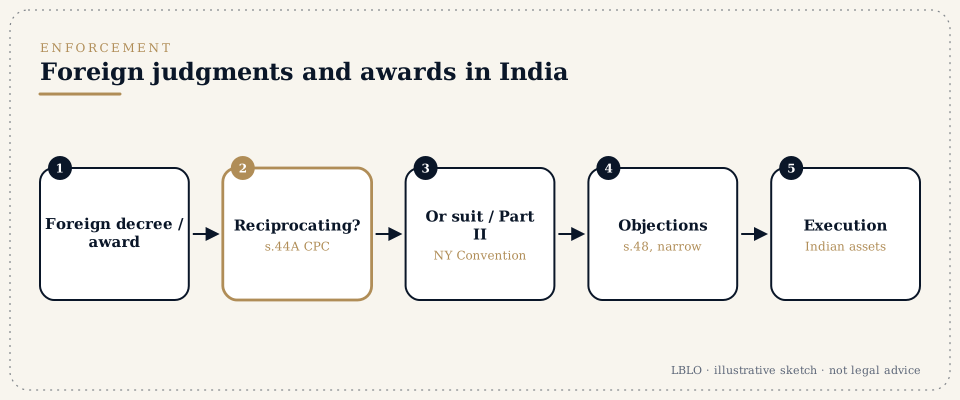
In brief
- Foreign court judgments: reciprocating territories.
- A decree of a superior court in a "reciprocating territory" notified by India under Section 44A of the Code of Civil Procedure, 1908 can be executed directly in India, as if it were an Indian decree.
- The notified territories include the United Kingdom, Singapore and, since January 2020, the United Arab Emirates.
- Foreign court judgments: other countries.
- A judgment from a country that is not a reciprocating territory, such as the United States, cannot be executed directly.
- The holder must file a suit in India on the judgment.
- In both routes the judgment must not fall within the exceptions in Section 13 of the Code, for example lack of jurisdiction, fraud, or a breach of natural justice.
- Foreign arbitral awards.
- An award made in a country that India has notified under the New York Convention is enforced under Part II of the Arbitration and Conciliation Act, 1996.
- The Indian court first decides whether the award is enforceable, on limited grounds. It is then executed as a decree.
- The steps, in short:
- check the route;
- obtain certified copies, with translations where needed;
- trace assets in India;
- file the execution petition, suit or enforcement petition;
- meet any objections;
- attach and realise assets.
- Keep ready:
- the judgment or award;
- certified copies;
- the arbitration agreement;
- proof of service on the Indian party;
- information on the Indian party's assets.
Terms you will hear
- Reciprocating territory (Section 44A CPC)
- countries whose superior court decrees can be executed directly. Examples include the UK, Singapore, the UAE and others. The US is not one.
- Suit on a foreign judgment
- the route for non-reciprocating countries.
- New York Convention award
- a foreign award from a notified country, enforceable under Part II of the Arbitration Act.
- Section 48 grounds
- the limited grounds to refuse enforcement of a foreign award.
- Public policy of India
- a narrow ground, confined to fraud or corruption in the making of the award, conflict with the fundamental policy of Indian law, and conflict with the most basic notions of morality or justice.
- Execution
- attachment of the debtor's Indian assets after the award is held enforceable.
In detail
Step 1: Identify the route
Check three things:
- whether the foreign court is a superior court of a notified reciprocating territory;
- whether an award was made in a notified Convention country;
- where the assets are.
The list of territories can change, so it is confirmed at the time of filing.
Step 2: Prepare the papers
The execution application or petition needs the certified copy of the judgment or award. For a decree of a reciprocating territory, a certificate from the foreign court of the amount satisfied is also needed. Translations are prepared where needed.
Step 3: Objections
The Indian party may raise the grounds the law allows:
- under Section 13 of the Code, for judgments;
- the limited grounds in the Arbitration Act, for awards.
The Indian court does not re-hear the merits.
Step 4: Execution
Once enforceability is established, execution follows: disclosure of assets on affidavit, attachment, sale and payment. The page on enforcing an arbitral award or a court decree describes each step.
Common mistakes
- Choosing a court in a country that is not a reciprocating territory, without realising this means a fresh suit in India.
- Delay in starting enforcement while assets are moved.
- Incomplete certified copies or translations.
Questions people ask
Can a US court judgment be enforced in India?
Not by direct execution, because the US is not a notified reciprocating territory. A suit on the judgment can be filed in India.
Is a Singapore arbitration award enforceable in India?
An award made in a notified New York Convention country is enforceable under Part II of the Arbitration Act, subject to the limited grounds of refusal.
Will the Indian court review the merits?
No. It examines only the grounds the law allows.
These answers are educational summaries; they are not legal advice on any individual matter.
A serious question deserves a read brief.
Conferences are by appointment at G-46, Basement, Greater Kailash III, New Delhi. The principal reads the correspondence.
This page gives general information about the work of Lokesh Bhardwaj Law Offices, as permitted under the Bar Council of India Rules. It is not legal advice, and it does not create an advocate-client relationship. LBLO acts in a matter only on an engagement agreed in writing.
Last reviewed: 14/11/2026. Lokesh Bhardwaj Law Offices.
Law stated as at 14/11/2026.