
Offices, Plants and Land: Property for a Foreign-Owned Business
A foreign business in India needs premises. This page explains who can own or lease property in India, and what must be checked first.
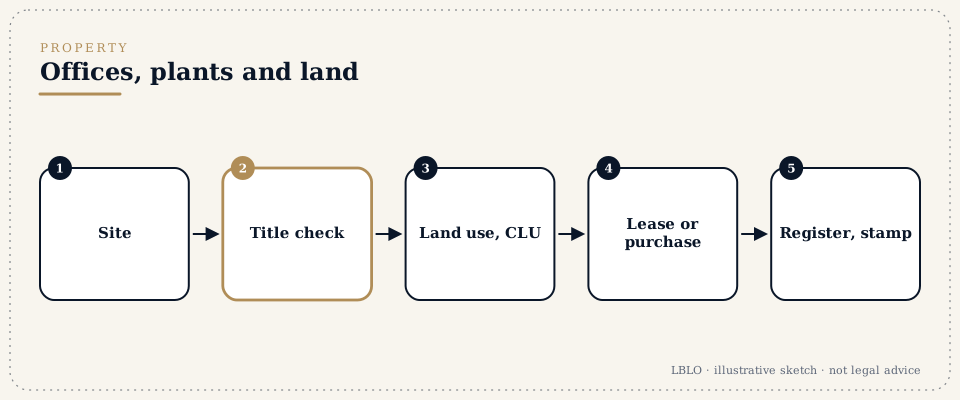
In brief
- Who can acquire property:
- An Indian company with foreign shareholding can acquire and lease property for its business, like any Indian company, subject to the FDI rules for the sector.
- A branch or project office of a foreign company may acquire immovable property necessary for, or incidental to, its permitted activity. The acquisition is reported to the RBI.
- A liaison office may not acquire immovable property.
- Agricultural land, plantation property and farmhouses cannot be acquired by a person resident outside India, other than by inheritance.
- Dealing in real estate as a business, meaning trading in land, is not open to foreign investment.
- Leases are the usual route for offices. Long leases must be registered and stamped.
- Industrial land usually comes through State industrial development authorities or industrial parks. Each has its own allotment conditions, building timelines and restrictions on transfer.
- What is checked:
- title;
- land-use permission;
- building approvals and occupancy certificates;
- environmental and fire clearances for plants;
- dues to the authority;
- pending cases;
- mortgages.
- The steps, in short:
- shortlist;
- title and regulatory due diligence;
- term sheet;
- agreement or lease;
- stamp duty and registration;
- mutation or the authority's record;
- post-completion compliance.
- Keep ready:
- the property details;
- the seller's or landlord's documents;
- the proposed use;
- for industrial plots, the authority's allotment terms.
Terms you will hear
- Leasehold and freehold
- occupation for a term, or full ownership.
- Industrial plot allotment
- a lease from a development authority, on its conditions.
- Change of land use (CLU)
- permission to use agricultural land for other purposes.
- Title search, encumbrance certificate
- the history of ownership, and the charges on it.
- Stamp duty and registration
- payable on sale and lease deeds.
- Foreign ownership of immovable property
- subject to the foreign exchange rules. Agricultural land is generally barred.
In detail
Step 1: Choose the holding vehicle
For most foreign groups, the Indian subsidiary holds or leases the property. A branch office may acquire property only for its permitted activity. The vehicle is decided before the search begins.
Step 2: Due diligence
Title is checked through the chain of documents and the revenue and registration records. The full process is on the Property Title Verification and Due Diligence page.
For commercial and industrial property, also check:
- land-use permission;
- sanctioned plans;
- occupancy certificates;
- fire and pollution approvals;
- the authority's dues and its consent to transfer.
Step 3: The lease or purchase
A lease covers:
- the term;
- rent and escalation;
- lock-in;
- fit-out;
- maintenance;
- restoration;
- termination;
- what happens on sale of the building.
A purchase uses an agreement to sell, and the sale is completed by a registered sale deed.
Step 4: Stamp duty and registration
Stamp duty and registration charges depend on the State. Leases above the statutory term must be registered. An unregistered lease that ought to have been registered can fail to protect the tenant.
Step 5: After completion
The new owner or lessee is entered in the municipal or authority records. Utilities are transferred. Reporting obligations are completed.
Common mistakes
- Signing a lease without checking the landlord's title or the building's occupancy certificate.
- Industrial plots bought without checking the authority's transfer conditions.
- Not registering a long lease.
- Buying through a vehicle that FEMA does not permit to hold the property.
Questions people ask
Can our liaison office buy an office?
No. A liaison office cannot acquire immovable property. It may lease premises.
Can our Indian subsidiary buy agricultural land for a plant?
Agricultural land generally needs conversion to industrial use under State law. Foreign-owned entities face restrictions on agricultural land. This is checked case by case.
How long should an office lease be?
That is commercial, but the lock-in, renewal and exit terms matter as much as the length.
These answers are educational summaries; they are not legal advice on any individual matter.
A serious question deserves a read brief.
Conferences are by appointment at G-46, Basement, Greater Kailash III, New Delhi. The principal reads the correspondence.
This page gives general information about the work of Lokesh Bhardwaj Law Offices, as permitted under the Bar Council of India Rules. It is not legal advice, and it does not create an advocate-client relationship. LBLO acts in a matter only on an engagement agreed in writing.
Last reviewed: 14/11/2026. Lokesh Bhardwaj Law Offices.
Law stated as at 14/11/2026.