
Personal Data under India's DPDP Act: What Foreign Companies Must Do
Any company processing the digital personal data of people in India, whether from India or from abroad in connection with offering goods or services in India, must plan for the Digital Personal Data Protection Act, 2023.
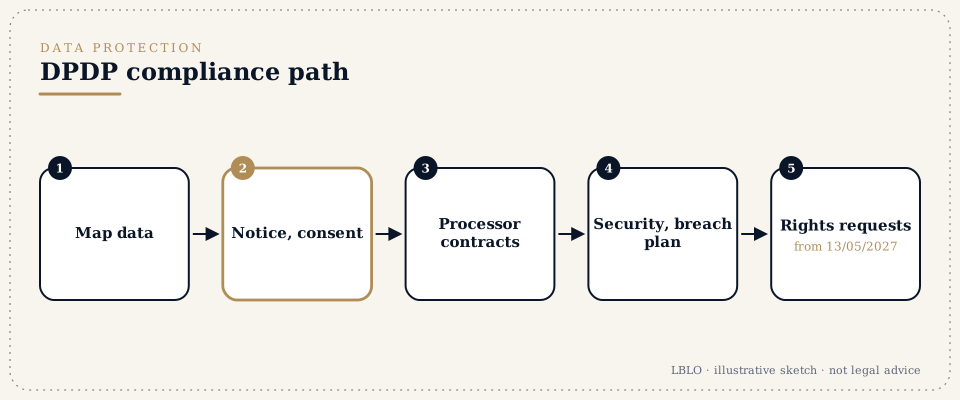
In brief
- The law. The Digital Personal Data Protection Act, 2023 (DPDP Act) and the DPDP Rules, 2025, notified on 13/11/2025. The main obligations apply from 13/05/2027.
- Who it applies to:
- Data fiduciaries decide why and how personal data is processed.
- Data processors process it on a fiduciary's behalf. A processor is bound through its contract with the fiduciary.
- Some fiduciaries may be designated "significant data fiduciaries", with extra duties.
- What a fiduciary must do:
- give a clear notice;
- obtain valid consent, or rely on a permitted legitimate use;
- keep data secure;
- report breaches;
- honour the rights of data principals (access, correction, erasure, grievance);
- erase data when its purpose is served;
- handle children's data with verifiable parental consent.
- Transfers abroad. Transfer outside India is permitted except to countries the Government restricts by notification, subject to the conditions in the Rules. Sector regulators may impose stricter rules.
- Penalties. Up to Rs. 250 crore for failing to take reasonable security safeguards. Up to Rs. 200 crore for failing to notify a breach or for breaches involving children's data. Lower ceilings apply to other breaches.
- The steps, in short:
- map the data;
- decide the role (fiduciary or processor);
- write notices and consent flows;
- put processor contracts in place;
- set security and breach procedures;
- set up a rights and grievance process;
- set retention schedules;
- train staff.
- Keep ready:
- a list of the personal data the company collects;
- where it is stored and who it is shared with;
- existing privacy policies and vendor contracts.
Terms you will hear
- Data fiduciary and data processor
- the business that decides why and how data is processed, and the vendor that processes it.
- Data principal
- the individual whose data it is.
- Consent and notice
- the core basis for processing, with a clear notice.
- Consent manager
- a registered intermediary that manages consents.
- Significant data fiduciary
- a business notified for higher obligations, such as audits and impact assessments.
- Personal data breach
- must be reported to the Board and the affected individuals.
- Data Protection Board
- the adjudicating body, with penalty powers.
In detail
Step 1: Map the data
Prepare a register recording:
- what personal data is collected;
- from whom and for what purpose;
- where it is stored, inside or outside India;
- which vendors receive it;
- how long it is kept.
Step 2: Decide the role
A group company providing services to Indian customers is usually a fiduciary. An Indian service centre processing data for its foreign parent may be a processor. The contracts between group companies record this.
Step 3: Notice and consent
The notice is written in clear language and is available in the languages the Act provides for. It sets out:
- the data collected;
- the purpose;
- how to withdraw consent;
- how to complain.
Consent must be free, specific, informed, unconditional and unambiguous, with a clear affirmative action (Section 6(1)).
Step 4: Processor contracts
Every vendor that processes personal data signs a contract that covers:
- security;
- confidentiality;
- sub-processing;
- breach notification;
- deletion at the end of the engagement.
Step 5: Security and breaches
Reasonable security safeguards are documented. A breach response plan covers containment, assessment, and notification to the Data Protection Board and to the affected persons as the Rules require.
Step 6: Rights, grievances and retention
A process handles requests for access, correction and erasure, and grievances. Data is erased once its purpose is served and the retention period ends.
Common mistakes
- Copying a GDPR policy without adapting it to Indian requirements.
- No contracts with vendors.
- Keeping data indefinitely.
- No breach plan.
Questions people ask
We are already GDPR-compliant. Is that enough?
It is a good base, but the DPDP Act has its own notice, consent, children's data and breach requirements.
Can we keep Indian customers' data on servers abroad?
Generally yes, unless the destination country is restricted by notification, or a sector regulator requires data to be kept in India.
When do we have to comply?
Most operative obligations apply from 13/05/2027. Preparation takes months, so it should start now.
These answers are educational summaries; they are not legal advice on any individual matter.
A serious question deserves a read brief.
Conferences are by appointment at G-46, Basement, Greater Kailash III, New Delhi. The principal reads the correspondence.
This page gives general information about the work of Lokesh Bhardwaj Law Offices, as permitted under the Bar Council of India Rules. It is not legal advice, and it does not create an advocate-client relationship. LBLO acts in a matter only on an engagement agreed in writing.
Law stated as at 14/11/2026.