
Building and Deploying AI in India: The Legal Checklist
Whether a company builds an AI product or uses one in its business, the same legal questions come up. This page sets them out in order.
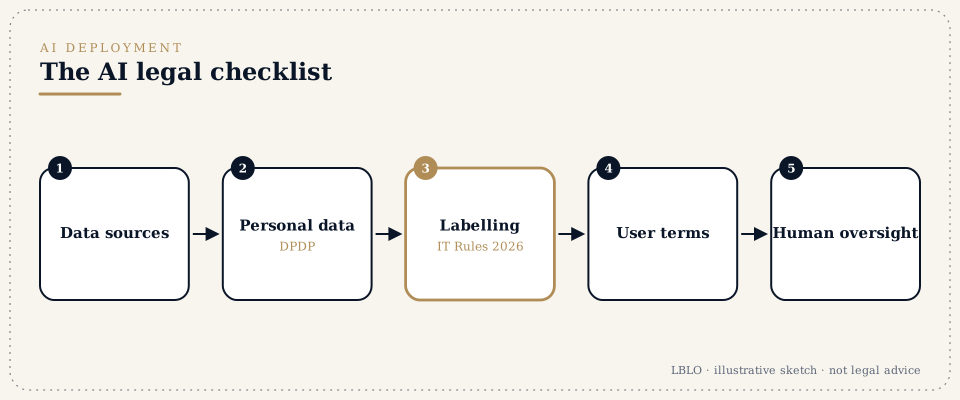
In brief
- No AI-specific law yet, but many laws apply:
- IT Act and IT Rules. Since the amendment in force from 20/02/2026, the IT Rules define "synthetically generated information" (audio, images and video made or altered so that they appear real) and impose labelling and takedown duties on intermediaries that host or enable it.
- DPDP Act. Personal data used for training or in prompts must be handled lawfully. Most obligations apply from 13/05/2027.
- Copyright. Training data and outputs raise copyright questions (see Article 2).
- Consumer protection. Misleading claims about what an AI product does, and defective services.
- Sector rules. Banking, insurance, health, telecom and securities regulators have their own expectations.
- What a company needs in place:
- a map of its data sources and their rights;
- customer terms that set out what the AI does and does not do;
- data processing terms;
- an internal AI-use policy;
- human review for consequential decisions;
- a plan for incidents and complaints.
- For platforms: due diligence on synthetic content, labelling, and takedown within the timelines the IT Rules now set.
- The steps, in short:
- classify the AI use;
- map data and rights;
- review the law that applies;
- draft contracts and policies;
- set up governance and records;
- review again as the rules change.
- Keep ready:
- a description of the product or use;
- the data sources;
- the model providers and their terms;
- the customer contracts;
- existing privacy and security policies.
Terms you will hear
- Training data
- the data used to build a model. Its source and consent status matter.
- Model and deployer
- the AI system, and the business using it with customers.
- Labelling of synthetic content
- visible labels on AI-generated material where the rules require.
- Personal data in prompts and outputs
- this falls under the DPDP Act.
- Terms of use and acceptable use policy
- the contract with users.
- Human oversight
- a person who can review AI decisions, especially in high-impact uses.
In detail
Step 1: Classify the use
Is the company:
- building a model;
- building an application on a third-party model;
- deploying an AI tool inside its business;
- running a platform where users create content with AI?
Each carries a different mix of duties.
Step 2: Data and rights
For each source of training or input data, record:
- who owns it;
- under what licence it was obtained;
- whether it contains personal data;
- whether its terms allow AI use.
Scraped data and customer data need particular care.
Step 3: The law that applies
- The IT Rules, as amended in 2026. These bring synthetically generated information within the intermediary framework. They require labelling, and they shorten takedown timelines.
- The DPDP Act. It governs personal data in training sets and prompts.
- Sector regulation. A lender or insurer using AI in decisions about customers must meet its regulator's expectations on fairness and explanation.
Step 4: Contracts
- Customer terms describe the service, its limits and the customer's responsibilities. They allocate liability and deal with ownership of outputs.
- Model-provider terms are reviewed for:
- data use;
- confidentiality;
- indemnities;
- service levels.
- Employees and contractors assign their rights in what they build.
Step 5: Governance
A written AI-use policy covers:
- approved tools;
- data that must not be entered;
- review of outputs;
- record-keeping.
Decisions that significantly affect people are reviewed by a human.
Common mistakes
- Assuming that public data is free to use.
- No contract with the model provider on how prompts and data are used.
- Customer terms that promise accuracy the system cannot deliver.
- No internal policy on staff use of AI tools.
Questions people ask
Does India require a licence to deploy AI?
There is no general AI licence. Sector regulators and the IT Rules impose specific duties.
Do we have to label AI-generated content?
Intermediaries that host or enable synthetic content have labelling duties under the amended IT Rules. Other businesses should consider labelling to avoid misleading users.
Can we train on our customers' data?
Only if the contract and the data protection law permit it. Personal data needs a lawful basis and a notice.
These answers are educational summaries; they are not legal advice on any individual matter.
A serious question deserves a read brief.
Conferences are by appointment at G-46, Basement, Greater Kailash III, New Delhi. The principal reads the correspondence.
This page gives general information about the work of Lokesh Bhardwaj Law Offices, as permitted under the Bar Council of India Rules. It is not legal advice, and it does not create an advocate-client relationship. LBLO acts in a matter only on an engagement agreed in writing.
Law stated as at 14/11/2026.