
Technology, Robotics and Energy: The Legal Work Behind India's Next Industries
Artificial intelligence, robotics and the energy to power them are three of the fastest-moving areas of Indian business. This page explains the legal questions each raises, and links to a detailed page on each.
In brief
- India has no single AI statute yet. AI is regulated through existing laws:
- the Information Technology Act, 2000 and the IT Rules (amended in 2026 to cover AI-generated content);
- the Digital Personal Data Protection Act, 2023;
- copyright and patent law;
- consumer protection law;
- sector regulators.
- Robots and industrial machinery imported or sold in India need BIS certification where a quality control order or technical regulation covers the product. The Machinery and Electrical Equipment Safety (Omnibus Technical Regulation) Order, 2024, which was to make certification compulsory for a wide range of machinery, was withdrawn by the Ministry of Heavy Industries in January 2026. Machinery also faces customs classification and product liability.
- Energy demand is rising with AI. India's data-centre capacity has grown several times over since 2020. Rules on green open access, storage, green hydrogen and now private nuclear power (the SHANTI Act) shape how that demand is met.
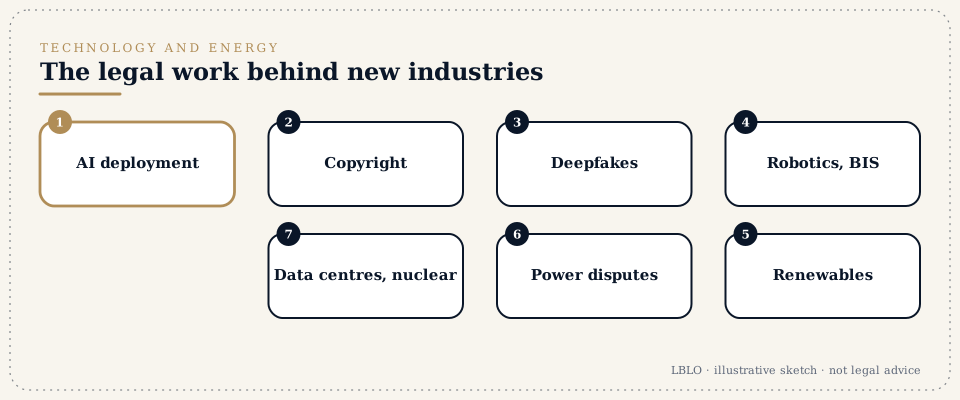
- The pages in this series:
- Building and deploying AI in India: the legal checklist
- AI, copyright and ownership of what AI produces
- Deepfakes and AI misuse: remedies for individuals and companies
- Importing and selling robots and machinery: BIS certification and customs
- When machines fail: liability, warranties and safety
- Renewable power for businesses: open access, captive and rooftop
- Power-sector disputes: regulatory commissions, APTEL and the Supreme Court
- Data centres, nuclear and new energy: approvals and contracts
- Who these pages are for:
- AI and software companies;
- businesses deploying AI;
- media and content owners;
- robot and machinery makers, importers and system integrators;
- renewable developers;
- commercial and industrial power users;
- data-centre builders;
- the investors behind all of them.
In detail
How the three sectors connect
An AI company needs:
- contracts for data, models and customers;
- a plan for personal data;
- clarity on who owns its outputs.
A robot maker needs:
- certification before its machines can be imported or sold;
- contracts that allocate liability when something goes wrong.
Both depend on reliable power, and data centres in particular need long-term power supply, land, approvals and grid connectivity. Disputes and approvals in these sectors come before:
- the Delhi High Court on technology and intellectual property;
- TDSAT on telecom and digital infrastructure;
- the electricity regulators and APTEL on power;
- customs authorities on imports.
Frequently asked questions
Do I need to meet in person?
No. A first conference can be held by video, and a matter can be conducted entirely by email and video conference. Original documents are needed only where a court or authority requires them, and the Office tells the client in advance when that is.
Can I instruct the Office from abroad?
Yes. Papers are sent by email or secure upload, conferences are held by video, and a vakalatnama can be signed abroad and couriered. Where an affidavit is needed, it can be sworn before a notary or an Indian consular officer, as the case requires.
Is the first conversation confidential?
Yes. What a prospective client tells the Office in seeking advice is treated as confidential whether or not the matter is taken. For that reason the Office asks for only the names of the parties and a short description until the conflict check is complete.
Will I know the fee before work begins?
Yes. The basis of fees, whether fixed, stage-wise, retainer or hourly, is agreed in writing in the engagement letter before work begins, together with what it includes and which disbursements are billed at cost.
These answers are educational summaries; they are not legal advice on any individual matter.
A serious question deserves a read brief.
Conferences are by appointment at G-46, Basement, Greater Kailash III, New Delhi. The principal reads the correspondence.
This page gives general information about the work of Lokesh Bhardwaj Law Offices, as permitted under the Bar Council of India Rules. It is not legal advice, and it does not create an advocate-client relationship. LBLO acts in a matter only on an engagement agreed in writing.
Law stated as at 14/11/2026.