
Renewable Power for Businesses: Open Access, Captive and Rooftop
Commercial and industrial users can now buy green power directly, generate it themselves, or install it on site. This page explains each route and the agreements behind it.
In brief
- Green energy open access. Under the Electricity (Promoting Renewable Energy Through Green Energy Open Access) Rules, 2022, a consumer with a contract demand or sanctioned load of 100 kW or more can buy green power through open access. The 100 kW can be one connection, or several connections in the same electricity division of the distribution licensee. The earlier general threshold was 1 MW.
- State regulations decide the details. Each State Electricity Regulatory Commission frames the charges, banking and procedure. Some States add conditions.
- Captive generation. A consumer that holds the ownership and consumption share the rules require can take power from a captive plant. Group captive structures need careful documentation.
- Rooftop and on-site solar is governed by State net-metering or gross-metering regulations.
- The main agreements:
- the power purchase agreement (PPA);
- shareholder agreements for captive structures;
- land or rooftop leases;
- connectivity and open access approvals;
- EPC and operation and maintenance contracts.
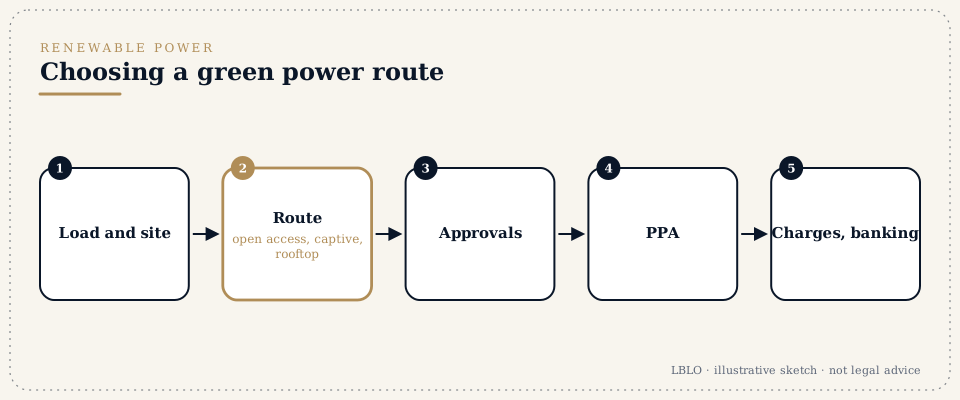
- The steps, in short:
- check eligibility and State regulations;
- choose the route;
- term sheet with the developer;
- PPA and related agreements;
- open access or connectivity application;
- commissioning;
- billing and compliance;
- disputes before the State Commission where needed.
- Keep ready:
- the electricity bills and sanctioned load;
- the locations of the facilities;
- consumption data;
- the developer's term sheet.
Terms you will hear
- Green energy open access
- buying renewable power from a threshold of 100 kW under the 2022 Rules.
- Captive generation
- a plant in which the consumer holds the ownership share, and takes the share of the output, that the Electricity Rules, 2005 require.
- Group captive
- several consumers jointly owning a plant.
- Rooftop and net metering
- on-site generation, with exported power credited.
- Cross-subsidy surcharge and additional surcharge
- the charges payable on open access power.
- Banking
- storing surplus power with the grid for later use, on terms.
In detail
Step 1: Eligibility and the State position
The consumer's load and the State's regulations under the Green Energy Open Access Rules decide:
- whether open access is available;
- the charges (cross-subsidy surcharge, additional surcharge, wheeling and banking);
- the procedure.
Step 2: Choosing the route
| Route | Main advantages | Main points to watch |
|---|---|---|
| Third-party open access | No capital investment | Charges, and changes in State rules |
| Group captive | Lower charges where captive status is maintained | Ownership and consumption tests must be met every year |
| Rooftop or on-site | Lower grid charges | Space, and metering regulations |
Step 3: The PPA
A PPA should cover:
- tariff and escalation;
- term;
- minimum offtake;
- change in law (who bears new charges or duties);
- curtailment;
- payment security;
- termination and compensation;
- dispute resolution.
Step 4: Approvals and commissioning
The open access application, metering, connectivity and the commissioning certificate are tracked against the State's timelines.
Step 5: Disputes
Disputes about open access charges or approvals go to the State Commission. PPA disputes go to the Commission or to arbitration, depending on the contract and the law.
Questions people ask
Can a small factory buy green power through open access?
If its contract demand or sanctioned load is 100 kW or more, and the State's regulations allow it.
What happens if the State increases open access charges?
The PPA's change-in-law clause decides who bears the cost.
Is group captive risky?
It works well when the ownership and consumption tests are met and documented every year. Failure can lead to surcharge demands.
These answers are educational summaries; they are not legal advice on any individual matter.
A serious question deserves a read brief.
Conferences are by appointment at G-46, Basement, Greater Kailash III, New Delhi. The principal reads the correspondence.
This page gives general information about the work of Lokesh Bhardwaj Law Offices, as permitted under the Bar Council of India Rules. It is not legal advice, and it does not create an advocate-client relationship. LBLO acts in a matter only on an engagement agreed in writing.
Law stated as at 14/11/2026.