
Data Centres, Nuclear and New Energy: Approvals and Contracts
Data centres need land, power, water, connectivity and approvals, and the new energy sources that will supply them are opening up. This page explains the legal path.
In brief
- Data-centre growth. According to the Ministry of Electronics and Information Technology, India's data-centre capacity grew from about 375 MW in 2020 to around 1,500 MW by 2025. A national data-centre policy is being prepared, and States have their own data-centre policies and incentives.
- Nuclear power is opening to private participation. The Sustainable Harnessing and Advancement of Nuclear Energy for Transforming India Act, 2025 (the SHANTI Act, Act 39 of 2025) received the President's assent on 20/12/2025. It:
- provides for the repeal of the Atomic Energy Act, 1962 and the Civil Liability for Nuclear Damage Act, 2010;
- permits licensed private participation in nuclear power;
- gives the Atomic Energy Regulatory Board statutory status.
The Act comes into force on the date or dates the Central Government appoints by notification in the Official Gazette, so the notifications should be checked before relying on any provision. Draft rules under it were published for consultation in August 2026.
- Green hydrogen, storage and open access are supported by the National Green Hydrogen Mission, the Green Energy Open Access Rules and State policies.
- What a data-centre or energy project needs:
- land and title;
- land-use change;
- building and environmental approvals;
- fire clearance;
- power connection, open access or captive supply;
- water;
- connectivity licences or arrangements;
- State incentive approvals;
- construction and operation contracts.
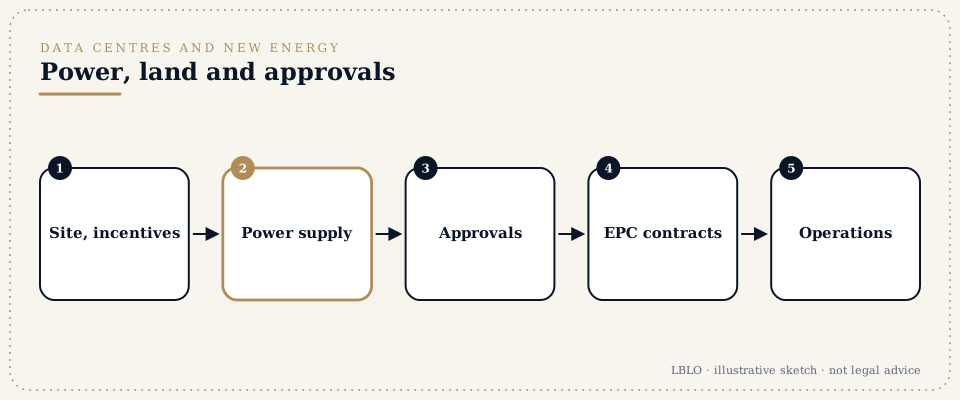
- The steps, in short:
- site selection and due diligence;
- incentive application under the State policy;
- land acquisition or lease;
- approvals;
- power arrangements;
- EPC and equipment contracts;
- customer contracts (colocation or cloud);
- operation and compliance.
- Keep ready:
- the proposed site;
- the power requirement;
- the investment plan;
- the State incentive policy relied on;
- customer commitments.
Terms you will hear
- Data centre park and policy incentives
- State policies offering power and land benefits.
- Power availability and redundancy
- core contract terms for data centres.
- SHANTI Act
- the December 2025 law opening civil nuclear power to licensed private participation. It comes into force on the dates the Central Government notifies.
- Small modular reactor (SMR)
- a smaller reactor design under discussion.
- Green hydrogen and battery storage
- emerging energy sectors with their own incentives and approvals.
- EPC contract
- engineering, procurement and construction, the standard build contract.
In detail
Step 1: Site and title
The site is checked for title, land use, access to power and water, flood risk and connectivity. The property due diligence follows the Property Title Verification and Due Diligence page.
Step 2: Incentives
State data-centre and industrial policies offer incentives, such as stamp duty, electricity duty, power tariff and land concessions. These are granted on application, subject to conditions. The incentive approval is obtained before investment is committed.
Step 3: Power
Power is the critical input. Options include:
- grid supply;
- green open access;
- captive or group captive renewable plants with storage;
- in future, nuclear supply under the SHANTI framework.
Each needs its own agreements and approvals (see the pages on renewable power and on power-sector disputes).
Step 4: Contracts
The main contracts are:
- EPC and equipment;
- operation and maintenance;
- power purchase;
- connectivity;
- customer agreements with service levels, liability caps and data protection terms (see the pages on deploying AI and on data protection).
Step 5: Nuclear in particular
Private participation under the SHANTI Act will depend on the licensing framework, rules and regulator's requirements as they are notified. Interested parties should track the rules and the regulator's notifications before committing to projects.
Questions people ask
Is there a national data-centre law?
Not yet. A national policy is being prepared, and State policies apply in the meantime.
Can a private company build a nuclear plant now?
The SHANTI Act opens the sector to licensed private participation once it is brought into force. The detailed rules and licensing process determine when and how.
What is the biggest legal risk for a data-centre project?
Usually power and land: securing reliable supply on predictable terms, and clean title with the right approvals.
These answers are educational summaries; they are not legal advice on any individual matter.
A serious question deserves a read brief.
Conferences are by appointment at G-46, Basement, Greater Kailash III, New Delhi. The principal reads the correspondence.
This page gives general information about the work of Lokesh Bhardwaj Law Offices, as permitted under the Bar Council of India Rules. It is not legal advice, and it does not create an advocate-client relationship. LBLO acts in a matter only on an engagement agreed in writing.
Law stated as at 14/11/2026.