
Power-Sector Disputes: the Commissions, APTEL and the Supreme Court
Disputes between generators, distribution companies, transmission licensees and consumers follow a statutory path. This page explains it.
In brief
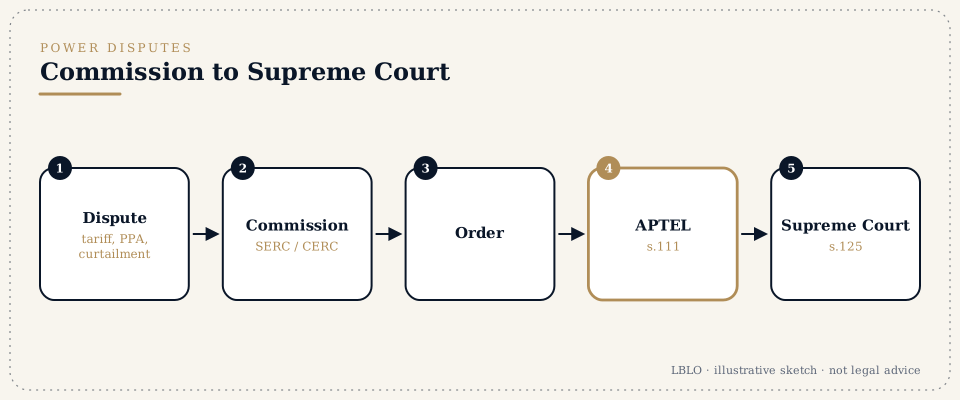
- The forums:
- Central Electricity Regulatory Commission (CERC): inter-State matters and central generators.
- State Electricity Regulatory Commissions (SERCs): intra-State matters, tariffs, open access.
- Appellate Tribunal for Electricity (APTEL): hears appeals from the Commissions under Section 111 of the Electricity Act, 2003.
- Supreme Court: hears appeals from APTEL under Section 125 of the Act.
- Common disputes:
- change-in-law compensation;
- carrying cost and late payment surcharge;
- force majeure;
- delay in commissioning and extension of the scheduled date;
- tariff determination;
- open access charges;
- termination of PPAs;
- payment default by distribution companies.
- Time limits. Appeals to APTEL and to the Supreme Court must be filed within the periods the Act prescribes. APTEL can condone delay for sufficient cause. Check the dates as soon as an order is received.
- The steps, in short:
- notice under the PPA;
- petition before the Commission;
- pleadings and hearing;
- order;
- appeal to APTEL;
- appeal to the Supreme Court on the grounds the Act allows;
- execution of the order.
- Keep ready:
- the PPA;
- the bidding documents;
- the notifications relied on (for example the change in law);
- invoices and payment records;
- correspondence;
- earlier orders.
Terms you will hear
- State and Central Electricity Regulatory Commissions
- the regulators that decide tariff and licensing disputes.
- APTEL
- the Appellate Tribunal for Electricity, which hears appeals from the Commissions under Section 111.
- Appeal to the Supreme Court (Section 125)
- on substantial questions of law.
- Change in law
- a PPA clause compensating a party when the law changes.
- Late payment surcharge
- interest on delayed payments by distribution companies.
- Curtailment
- a direction by the load despatch centre to reduce or stop a generator's supply. It is a frequent renewable dispute.
In detail
Step 1: The PPA and the notice
Most power disputes begin with the PPA's notice and dispute-resolution clause. Notices of change in law or force majeure must be given within the time and in the form the PPA requires.
Step 2: The Commission
The petition sets out the claim, the PPA provisions and the evidence, with the calculation of the amount. The Commission may call for further material. Interim relief, such as protection against coercive recovery or regulation of supply, can be sought.
Step 3: Appeal to APTEL
An appeal against the Commission's order lies to APTEL under Section 111. Where the appeal is filed late, an application for condonation of delay is filed with reasons.
Step 4: The Supreme Court
An appeal from APTEL lies to the Supreme Court under Section 125, on the grounds the Act allows. Supreme Court decisions on change in law, carrying cost and PPA interpretation guide most of these disputes.
Step 5: Execution
Orders of the Commissions and APTEL are executed through the procedure the Act provides. Payment security mechanisms under the PPA are invoked where available.
Questions people ask
Can a PPA dispute go to arbitration instead?
It depends on the PPA, the parties and the law. Disputes involving the regulatory functions of the Commission usually go to the Commission.
What is "change in law" compensation?
Compensation under the PPA for the cost impact of a new or changed law after the bid date, such as a new duty or tax.
How long does an APTEL appeal take?
It varies with the issues and the Tribunal's list. Interim protection can be sought.
These answers are educational summaries; they are not legal advice on any individual matter.
A serious question deserves a read brief.
Conferences are by appointment at G-46, Basement, Greater Kailash III, New Delhi. The principal reads the correspondence.
This page gives general information about the work of Lokesh Bhardwaj Law Offices, as permitted under the Bar Council of India Rules. It is not legal advice, and it does not create an advocate-client relationship. LBLO acts in a matter only on an engagement agreed in writing.
Law stated as at 14/11/2026.