
Importing and Selling Robots and Machinery: BIS Certification and Customs
Machinery and electrical equipment covered by a BIS certification order cannot be made, imported or sold in India without certification. This page explains what makers, importers and integrators must check.
In brief
- The rule. BIS certification is compulsory for the products covered by a quality control order or technical regulation issued under the Bureau of Indian Standards Act, 2016. Uncertified covered products cannot be manufactured, imported or sold.
- The Omnibus Order has been withdrawn. The Machinery and Electrical Equipment Safety (Omnibus Technical Regulation) Order, 2024 was to make BIS certification compulsory for a wide range of machinery. Its enforcement was deferred from 28/08/2025 to 01/09/2026, and the Ministry of Heavy Industries then withdrew the Order by a notification published on 16/01/2026. Each machine is therefore checked against the orders that remain in force.
- Foreign manufacturers apply to BIS and generally need an authorised Indian representative, who takes responsibility for compliance.
- Robots specifically. BIS publishes Indian Standards for robotics and added to them in October 2026. Whether a particular robot is covered by a certification order depends on its classification and the notified standard. Check this for each product.
- Customs. The tariff classification of a robot (as an industrial robot, a machine, or a part) decides the duty and the import conditions. An advance ruling can settle it before imports begin.
- Consequences of non-compliance:
- goods detained at the port;
- a ban on sale;
- penalties under the Bureau of Indian Standards Act, 2016.
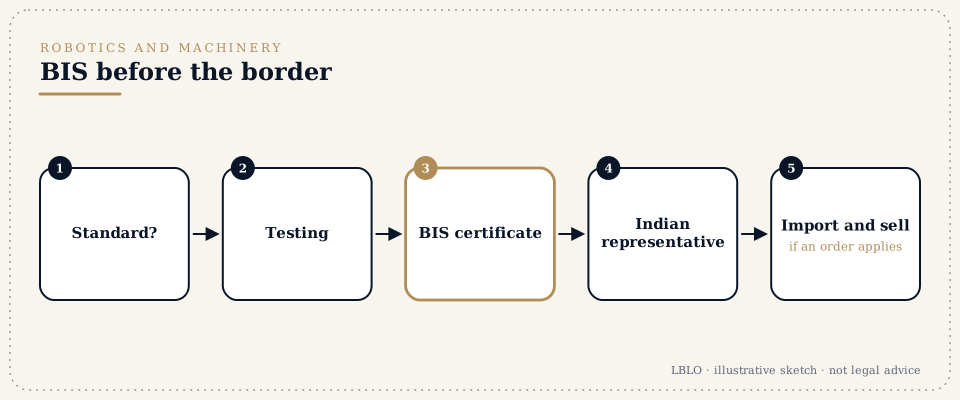
- The steps, in short:
- identify the products and the applicable orders and standards;
- appoint the Indian representative;
- prepare the technical file and test in a recognised laboratory;
- apply for the BIS licence;
- factory inspection where required;
- licence granted; marking;
- surveillance and renewal.
- Keep ready:
- product specifications and drawings;
- test reports;
- factory details;
- the importer's details;
- the distribution model in India.
Terms you will hear
- Omnibus Technical Regulation
- the order that was to make BIS certification compulsory for a wide range of machinery and electrical equipment from 01/09/2026. The Ministry of Heavy Industries withdrew it in January 2026.
- Conformity assessment
- testing and certification against the standard.
- Authorised Indian representative
- the person in India whom a foreign manufacturer nominates under the BIS certification schemes, and who is answerable to BIS.
- Standard mark
- the BIS mark on certified products.
- Customs hold for non-compliance
- imports without required certification can be stopped.
- Product manual and safety warnings
- part of compliance and of liability defence.
In detail
Step 1: Map products to orders
The first task is a product-by-product map. For each machine, record:
- whether a quality control order or technical regulation covers it;
- which Indian Standard applies;
- whether exemptions apply.
Step 2: Appoint the Indian representative
The authorised Indian representative signs undertakings and is answerable to BIS. The agreement with that representative allocates responsibility and liability.
Step 3: Testing and licensing
Samples are tested in a BIS-recognised laboratory. BIS may inspect the factory. Once licensed, the products carry the required marking. BIS conducts surveillance afterwards.
Step 4: Customs
Classification, valuation and any import licence are settled before shipment (see importing goods into India). Where classification is uncertain, an advance ruling under the Customs Act, 1962 can be sought.
Step 5: Contracts in India
The distribution or supply agreement with Indian buyers should cover:
- who holds the certification;
- warranties;
- installation;
- training;
- safety obligations;
- liability (see Article 5).
Questions people ask
Our robots are certified in Europe. Do we still need BIS certification?
If the product is covered by an Indian order, yes. Foreign certification does not replace it, though test data may help.
What happens if goods arrive without certification?
They may be detained, and they cannot be sold until the requirements are met.
Can our Indian distributor hold the certification?
The structure depends on the scheme. The responsible parties and their duties are agreed in writing.
These answers are educational summaries; they are not legal advice on any individual matter.
A serious question deserves a read brief.
Conferences are by appointment at G-46, Basement, Greater Kailash III, New Delhi. The principal reads the correspondence.
This page gives general information about the work of Lokesh Bhardwaj Law Offices, as permitted under the Bar Council of India Rules. It is not legal advice, and it does not create an advocate-client relationship. LBLO acts in a matter only on an engagement agreed in writing.
Law stated as at 14/11/2026.