
When Machines Fail: Liability, Warranties and Workplace Safety
A robot that injures a worker, a defective machine that halts a plant, or an AI-driven system that causes loss raises the question of who pays. This page explains how Indian law allocates that risk.
In brief
- Several sources of liability:
- the contract (warranties, indemnities, limits on liability);
- product liability under the Consumer Protection Act, 2019;
- negligence;
- workplace safety law;
- regulatory penalties, for example for missing BIS certification.
- Product liability. The Consumer Protection Act, 2019 lets a consumer claim compensation from the manufacturer, the service provider or the seller for harm caused by a defective product or deficient service. Business buyers of machinery for commercial purposes are generally not "consumers". Their remedy is mainly in contract.
- Workplace safety. The Occupational Safety, Health and Working Conditions Code, 2020, in force from 21/11/2025, places safety duties on employers. Machines and automated systems in a workplace are part of that duty.
- Contracts decide most business disputes. Key terms:
- specifications and acceptance tests;
- warranty period and remedies;
- service levels;
- liability caps and exclusions;
- indemnities;
- insurance;
- software updates;
- responsibility for AI-driven decisions.
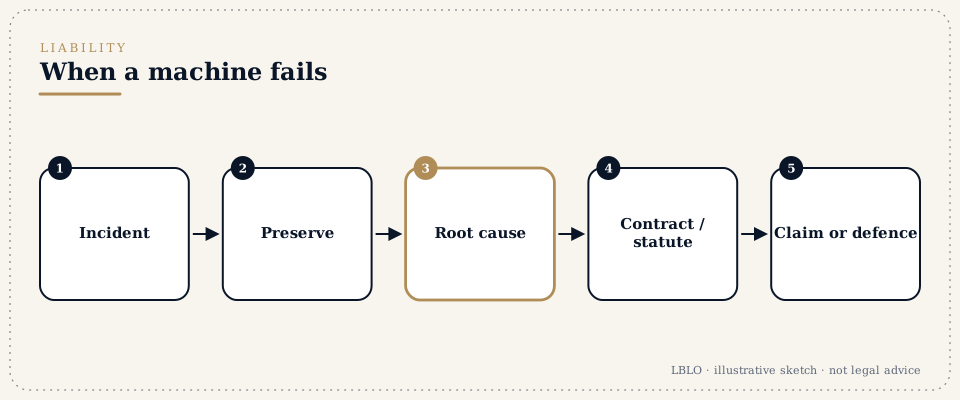
- When something goes wrong:
- secure the machine and the data logs;
- notify the supplier and the insurer;
- record the facts;
- check the contract for notice requirements and time limits.
- Keep ready:
- the supply contract;
- specifications and test reports;
- maintenance records;
- incident reports;
- the insurance policy;
- correspondence.
Terms you will hear
- Product liability
- under the Consumer Protection Act, claims against manufacturers, sellers and service providers.
- Warranty and guarantee
- promises about performance and repair.
- Exclusion clause
- a contract term limiting liability. Courts read it narrowly.
- Root cause analysis
- the technical investigation that decides who is at fault.
- Joint and several liability
- several parties each liable for the whole loss.
- Insurance subrogation
- the insurer's right to sue after paying a claim.
In detail
Step 1: Contract allocation at the start
Supply and integration agreements should state:
- what the machine must do, and how this will be tested;
- what happens if it fails acceptance;
- the warranty and its remedies (repair, replacement, refund);
- the cap on liability, and what is outside the cap (for example personal injury, or breach of confidentiality);
- indemnities for third-party claims;
- who updates the software, and what happens after updates.
Step 2: Safety duties
The employer assesses risks, trains workers and maintains the machine. The supplier provides safe design, instructions and warnings. Responsibilities between them are recorded in writing.
Step 3: Incident response
After an incident:
- preserve the machine, the logs and the data;
- report as required by law;
- notify the insurer within the policy period;
- notify the supplier under the contract.
Step 4: Claims and disputes
The route is decided by the contract, usually arbitration or the commercial courts. Third-party injury claims and consumer claims follow their own procedures. Insurance claims run in parallel.
Questions people ask
Can a business that bought a machine use the Consumer Protection Act?
Usually not, where the machine was bought for a commercial purpose. The remedy is under the contract.
Who is liable if an AI-driven system makes a harmful decision?
It depends on the contract, the facts and the law that applies. Contracts should allocate this expressly.
Should we insure?
Product liability, professional indemnity and property insurance are commonly used. The contract should require the right cover.
These answers are educational summaries; they are not legal advice on any individual matter.
A serious question deserves a read brief.
Conferences are by appointment at G-46, Basement, Greater Kailash III, New Delhi. The principal reads the correspondence.
This page gives general information about the work of Lokesh Bhardwaj Law Offices, as permitted under the Bar Council of India Rules. It is not legal advice, and it does not create an advocate-client relationship. LBLO acts in a matter only on an engagement agreed in writing.
Law stated as at 14/11/2026.