
Importing Goods into India: Classification, Valuation and Seizures
For manufacturers and traders, customs is often the first point of friction in India. This page explains how to get it right before the goods arrive.
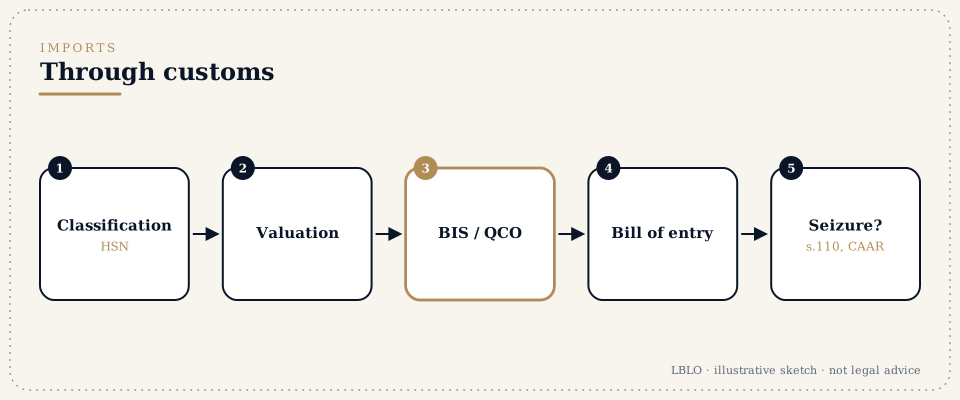
In brief
- Three questions decide the duty:
- Classification: which tariff heading the goods fall under.
- Valuation: the transaction value and the adjustments to it.
- Origin: which affects concessional duty under trade agreements.
- Advance rulings. An importer or exporter can apply to the Customs Authority for Advance Rulings under Section 28H of the Customs Act, 1962 for a ruling on classification, valuation, the applicability of exemption notifications, and origin. Benches sit in Delhi and Mumbai. The ruling binds the applicant and customs on the question decided, for the period Section 28J allows, and only while the law and the facts stay the same.
- Related-party imports. Imports from a group company are examined to see whether the relationship influenced the price.
- Seizure. If goods are seized, a show cause notice must ordinarily be issued within six months, extendable by up to six months. Provisional release on bond and security is available. The page on challenging government and regulatory action explains this in detail.
- The steps, in short:
- Classify the goods and check duty, exemptions and origin benefits.
- Seek an advance ruling where the position is uncertain.
- Register (IEC and other registrations).
- Prepare documents.
- File the bill of entry.
- Assessment and clearance.
- If there is a dispute: reply, adjudication, appeal.
- Keep ready:
- product specifications and technical literature;
- the commercial invoice and purchase contract;
- certificates of origin;
- licences for restricted goods;
- earlier assessments of the same goods.
Terms you will hear
- Bill of entry
- the import declaration filed with customs.
- HSN classification
- the tariff heading that fixes duty.
- Assessable value
- the value on which duty is calculated, normally the transaction value.
- Related-party imports and SVB
- imports between group companies. They may be examined for valuation.
- Seizure (Section 110) and show cause notice
- detention of goods, and the notice proposing duty, confiscation and penalty.
- Redemption fine
- payment to release confiscated goods.
- Advance ruling (CAAR)
- a binding ruling on classification or valuation before import.
- BIS and quality control orders
- mandatory certification for notified products.
In detail
Step 1: Classification and duty
The goods are classified under the Customs Tariff Act, 1975, using the General Rules of Interpretation. The duty, exemption notifications, anti-dumping or safeguard duties and import conditions are then checked.
Step 2: Advance ruling
Where classification or valuation is uncertain, an application to the Customs Authority for Advance Rulings gives certainty before imports begin. The application states the question, the facts and the applicant's view, with supporting material.
Step 3: Valuation and related parties
The declared value is the transaction value, adjusted as the valuation rules require. Imports from related parties may be examined to see whether the relationship influenced the price. The documents supporting the price should be ready.
Step 4: Clearance
The bill of entry is filed electronically, with assessment and examination as required. Differences with the assessing officer are recorded at once, so that the right to challenge them is kept.
Step 5: Disputes
A show cause notice is answered with documents. The adjudication order can be appealed through the appellate authority and then CESTAT. Where an action is without jurisdiction or breaches natural justice, a writ petition may lie in the High Court.
Common mistakes
- Classifying by the commercial name, not the tariff.
- Importing at scale before a disputed classification is settled.
- Paying differential duty without protest.
- Missing the time to reply to a notice or to file an appeal.
Questions people ask
Is an advance ruling binding?
Yes. Under Section 28J it binds the applicant and the customs authorities on the question decided, for the period the section fixes, and it ceases to bind if the law or the facts on which it was given change.
Customs has seized our shipment. What now?
Apply for provisional release and check the dates. If no show cause notice is issued within the period the law allows, the goods are ordinarily to be returned.
Can we import goods for our Indian subsidiary from the parent?
Yes. The valuation must be supportable, and documents on the relationship may be called for.
These answers are educational summaries; they are not legal advice on any individual matter.
A serious question deserves a read brief.
Conferences are by appointment at G-46, Basement, Greater Kailash III, New Delhi. The principal reads the correspondence.
This page gives general information about the work of Lokesh Bhardwaj Law Offices, as permitted under the Bar Council of India Rules. It is not legal advice, and it does not create an advocate-client relationship. LBLO acts in a matter only on an engagement agreed in writing.
Last reviewed: 14/11/2026. Lokesh Bhardwaj Law Offices.
Law stated as at 14/11/2026.