
Deepfakes and AI Misuse: Remedies for Individuals and Companies
A fake video of a director, a cloned voice used in fraud, or a brand imitated by an AI-generated campaign needs a fast response. This page explains the remedies.
In brief
- Platforms must act. Under the IT Rules, as amended in 2026, intermediaries must deal with unlawful synthetically generated information. They must label permitted synthetic content and remove unlawful content within shorter timelines. Content showing a person in nudity or a sexual act, including morphed images, must be removed within two hours of that person's complaint. Removal in compliance with the Rules does not cost the platform its safe-harbour protection.
- Civil remedies:
- a suit for injunction and damages for defamation;
- passing off and trade mark infringement;
- breach of privacy;
- misuse of personality rights.
The Delhi High Court has granted urgent orders in personality-rights cases.
- Criminal remedies: a complaint to the police or the national cyber-crime reporting system for impersonation, cheating, forgery, identity theft and obscenity, under the Bharatiya Nyaya Sanhita and the IT Act.
- Company impersonation (fake executives, fake customer-care numbers, cloned websites) is dealt with through takedown requests, domain and platform complaints, and urgent injunctions.
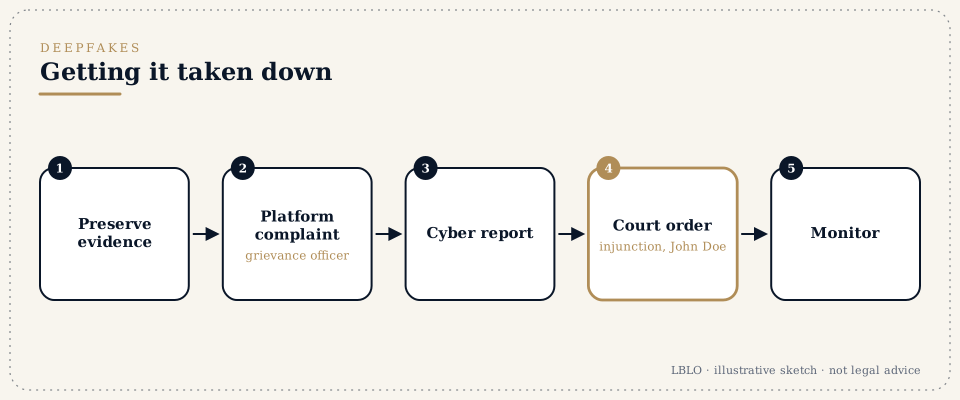
- The steps, in short:
- preserve evidence (screenshots, links, dates);
- report to the platform;
- send a legal notice where useful;
- file a cyber-crime complaint where there is fraud;
- file a suit with an urgent interim application;
- ask the court for orders against unknown persons and directions to platforms.
- Keep ready:
- links and screenshots with dates;
- proof of your identity or rights;
- details of any loss;
- earlier complaints to the platform.
Terms you will hear
- Deepfake
- AI-made audio, image or video that falsely depicts a person.
- Takedown and grievance officer
- the platform's duty to act on complaints, through its named officer.
- Personality rights
- protection of name, image, voice and likeness.
- John Doe order
- an injunction against unknown persons.
- Cyber crime complaint
- made on the national portal or at a police station.
- Blocking order
- a government or court direction to block content.
In detail
Step 1: Preserve the evidence
Before content disappears, record:
- the URLs;
- screenshots with dates and times;
- account names;
- any payments made to fraudsters.
Electronic evidence later needs the certificate required by the Bharatiya Sakshya Adhiniyam.
Step 2: Platform reporting
Report through the platform's grievance mechanism, citing the IT Rules. Keep the acknowledgement. Where someone threatens to release intimate images, see the Know the Law answer on threats to leak private photos or videos.
Step 3: Cyber-crime complaint
Where money has been lost, report at once through the national cyber-crime portal and the bank, so that the money can be traced.
Step 4: Court action
A suit seeks:
- an injunction against the content and its creators, including unknown persons;
- directions to platforms and domain registrars to remove content and disclose details;
- damages.
Urgent interim orders can be sought on the first day.
Questions people ask
Can I get a deepfake of me removed quickly?
Report it to the platform at once. If it is not removed, a court can order removal, often urgently.
Someone is using AI to imitate our brand. What can we do?
Trade mark, passing-off and copyright remedies apply. Platforms can be directed to take content down.
Can I sue someone whose identity I do not know?
Yes. Courts can grant orders against unknown persons and direct platforms to disclose details.
These answers are educational summaries; they are not legal advice on any individual matter.
A serious question deserves a read brief.
Conferences are by appointment at G-46, Basement, Greater Kailash III, New Delhi. The principal reads the correspondence.
This page gives general information about the work of Lokesh Bhardwaj Law Offices, as permitted under the Bar Council of India Rules. It is not legal advice, and it does not create an advocate-client relationship. LBLO acts in a matter only on an engagement agreed in writing.
Law stated as at 14/11/2026.