
AI, Copyright and Ownership of What AI Produces
Two questions dominate: can a model be trained on others' works, and who owns what the model produces? Indian law is developing on both.
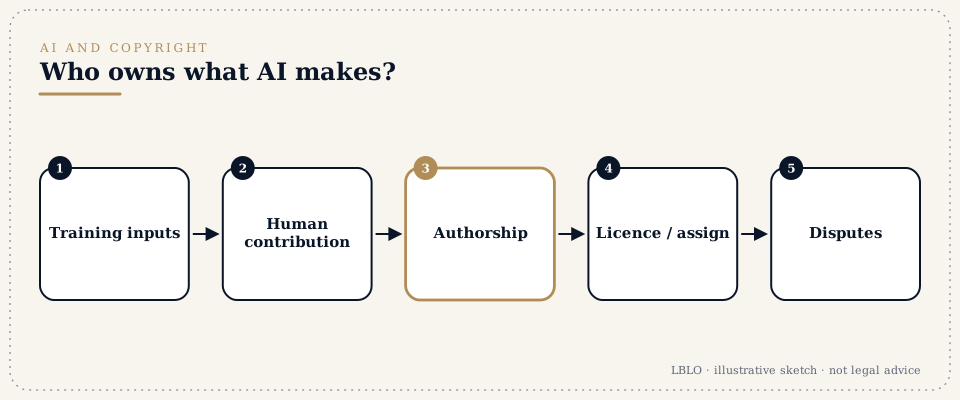
In brief
- Training on copyrighted works.
- In ANI Media Pvt. Ltd. v. Open AI OpCo LLC, CS(COMM) 1028/2024, the Delhi High Court, by its judgment of 24/07/2026, refused ANI's application for an interim injunction against OpenAI.
- It held that it had jurisdiction, even though training took place on servers abroad.
- It took the prima facie view that storing the works for training fell within fair dealing.
- This is an interim view only. The suit is pending, and the question will be decided at trial. ANI's appeal against the judgment is pending before a Division Bench of the High Court.
- Outputs. In the same judgment the Court found, at the interim stage, that ANI had not shown that ChatGPT memorised and reproduced its works.
- Who owns AI output. Indian copyright law protects works of human authors. Whether, and to what extent, output generated mainly by AI is protected, and who owns it, is not settled. Contracts should allocate it expressly.
- Patents. AI-related inventions can be patented only where they meet the tests for patentability. Computer programmes per se are excluded.
- Trade secrets. Models, weights, prompts and datasets are commonly protected as confidential information through contracts.
- What to do:
- record the sources of training data and their licences;
- allocate ownership of outputs in contracts;
- protect models and data through confidentiality;
- keep human creative contribution documented where protection matters.
Terms you will hear
- Author and owner
- the creator recognised by law, and the person who holds the rights.
- Originality
- the threshold for copyright protection.
- Computer-generated work
- the Copyright Act treats the person who causes the work to be created as its author. How this applies to output generated mainly by AI is not settled.
- Fair dealing
- limited permitted uses, such as research, review and reporting.
- Licence and assignment
- permission to use, and transfer of ownership.
- Training on copyrighted works
- a contested question, litigated before the Delhi High Court.
In detail
Step 1: Know what is protected
Copyright protects original literary, artistic, musical and dramatic works, films, sound recordings and computer programmes. Facts and ideas are not protected; their expression is.
Step 2: Training
Until the ANI case is decided at trial, the position on training is an interim view of one court. Companies should:
- prefer licensed or permitted data;
- respect opt-outs and site terms;
- keep records of what was used and on what basis.
Content owners should record what was taken and how it appears in outputs.
Step 3: Outputs and ownership
Where a person makes the creative choices and uses AI as a tool, the person's contribution may be protected. Where the output is largely machine-generated, protection is uncertain. Contracts with customers, employees and freelancers should state who owns outputs and what each side may do with them.
Step 4: Enforcement
For a business whose content is copied, the remedies include:
- a legal notice;
- a suit for infringement in the Commercial Division of the Delhi High Court;
- interim injunctions;
- takedown requests to platforms.
Questions people ask
Is training an AI model on copyrighted material legal in India?
Not yet settled. The Delhi High Court refused an interim injunction in July 2026, but the main suit, and an appeal against that refusal, are pending.
Who owns an image or text our staff make with an AI tool?
That depends on the human contribution and on the tool's terms. Your contracts should state the position.
Can we patent our AI system?
Possibly, if it is more than a computer programme per se and meets the tests of novelty, inventive step and industrial application.
These answers are educational summaries; they are not legal advice on any individual matter.
A serious question deserves a read brief.
Conferences are by appointment at G-46, Basement, Greater Kailash III, New Delhi. The principal reads the correspondence.
This page gives general information about the work of Lokesh Bhardwaj Law Offices, as permitted under the Bar Council of India Rules. It is not legal advice, and it does not create an advocate-client relationship. LBLO acts in a matter only on an engagement agreed in writing.
Law stated as at 14/11/2026.