
Trade Marks and Brand Protection: Filing, Objections, Oppositions, Infringement
A registered trade mark gives its owner the exclusive right to use it for the goods and services registered, and to sue for infringement.
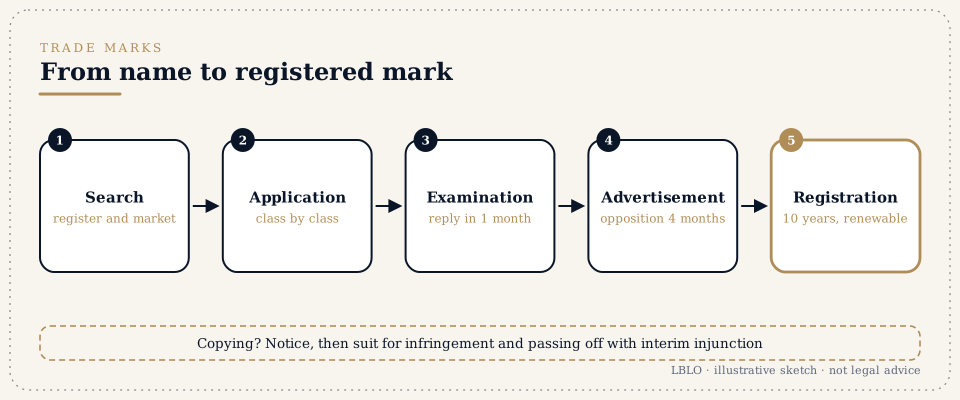
In brief
- A registered trade mark gives its owner the exclusive right to use it for the goods and services registered, and to sue for infringement. An unregistered mark can still be protected through a passing-off action, but proof is harder.
- Before filing, search the register and the market. Most refusals and oppositions are predictable from a good search.
- Examination report. After filing, the Registry issues one. The reply is due within one month.
- Opposition. Once the mark is advertised in the Trade Marks Journal, anyone can oppose it within four months. The applicant files a counter-statement within two months of receiving the opposition.
- Registration lasts 10 years from the application date and can be renewed indefinitely.
- Against copying, a cease and desist notice, then a suit for infringement and passing off with an application for an interim injunction. In Delhi, these go to the Commercial Courts or the Delhi High Court's IP Division. Urgent ex parte injunctions are available where the case is strong.
- Domain names, social media handles and marketplace listings have their own takedown routes, which run alongside the court case.
Terms you will hear
- Class
- goods and services are grouped into 45 classes. A mark is registered class by class.
- Proposed to be used and user date
- filing on intent to use, or claiming use from an earlier date with evidence.
- Word mark, device mark, label
- the name alone, a logo, or a combination.
- Examination report and objections under Sections 9 and 11
-
- Section 9 (absolute grounds): the mark is descriptive, generic or lacks distinctiveness;
- Section 11 (relative grounds): the mark conflicts with an earlier mark.
- Show cause hearing
- the hearing on objections before the Examiner.
- Advertisement and opposition
- the mark is published for public objection.
- Rectification
- an application to remove or correct a registered mark.
- Well-known mark
- a mark protected across all classes because of its reputation.
- Infringement and passing off
- use of an identical or deceptively similar mark on goods or services (infringement), and misrepresentation causing confusion (passing off).
- John Doe (Ashok Kumar) order
- an order against unnamed infringers, often used against counterfeit sellers.
- Anton Piller order (Local Commissioner)
- court-supervised seizure of infringing goods.
In detail
1. Choosing and clearing a mark.
Invented and arbitrary words register easily. Descriptive words ("Best Rice") do not. Search:
- identical and similar marks in the relevant classes;
- company names;
- domains;
- marketplace listings.
2. Filing.
File online with:
- the applicant's details;
- the mark;
- the class and specification;
- the user claim with evidence, if any;
- a power of attorney, where an agent files.
Start-ups, small enterprises and individuals pay a lower fee.
3. Examination and reply.
The reply should:
- address each objection;
- argue distinctiveness or show acquired distinctiveness through use (sales, advertisements, invoices);
- distinguish the cited marks.
A hearing may follow.
4. Opposition.
A well-run opposition is evidence-led. The opponent files evidence of prior use and reputation. The applicant replies with its own evidence.
5. Enforcement.
- Investigate: test purchases and screenshots.
- Send a notice.
- File the suit, with interim injunction, Local Commissioner and John Doe applications as needed.
Damages, accounts of profits and costs are available. Delay in suing can weaken the case for an interim injunction, so act promptly once you discover copying.
6. Portfolio management.
Keep a calendar of renewal dates, watch the Journal for conflicting marks, and record assignments and licences with the Registry.
Questions people ask
Can I use ™ before registration?
Yes. ™ shows a claim. ® is only for a registered mark.
Someone filed my brand name first. What can I do?
Oppose it, or seek rectification, relying on your prior use and evidence.
How long does registration take?
Without objection or opposition, months. With them, longer.
Do I need a trade mark in each country?
Yes, rights are territorial. The Madrid Protocol allows one international application covering many countries.
A marketplace seller is copying my product. Is a court case needed?
Platform takedowns help quickly. A court order is needed against repeat or large-scale infringers.
These answers are educational summaries; they are not legal advice on any individual matter.
A serious question deserves a read brief.
Conferences are by appointment at G-46, Basement, Greater Kailash III, New Delhi. The principal reads the correspondence.
This page gives general information about the work of Lokesh Bhardwaj Law Offices, as permitted under the Bar Council of India Rules. It is not legal advice, and it does not create an advocate-client relationship. LBLO acts in a matter only on an engagement agreed in writing.
Law stated as at 14/11/2026.