
Retainers & the Outsourced Legal Department
A named counsel, a written scope, and a record each quarter of what was done.
Lokesh Bhardwaj Law Offices (LBLO) acts on standing retainers for companies that need regular legal attention through the year. For companies that prefer not to carry a legal department, the Office acts as one: a dedicated team, a named point of contact, a compliance calendar kept current, contracts reviewed before signature, notices answered, disputes conducted, and a quarterly note of what was done. Scope and fees are recorded in writing before work begins. The arrangement suits companies whose legal questions arise every week rather than once a year.
The calendar covers the company's obligations under the Companies Act, 2013, the four labour codes in force since 21/11/2025, the Sexual Harassment of Women at Workplace (Prevention, Prohibition and Redressal) Act, 2013, and the Digital Personal Data Protection Act, 2023. Contracts are reviewed before they are signed; notices from regulators, tax authorities and counterparties are answered; the board and the company secretary are supported with resolutions, minutes and filings; and disputes are conducted as they arise, either within the retainer or under a separate engagement letter, as the written scope provides.
Terms you will hear
- Retainer
- a standing engagement for a defined scope of work.
- Scope of services
- the list of work covered, such as contracts, notices, compliance and advice.
- Turnaround time
- the time, fixed in the retainer letter, within which instructions are acknowledged.
- Matter intake
- how requests are logged and assigned.
- Contract lifecycle
- drafting, review, negotiation, signature, storage and renewal tracking.
- Compliance calendar
- the schedule of statutory filings and renewals.
- Escalation
- when a retainer matter becomes litigation. It is handled within the retainer or under a separate engagement letter, as the written scope provides.
What the Office takes on
- Companies Act Compliance Calendar
- Board Meetings, Resolutions & Minutes
- Annual Filings with the Registrar
- Labour Codes & Employment Policies
- POSH Internal Committee & Annual Report
- Data Protection & DPDP Readiness
- Commercial Contracts & Vendor Agreements
- Leases, Licences & Property Documents
- Notices from Regulators & Tax Authorities
- Legal Notices & Pre-litigation Correspondence
- Disputes, Arbitration & Court Work
- Quarterly Note to the Board
How the work is conducted
Every retainer begins with a written scope. It lists what is covered and what is not, the documents the company will share, and how matters outside the scope are to be handled. A named counsel is the company's point of contact, and a second advocate is named for cover, so that a question does not wait because one person is in court. The compliance calendar is prepared from the company's own records and kept current as the law changes. Each quarter the Office sends a short note recording the matters handled, the filings made, the notices answered, and what is due next. Before any new matter is taken up, conflicts are checked against the Office's records. Where the Office cannot act, because of a conflict or because the matter calls for expertise outside its practice, the company is told promptly and in writing, so that it can instruct other counsel in time. Everything the company shares is held in confidence.
The work of a company's legal department
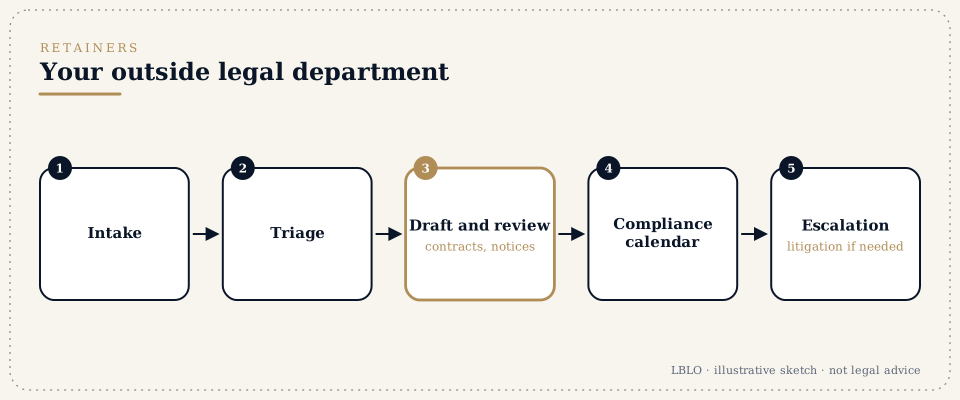
For a company, LBLO can do the work of an in-house legal team. Under a retainer, a team at G-46 works on the company's matters, so the company deals with the same advocates throughout. Besides the matters listed above, the work includes:
- Contracts: standard templates for the agreements the company signs regularly; review of agreements it receives, including non-disclosure agreements; renewals; and a register of contract dates and obligations. How a single agreement is handled is explained on Agreements: From First Draft to Signature.
- Compliance: statutory notices and filings, prepared with the company's chartered accountant or company secretary, and employment documents.
- Disputes: a record of every case the company is party to; coordination with lawyers in other cities; and representation before the courts and tribunals where LBLO practises.
The other work LBLO takes on for companies, law firms and clients outside India is described on Working With Lokesh Bhardwaj Law Offices.
How a retainer is set up
- Understanding the business. The first meeting covers what the company does and where it operates, who its customers and suppliers are, and what has gone wrong legally before.
- The first review. LBLO reviews the company's standard agreements and pending matters, and gives a short note of the main risks and the work they call for. This note forms the basis for the scope of the retainer.
- The retainer letter. Besides the scope, with examples of what is included and excluded, and the advocate responsible, the letter fixes how instructions are given and how fast they are acknowledged, monthly or quarterly reporting, confidentiality and data handling, and how matters outside the scope are quoted.
- The working rhythm. Day-to-day requests come in through named contacts. Contracts are returned with a marked-up version and a short note. Every case is tracked in one register, with next dates and actions.
- Periodic review. At agreed intervals the scope is reviewed against the work actually done, and adjusted.
What falls outside, and what to keep ready
Litigation and large transactions are usually agreed separately, and the retainer letter says so. For the first meeting, keep ready:
- the company's standard contracts;
- the list of pending cases and notices;
- the compliance calendar if there is one;
- names of the people who will instruct LBLO.
Common mistakes when companies set up legal support
- No written scope, so expectations differ.
- Several lawyers for different matters, so no one sees the whole picture.
- No single register of cases and contract deadlines.
Frequently asked questions
How many board meetings must a private company hold in a year?
Section 173 of the Companies Act, 2013 requires every company to hold at least four board meetings each year, with not more than one hundred and twenty days between two consecutive meetings. A one person company, a small company and a dormant company need hold only one meeting in each half of the calendar year, with at least ninety days between the two. The first board meeting must be held within thirty days of incorporation. Meetings, notices and minutes are tracked on the compliance calendar, because a missed meeting is a default that stays on the company's record.
What yearly filings does a company have to make with the Registrar?
Two are central. Under Section 137 of the Companies Act, 2013, the financial statements adopted at the annual general meeting must be filed with the Registrar of Companies within thirty days of that meeting. Under Section 92, the annual return must be filed within sixty days of the meeting, or of the date by which it should have been held. Each attracts additional fees if filed late, and a continuing default carries further consequences for the company and its officers. The compliance calendar records each due date against the company's own financial year and meeting dates.
Does a small company need a POSH Internal Committee?
If it has ten or more employees, yes. Section 4 of the Sexual Harassment of Women at Workplace (Prevention, Prohibition and Redressal) Act, 2013 requires every such employer to constitute an Internal Committee, presided over by a senior woman employee and including an external member. Under Section 21, the Committee prepares an annual report for the employer and the District Officer, and Section 22 requires the number of cases and their disposal to be stated in the organisation's annual report. Under Section 26, failure to constitute the Committee is punishable with a fine of up to Rs. 50,000, with heavier consequences on repetition.
When do the data protection rules start applying to my company?
The Digital Personal Data Protection Act, 2023 was brought into operation in stages by the Digital Personal Data Protection Rules, 2025, notified on 13/11/2025. The provisions on the Data Protection Board took effect that day; the rules on consent managers follow after one year; and the operative duties of a Data Fiduciary under Section 8 of the Act, together with the rules on notice, security safeguards and breach intimation, apply eighteen months after notification. The interval is the time to map what personal data the company holds, why, where it is stored and who can see it, and to put notices and contracts in order.
Does the retainer cover court cases?
It can, and the written scope says which. Some retainers include defined disputes; others provide that litigation is taken under a separate engagement letter as matters arise. Either way, an advocate acts for a party in a civil court on a written appointment: Order III, Rule 4 of the Code of Civil Procedure, 1908 requires the appointment to be in writing, signed by the party or an authorised agent, and filed in court. In practice this is the vakalatnama, which the company signs for each matter so that the Office can appear and act.
What happens if the Office cannot take on a matter for us?
The company is told promptly and in writing. The standards of professional conduct in the Bar Council of India Rules, Part VI, Chapter II include Rule 33, which bars an advocate who has advised a party, or drawn pleadings or acted for a party, in a matter from acting, appearing or pleading for the opposite party in the same matter. Conflicts are therefore checked before any new matter is accepted. Where a conflict exists, or the matter needs expertise outside the Office's practice, the Office says so early enough for the company to instruct other counsel, and keeps everything it has received in confidence.
Will our documents and correspondence stay confidential?
Yes. Section 132 of the Bharatiya Sakshya Adhiniyam, 2023 bars an advocate from disclosing any communication made in the course of and for the purpose of the professional engagement, the contents of documents seen in that engagement, or the advice given, without the client's express consent. The protection does not extend to communications in furtherance of an illegal purpose. Under a retainer the volume of shared material is large, so the scope also records how documents are exchanged and stored, who at the company may give instructions, and what happens to the files when the retainer ends.
Do the new labour codes change what a company has to comply with?
Yes. The Code on Wages, 2019, the Industrial Relations Code, 2020, the Code on Social Security, 2020 and the Occupational Safety, Health and Working Conditions Code, 2020 came into force on 21/11/2025, consolidating a large number of earlier central labour laws. They change definitions such as wages, registers and returns, standing orders and social security coverage. Several provisions depend on central and state rules, some of which have been notified in stages since, so the compliance calendar is reviewed against the rules in force in each state where the company employs people.
Is a retainer only for large companies?
No. The scope is set to the company's needs, from a few contracts a month to all of its legal work.
Can we end the retainer?
Yes, on the notice period stated in the retainer letter.
These answers are educational summaries; they are not legal advice on any individual matter.
Regular work deserves a written scope.
Conferences are by appointment at G-46, Basement, Greater Kailash III, New Delhi, or by video. The principal reads the correspondence.