
Commercial Suits and Protecting a Brand
Many business disputes over money, contracts and brands are decided in commercial courts. This page explains how a commercial suit runs and how a brand is protected.
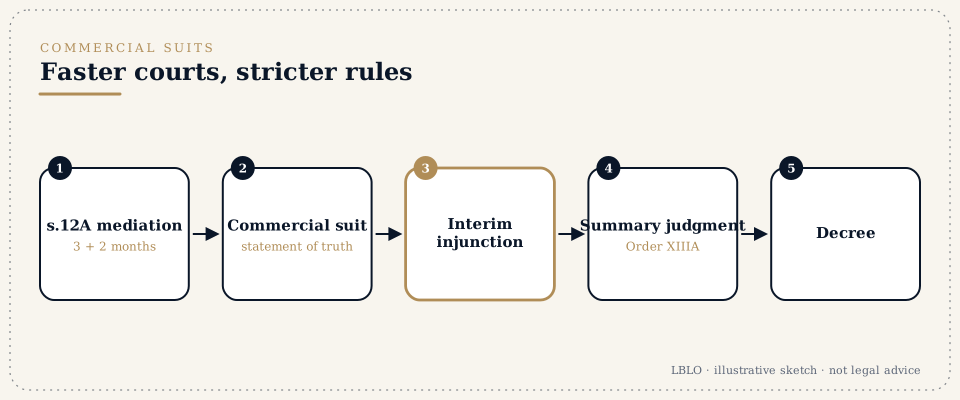
In brief
- What it is. A dispute arising from a commercial transaction is a "commercial dispute" under the Commercial Courts Act, 2015 when it is worth Rs. 3 lakh or more. Examples include supply, services, distribution, construction, leases of business property, and intellectual property. It is heard by a commercial court, or by the commercial division of a High Court such as the Delhi High Court.
- Mediation first. Unless the suit genuinely needs urgent interim relief, the plaintiff must first try pre-institution mediation. It is to be completed within three months, extendable by two months with the parties' consent.
- Strict timelines. Commercial suits run on fixed time limits for written statements, documents and case management. Delay is penalised.
- Brands. The owner of a registered trade mark can sue for infringement, and the owner of an unregistered mark can sue for passing off. Urgent injunctions are available against copycats. The Delhi High Court has a dedicated division for intellectual property matters.
- The steps, in short:
- legal notice;
- mediation, or an application for exemption on grounds of urgency;
- plaint with all documents;
- interim injunction;
- written statement;
- case management;
- evidence;
- judgment;
- execution.
- Keep ready:
- the contract, invoices, ledgers and emails;
- for a brand: registration certificates, proof of first use, sales figures and advertising material, and samples or screenshots of the infringing product.
Terms you will hear
- Commercial dispute and specified value
- the Commercial Courts Act applies to listed disputes of Rs. 3 lakh and above.
- Pre-institution mediation (Section 12A)
- three months, extendable by two, unless urgent relief is sought.
- Statement of truth
- the verification format for commercial pleadings.
- Summary judgment (Order XIIIA)
- judgment without trial where the defence has no real prospect.
- Interim injunction
- a temporary order to stop infringement or a breach.
- Local Commissioner
- a court-appointed person who inspects, seizes or records evidence.
- Damages and account of profits
- money remedies for infringement.
- Passing off
- protection for an unregistered brand against confusion.
In detail
Step 1: Legal notice and assessment
A notice:
- sets out the claim;
- gives the other side a chance to pay or stop;
- often decides whether the matter settles.
At the same time the claim is checked for limitation, jurisdiction and any arbitration clause. If the contract has an arbitration clause, the dispute will ordinarily go to arbitration instead of a suit.
Step 2: Mediation or exemption
Section 12A of the Act requires pre-institution mediation for suits that do not contemplate urgent interim relief. Courts look at whether the urgency is real; a bare assertion of urgency is not enough. Where a brand is being copied on the market, urgency is usually evident.
Step 3: The plaint and documents
Commercial suits require the plaintiff to file all documents in its power at the outset, with a statement of truth. Documents not filed then may not be allowed later.
Step 4: Interim injunction
For a brand, the court considers three questions:
- whether there is a prima facie case;
- whether the balance of convenience favours an injunction;
- whether the owner would suffer irreparable harm without one.
Orders can restrain sale, direct takedown from online marketplaces, and appoint a local commissioner to seize infringing goods.
Step 5: Trial
The court sets a timetable at the case management hearing. Evidence is often recorded by affidavit and cross-examination before a court commissioner. Summary judgment is available where the defence has no real prospect of success.
Step 6: Judgment and execution
A decree for money is executed in the way explained on the page on enforcing an award or a decree. A brand case may end with a permanent injunction, damages or an account of profits, and costs.
Common mistakes
- Filing a suit when the contract requires arbitration.
- Skipping mediation without real urgency.
- Not filing all documents at the start.
- Waiting months after discovering a copycat, which weakens the case for an urgent injunction.
How LBLO handles these matters
- Each suit is prepared on the documents first, so the plaint and documents can be filed together.
- For brand cases, evidence of use and of the infringement is collected before filing, so that interim relief can be sought at the first hearing.
Questions people ask
Do I need a registered trade mark to sue?
Registration helps. An unregistered mark can still be protected by a passing-off action if goodwill is shown.
Can the court order products off Amazon or Flipkart?
Yes. Courts regularly direct online marketplaces to take down infringing listings.
Is mediation compulsory for every commercial suit?
It is required unless the suit genuinely needs urgent interim relief.
These answers are educational summaries; they are not legal advice on any individual matter.
A serious question deserves a read brief.
Conferences are by appointment at G-46, Basement, Greater Kailash III, New Delhi. The principal reads the correspondence.
This page gives general information about the work of Lokesh Bhardwaj Law Offices, as permitted under the Bar Council of India Rules. It is not legal advice, and it does not create an advocate-client relationship. LBLO acts in a matter only on an engagement agreed in writing.
Law stated as at 14/11/2026.