
Data Protection and Cyber Law: The DPDP Act and Rules, Cyber Offences, Fraud, Takedowns and IT Act Appeals
Two bodies of law meet here: the Digital Personal Data Protection Act, 2023, which governs how businesses handle personal data, and the Information Technology Act, 2000 with the criminal law, which deal with misuse of computers and online fraud.
In brief
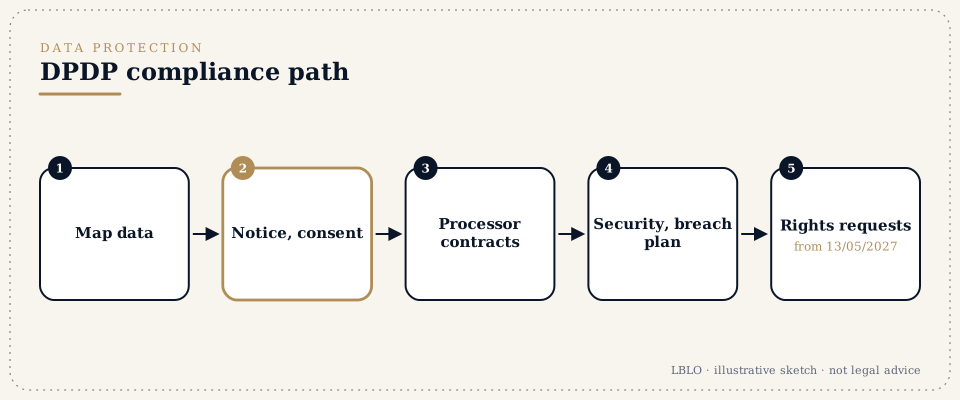
- The DPDP framework. The Digital Personal Data Protection Rules, 2025 were notified on 13/11/2025. The Data Protection Board provisions applied at once; the consent manager provisions from 13/11/2026; the main duties of businesses, and the rights of individuals, apply from 13/05/2027.
- Penalties. Up to Rs. 250 crore for failing to take reasonable security safeguards, up to Rs. 200 crore for failing to report a breach or for breaches of the duties on children's data, and up to Rs. 50 crore for other breaches. Penalties go to the Government, not to the individual.
- Breach reporting. From 13/05/2027 a personal data breach is reported to the Board without delay and in detail within seventy-two hours, and each affected person is told.
- Cyber offences. Identity theft and cheating by personation (Sections 66C and 66D, IT Act) carry up to three years and a fine; cheating and extortion are punished under Sections 318 and 308 of the Bharatiya Nyaya Sanhita, 2023.
- Online fraud. Report at once on the 1930 helpline or cybercrime.gov.in so the money can be frozen in the receiving account; frozen money is released by the Magistrate.
- Takedown. Platforms must remove intimate or morphed images within two hours of the person's complaint, and unlawful content within three hours of a court order or authorised Government notice (IT Rules, 2021, as amended in 2026).
- Compensation. Claims for damage to a computer system up to Rs. 5 crore go to the adjudicating officer under Section 46 of the IT Act; appeals lie to the TDSAT within forty-five days, and then to the High Court within sixty days.
Terms you will hear
- Data fiduciary
- The person who decides why and how personal data is processed, usually the business dealing with the customer or employee.
- Data processor
- A person who processes personal data on behalf of a data fiduciary, such as a cloud, payroll or marketing vendor.
- Data principal
- The individual to whom the personal data relates; for a child, the parent or lawful guardian.
- Consent manager
- A person registered with the Data Protection Board through whom an individual can give, manage and withdraw consent (Section 6(7) to 6(9), DPDP Act).
- Significant data fiduciary
- A data fiduciary notified by the Government because of the volume or sensitivity of the data it handles, with extra duties: a data protection officer in India, an independent data auditor and periodic impact assessments (Section 10).
- Intermediary
- A person who receives, stores or transmits electronic records on behalf of others: telecom and internet providers, platforms, marketplaces, search engines, hosting services.
- Safe harbour
- The protection in Section 79 of the IT Act that keeps an intermediary from liability for third-party content, so long as it observes due diligence and acts on lawful takedown demands.
- Adjudicating officer
- The officer appointed under Section 46 of the IT Act to decide claims for compensation and penalties; the Secretary of the Information Technology department of each State or Union territory was appointed by a 2003 Central order.
- Section 63 certificate
- The certificate required to prove an electronic record under the Bharatiya Sakshya Adhiniyam, 2023 (old Section 65B of the Evidence Act), signed both by the person in charge of the device or system and by a technically qualified person, in the form in the Schedule.
In detail
Data protection under the DPDP Act and Rules
The dates
The Digital Personal Data Protection Act, 2023 (Act 22 of 2023) is being brought into force in three stages. By notification G.S.R. 843(E) and the Digital Personal Data Protection Rules, 2025 (G.S.R. 846(E)), both of 13/11/2025:
- from 13/11/2025: the definitions, the Data Protection Board (Sections 18 to 26), the rule-making and other machinery provisions, and the amendment to the Right to Information Act, 2005, which now exempts "information which relates to personal information" (Section 44(3)); Rules 1, 2 and 17 to 21;
- from 13/11/2026: registration and obligations of consent managers (Section 6(9) and Rule 4);
- from 13/05/2027: everything else, including the duties of data fiduciaries (Sections 4 to 10), the rights of data principals (Sections 11 to 14), cross-border transfers (Section 16), penalties (Section 33) and Rules 3, 5 to 16, 22 and 23. On the same date Section 43A of the IT Act, the present source of compensation for negligent handling of sensitive personal data, is omitted (Section 44(2)).
The Board was established from 13/11/2025. Reports during 2026 indicated that its Chairperson and Members had not yet been appointed, so its working position should be checked before relying on it.
Who it applies to
The Act applies to digital personal data processed in India, and to processing outside India connected with offering goods or services to people in India (Section 3). It does not apply to personal data processed for a purely personal or domestic purpose, or to data that the individual has made publicly available or that someone is legally obliged to publish.
What a business must do by 13/05/2027
- A lawful ground. Process personal data only on consent or for a legitimate use listed in Section 7 (for example, a purpose for which the person voluntarily gave the data, employment purposes, or compliance with law).
- Notice. Give a notice, before or with the request for consent, in clear and plain language, describing the data and the purpose and how to withdraw consent and complain (Section 5 and Rule 3).
- Valid consent. Free, specific, informed, unconditional and unambiguous, by a clear affirmative action, and as easy to withdraw as to give (Section 6).
- Security. Reasonable security safeguards, including encryption or masking where appropriate, access controls, and logs kept for at least one year (Section 8(5) and Rule 6).
- Breach response. Inform the Board without delay and give it a detailed report within seventy-two hours of becoming aware of the breach, or a longer period the Board allows, and inform each affected data principal (Section 8(6) and Rule 7).
- Erasure. Erase data when the purpose is served or consent is withdrawn (Section 8(7)); large e-commerce, gaming and social media platforms must erase data of inactive users after the period in the Third Schedule, with forty-eight hours' notice (Rule 8).
- Processor contracts. Engage processors only under a valid contract; the fiduciary remains responsible for what they do (Section 8(1) and (2)).
- Grievances. Publish a contact for questions and a grievance system that responds within a period not exceeding ninety days (Section 8(10) and Rule 14).
- Children. Obtain verifiable consent of a parent before processing a child's data, and do not track, monitor the behaviour of, or target advertising at children (Section 9 and Rule 10).
The individual's rights and the Board
From 13/05/2027 an individual can ask for a summary of the data held and with whom it was shared, have it corrected, completed, updated or erased, use the grievance system, and nominate someone to act after death or incapacity (Sections 11 to 14). The grievance system must be used first; only then can a complaint go to the Data Protection Board (Section 13(3) and Section 27). The Board can accept a voluntary undertaking (Section 32) and impose penalties up to the limits in the Schedule (Section 33). An appeal against the Board's order lies to the Telecom Disputes Settlement and Appellate Tribunal (TDSAT) within sixty days of receipt of the order, and the TDSAT is to try to dispose of it within six months (Section 29). A person who wants compensation for loss must claim it in a civil court, a consumer commission or, until 13/05/2027, under Section 43A of the IT Act.
Transfers abroad
Personal data may be transferred to any country except one the Central Government restricts by notification (Section 16). Sector rules that require data to be stored in India, such as the Reserve Bank's rule for payment system data, continue to apply.
Cyber offences under the IT Act and the BNS
The IT Act offences most often invoked
- Section 66: dishonestly or fraudulently doing any act in Section 43 (unauthorised access, downloading, introducing malware, damage, denial of access): up to three years or fine up to Rs. 5 lakh, or both.
- Section 66C: identity theft, by fraudulent use of another's password, electronic signature or other unique identification feature: up to three years and fine up to Rs. 1 lakh.
- Section 66D: cheating by personation using a computer resource: up to three years and fine up to Rs. 1 lakh.
- Section 66E: capturing or publishing images of a person's private area without consent: up to three years or fine up to Rs. 2 lakh, or both.
- Sections 67, 67A and 67B: publishing obscene material, sexually explicit material, and child sexual abuse material in electronic form, with higher punishments in that order.
- Section 72A: disclosure of personal information in breach of a lawful contract.
Offences punishable with three years or more are cognizable, and those punishable with three years are bailable (Section 77B). Offences other than those punishable with life imprisonment or more than three years can be compounded by the court (Section 77A). Investigation is by an officer not below the rank of Inspector (Section 78). Section 66A, struck down by the Supreme Court in 2015, has since been omitted from the Act.
The Bharatiya Nyaya Sanhita, 2023
Most online frauds are also offences under the general criminal law, which applies since 01/07/2024: cheating (Section 318, old Section 420 IPC), cheating by personation (Section 319), extortion (Section 308), criminal breach of trust (Section 316), forgery for the purpose of cheating (Section 336(3)), stalking, including monitoring a woman's use of the internet (Section 78), defamation (Section 356) and obscenity (Section 294). Where a fraud is run by a gang, the offences of organised crime and petty organised crime (Sections 111 and 112) may be added.
Proving it
Screenshots, chats, emails, call records and bank statements are electronic records. To be admitted they need the certificate under Section 63 of the Bharatiya Sakshya Adhiniyam, 2023, in the form in its Schedule. Preserve the original device and the links, record the date and time, and get the platform's and bank's records early, before they are overwritten.
Cyber fraud: reporting, freezing and recovery
The first hour
- Call 1930 or report on cybercrime.gov.in at once. The national reporting system passes the complaint to the banks and wallets that received the money, which can put a hold on the amount before it is withdrawn.
- Inform your own bank in writing the same day, block cards and UPI, and keep the acknowledgement. Prompt reporting also decides how much loss the customer bears under the Reserve Bank's customer protection framework for unauthorised electronic transactions.
- File a written complaint with the police or the district cyber police station, attaching the transaction IDs, screenshots, the numbers used and the acknowledgement number of the 1930 complaint.
Getting frozen money back
The hold on the receiving account is a seizure by the police (Section 106 of the Bharatiya Nagarik Suraksha Sanhita, 2023, old Section 102 CrPC), which must be reported to the Magistrate. Release to the victim is ordered by the Magistrate on an application under Sections 497 and 503 BNSS (old Sections 451 and 457 CrPC), supported by the complaint, the bank's confirmation of the amount held and proof of identity. Section 107 BNSS also allows the police, with senior officers' approval, to ask the Magistrate to attach property believed to be the proceeds of crime. A civil suit for recovery, or a consumer complaint against a bank that failed in its duties, can run alongside.
When your own account is frozen
Many account holders find their account frozen because money from a fraud passed through it, often several transfers away. Ask the bank in writing for the complaint number and the police station that asked for the freeze, then write to that investigating officer with your statement and an explanation of the disputed credit. If the freeze continues, apply to the Magistrate concerned for release, or, where the action is disproportionate or without authority, file a writ petition in the High Court. The Office's Know the Law answer on frozen accounts sets out the steps.
"Digital arrest" and similar scams
No police force, investigating agency or court arrests anyone over a video call or asks for money to be moved to a "safe account". Arrest requires physical custody, an arrest memo and production before a Magistrate within twenty-four hours under the BNSS. A caller who demands secrecy and a transfer is committing the crime, which should be reported on 1930.
Intermediaries and takedown
The safe harbour and its conditions
Section 79 of the IT Act protects an intermediary from liability for third-party information only if its role is limited to providing access or hosting, it does not initiate the transmission, select the receiver or modify the content, and it observes due diligence and the guidelines the Government prescribes. The protection is lost if it conspires in the unlawful act, or fails to remove or disable access expeditiously after receiving actual knowledge, or a notice from the Government, that the material is being used to commit an unlawful act (Section 79(3)).
The IT Rules, 2021 as amended in 2025 and 2026
The due diligence is set out in the Information Technology (Intermediary Guidelines and Digital Media Ethics Code) Rules, 2021, amended by notification of 10/02/2026 with effect from 20/02/2026:
- Court orders and Government notices. Content must be removed within three hours of actual knowledge (earlier thirty-six hours), which arises only from a court order or a written intimation from an authorised officer not below the rank of Joint Secretary (or Director where no such officer is appointed), or, for the police, a Deputy Inspector General specially authorised, with a monthly review at Secretary level (Rule 3(1)(d)).
- Intimate images and impersonation. Content exposing a person's private area, showing nudity or a sexual act, or impersonating a person, including morphed images, must be removed within two hours of that person's complaint (Rule 3(2)(b), earlier twenty-four hours).
- Grievances. The grievance officer acknowledges a complaint within twenty-four hours and resolves it within seven days (earlier fifteen), and requests to remove certain categories of unlawful content are resolved within thirty-six hours (earlier seventy-two) (Rule 3(2)(a)).
- AI-generated content. Platforms must label lawful synthetically generated content, prevent unlawful deepfakes and act on their own knowledge, not only on complaints. Removal in compliance with the Rules does not cost a platform its safe harbour.
A user dissatisfied with the grievance officer may appeal to the Grievance Appellate Committee set up under the Rules. Separately, the Central Government can direct blocking of content under Section 69A, and courts grant injunctions against named and unknown persons, with directions to platforms to remove content and disclose who posted it. The Office's page on deepfakes and AI misuse covers the court remedies.
Adjudication and appeals under the IT Act
The adjudicating officer
A person whose computer, data or network has been damaged by unauthorised access, downloading, malware, disruption or similar acts can claim compensation under Section 43, and, until 13/05/2027, a person harmed by a company's negligent handling of sensitive personal data can claim under Section 43A. The claim goes to the adjudicating officer under Section 46, who decides claims where the injury or damage does not exceed Rs. 5 crore; larger claims go to the competent civil court (Section 46(1A)). By a Central order of 2003 the Secretary of the Information Technology department of each State or Union territory is the adjudicating officer. The officer holds an inquiry, gives the person complained against an opportunity to be heard, and fixes compensation having regard to the gain made, the loss caused and whether the default was repeated (Section 47). No civil court may entertain a matter that the adjudicating officer or the Appellate Tribunal is empowered to decide (Section 61).
Appeals
- To the TDSAT. Since the Finance Act, 2017 the Telecom Disputes Settlement and Appellate Tribunal is the Appellate Tribunal under the IT Act, in place of the former Cyber Appellate Tribunal (Section 48). An appeal against the adjudicating officer's order is filed within forty-five days of receiving a copy, and the Tribunal may admit a later appeal on sufficient cause (Section 57). No appeal lies from an order made with the consent of the parties.
- To the High Court. An appeal against the TDSAT's decision lies to the High Court on any question of fact or law, within sixty days of communication of the decision, extendable by a further sixty days on sufficient cause (Section 62).
- DPDP appeals. Appeals against orders of the Data Protection Board also go to the TDSAT, within sixty days (Section 29, DPDP Act). The Office's page on the TDSAT process describes how the Tribunal works.
Questions people ask
Is the DPDP Act in force now?
Partly. The Digital Personal Data Protection Rules, 2025 were notified on 13/11/2025 and the Act is commencing in stages. The Data Protection Board and the machinery provisions have applied since 13/11/2025, and the consent manager provisions since 13/11/2026. The main duties of businesses, such as notice, consent, security, breach reporting and erasure, and the rights of individuals apply from 13/05/2027, together with the penalties. Until then, Section 43A of the IT Act and the 2011 rules on sensitive personal data continue to govern compensation for negligent handling of such data. Preparation, however, takes months.
What is the penalty for a data breach under the DPDP Act?
The Schedule to the Digital Personal Data Protection Act, 2023 sets maximum penalties. Failure to take reasonable security safeguards to prevent a breach can attract up to Rs. 250 crore; failure to notify the Board and affected individuals of a breach, or breach of the duties on children's data, up to Rs. 200 crore; breach of the additional duties of a significant data fiduciary, up to Rs. 150 crore; and other contraventions, up to Rs. 50 crore. The Board fixes the amount having regard to the nature, gravity and duration of the breach and the steps taken to mitigate it. These penalties apply from 13/05/2027.
Within how many hours must a company report a data breach?
Under Rule 7 of the Digital Personal Data Protection Rules, 2025, which applies from 13/05/2027, a data fiduciary must inform the Data Protection Board without delay on becoming aware of a personal data breach, with a description of its nature, extent, timing and likely impact. Within seventy-two hours, or a longer period the Board allows on request, it must give the Board updated and detailed information about the breach, including the measures taken to mitigate it. Each affected individual must also be informed without delay, in plain language, of the breach, its likely consequences and what he or she can do.
I lost money in an online fraud. How do I get it back?
Report immediately on the 1930 helpline or cybercrime.gov.in, because the system can put a hold on the amount in the receiving account before it is withdrawn. Inform your bank in writing the same day and keep the acknowledgement. File a written complaint with the police, with transaction IDs and screenshots. Money that has been frozen is released to you by the Magistrate on an application under Sections 497 and 503 of the Bharatiya Nagarik Suraksha Sanhita, 2023. If the bank failed in its duties, a complaint to the bank and then to the Reserve Bank's ombudsman, or a consumer complaint, can also lie.
My bank account was frozen because of someone else's cyber complaint. What can I do?
Ask the bank in writing for the complaint or acknowledgement number, the police station or cyber cell that asked for the freeze, and the amount marked. Write to that investigating officer with your account statement and documents explaining the disputed credit. A freeze is a seizure that the police must report to the Magistrate, so if it continues you can apply to the Magistrate concerned for release of the account or of the amount above the disputed sum. Where the freeze is without authority or plainly disproportionate, a writ petition in the High Court under Article 226 of the Constitution may be filed.
Which sections apply to online cheating and identity theft?
Under the Information Technology Act, 2000, identity theft is Section 66C and cheating by personation using a computer resource is Section 66D, each punishable with up to three years and a fine of up to Rs. 1 lakh. Dishonest hacking or data theft falls under Section 66 read with Section 43. Under the Bharatiya Nyaya Sanhita, 2023, cheating is Section 318, cheating by personation Section 319, extortion Section 308, and forgery for cheating Section 336(3). Police usually register both sets of offences. Since IT Act offences of three years are bailable, the BNS sections often decide the gravity of the case.
How quickly must a platform remove a fake or intimate image of me?
Under Rule 3(2)(b) of the IT Rules, 2021, as amended with effect from 20/02/2026, an intermediary must take all reasonable measures to remove or disable access within two hours of receiving your complaint where the content exposes your private area, shows you in nudity or a sexual act, or impersonates you, including morphed or AI-generated images. Earlier the period was twenty-four hours. Complain through the platform's grievance mechanism, keep the acknowledgement and the links, and report on cybercrime.gov.in. If the content stays up, a court can order removal, often on the first day.
Can I claim compensation from a company that leaked my data?
Yes, but not from the Data Protection Board, whose penalties go to the Government. Until 13/05/2027, a body corporate that negligently fails to protect sensitive personal data it holds is liable to pay compensation under Section 43A of the IT Act, claimed before the adjudicating officer where the amount does not exceed Rs. 5 crore and in the civil court above that. After 13/05/2027 Section 43A is omitted, and compensation is claimed in a civil suit or a consumer complaint, while the Board deals with the breach and the penalty. Keep the breach notice and evidence of the loss.
Who hears IT Act appeals now that the Cyber Appellate Tribunal is gone?
The Telecom Disputes Settlement and Appellate Tribunal. Since the Finance Act, 2017, Section 48 of the Information Technology Act, 2000 makes the TDSAT the Appellate Tribunal under the Act. An appeal against an adjudicating officer's order must be filed within forty-five days of receiving a copy, and the Tribunal may admit a later appeal for sufficient cause (Section 57). A further appeal lies to the High Court on any question of fact or law within sixty days of the decision, extendable by sixty days (Section 62). Appeals from the Data Protection Board also go to the TDSAT, within sixty days.
Does the DPDP Act apply to a small business or a startup?
Yes. The Act has no turnover or size threshold: any person who processes digital personal data in India, or offers goods or services to people in India from abroad, is a data fiduciary for the data it decides to process, including customer, employee and vendor data. The Government may exempt certain classes, including startups, from some duties by notification, and the heavier duties fall only on those notified as significant data fiduciaries. A small business should map the data it collects, write a clear notice, set up a grievance contact and put contracts in place with its vendors before 13/05/2027.
These answers are educational summaries; they are not legal advice on any individual matter.
A serious question deserves a read brief.
Conferences are by appointment at G-46, Basement, Greater Kailash III, New Delhi. The principal reads the correspondence.
This page gives general information about the work of Lokesh Bhardwaj Law Offices, as permitted under the Bar Council of India Rules. It is not legal advice, and it does not create an advocate-client relationship. LBLO acts in a matter only on an engagement agreed in writing.
Law stated as at 16/11/2026.