
For Victims and Complainants: Getting an FIR Registered and Following the Case Through
If you are the victim of a crime, the law gives you a clear route to get the police to act and to stay involved until the trial ends.
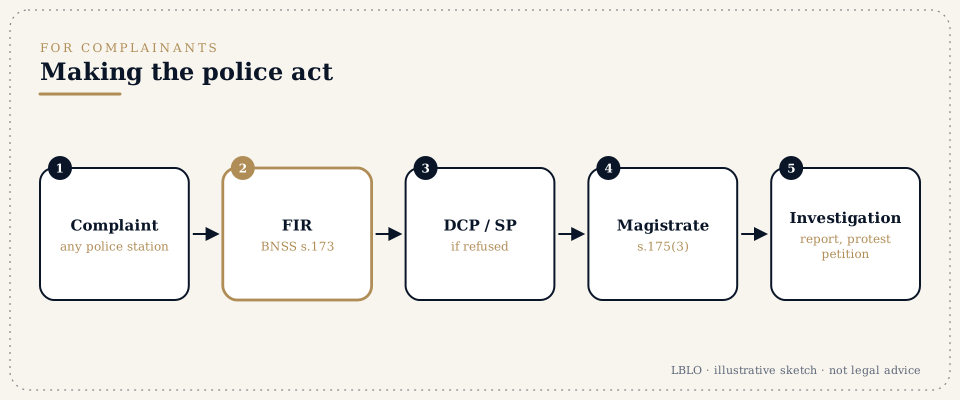
In brief
- If you are the victim of a crime, the law gives you a clear route to get the police to act and to stay involved until the trial ends.
- Cognizable offences. For a cognizable offence (one where the police can arrest without a warrant), the police must register information as an FIR. This is Section 173 of the Bharatiya Nagarik Suraksha Sanhita, 2023 (BNSS), formerly Section 154 CrPC.
- Zero FIR and e-FIR. Information can be given at any police station regardless of where the offence happened (a "zero FIR"). Electronic information (e-FIR) is recognised, subject to signature by the informant within three days.
- Refusal to register. If the police refuse, send the substance of the complaint in writing and by post to the Superintendent of Police (Deputy Commissioner of Police in Delhi) under Section 173(4) BNSS, formerly Section 154(3) CrPC. If that fails, apply to the Magistrate, on an application supported by an affidavit, for a direction to investigate under Section 175(3) BNSS, formerly Section 156(3) CrPC.
- During the case, a complainant can:
- ask for a copy of the FIR;
- follow the investigation;
- receive notice of the police report;
- file a protest petition if the police close the case;
- in serious cases, assist the prosecution through their own advocate.
- Economic offences (cheating, criminal breach of trust, forgery) are often investigated in Delhi by the Economic Offences Wing above value thresholds. Clear documents and a money trail make the complaint stronger.
Terms you will hear
- FIR (First Information Report)
- the police's record of the first information of a cognizable offence.
- Cognizable and non-cognizable
- whether police can arrest and investigate without a Magistrate's order.
- Preliminary enquiry
- for offences punishable with three years or more but less than seven years, the officer in charge of the police station may, with the permission of an officer not below the rank of Deputy Superintendent of Police, hold a preliminary enquiry within 14 days to see whether there is a prima facie case for proceeding (Section 173(3) BNSS).
- Complaint case
- a complaint filed directly before the Magistrate. The Magistrate examines the complainant and the witnesses on oath, gives the accused an opportunity of being heard before taking cognizance, and decides whether to summon the accused (Sections 223 and 227 BNSS).
- Charge-sheet (police report or final report) and closure report
- the police's report at the end of investigation, either sending the accused for trial or proposing closure.
- Protest petition
- the complainant's objection to a closure report.
- Victim's rights
- the right to be heard on bail in some offences, to receive copies, and to compensation under the victim compensation scheme.
- Economic Offences Wing (EOW)
- the Delhi Police unit for large-value economic offences.
In detail
1. Writing the complaint.
Set out:
- who did what;
- when and where;
- the amount involved;
- the witnesses;
- the documents.
Keep it factual. Attach copies, not originals. Get a receipt (a diary number) for the complaint.
2. If the FIR is not registered.
- Written complaint to the SP or DCP by post, with proof of dispatch (Section 173(4) BNSS).
- If there is no action, an application to the Magistrate under Section 175(3) BNSS, supported by an affidavit. The Magistrate can direct registration and investigation.
3. Following the investigation.
Give the investigating officer the evidence promptly. Ask in writing for the status. For seized property, the Magistrate can order its interim release.
4. When the police file a closure report.
The Magistrate must give the informant notice. File a protest petition explaining why the closure is wrong, with material. The Magistrate can take cognizance despite the closure, or order further investigation.
5. Trial.
The Public Prosecutor conducts the case. The victim's advocate can assist, acting under the directions of the Public Prosecutor, and may file written arguments with the court's permission (Section 338(2) BNSS). Where the accused is acquitted, convicted of a lesser offence or ordered to pay inadequate compensation, the victim has a right to appeal (proviso to Section 413 BNSS).
6. Civil remedies alongside.
For money lost to fraud, a civil recovery suit can run alongside the criminal case. Attachment before judgment can protect assets.
Questions people ask
The police say my matter is "civil". Can they refuse an FIR?
If the information discloses a cognizable offence, registration is the rule. Where a preliminary enquiry is permitted, it must be completed within 14 days.
Can I file the FIR where I live if the fraud was online?
You can give information at any police station. The case will be transferred to the station with jurisdiction.
Do I need my own lawyer if the State is prosecuting?
Not always. In serious or complex cases, your advocate can help with the complaint, investigation follow-up, bail hearings and the protest petition.
The accused has offered to settle. Can the case be closed?
Compoundable offences can be settled before the court. For non-compoundable offences, a High Court can quash proceedings in suitable cases.
How do I get my seized phone or car back?
Apply to the Magistrate for interim custody (superdari).
These answers are educational summaries; they are not legal advice on any individual matter.
A serious question deserves a read brief.
Conferences are by appointment at G-46, Basement, Greater Kailash III, New Delhi. The principal reads the correspondence.
This page gives general information about the work of Lokesh Bhardwaj Law Offices, as permitted under the Bar Council of India Rules. It is not legal advice, and it does not create an advocate-client relationship. LBLO acts in a matter only on an engagement agreed in writing.
Last reviewed: 15/11/2026. Lokesh Bhardwaj Law Offices.
Law stated as at 15/11/2026.