
Cheque Bounce (Section 138, Negotiable Instruments Act): The Complete Timeline
A bounced cheque is a criminal offence where it was given for a legally enforceable debt or liability and the drawer fails to pay after a proper notice.
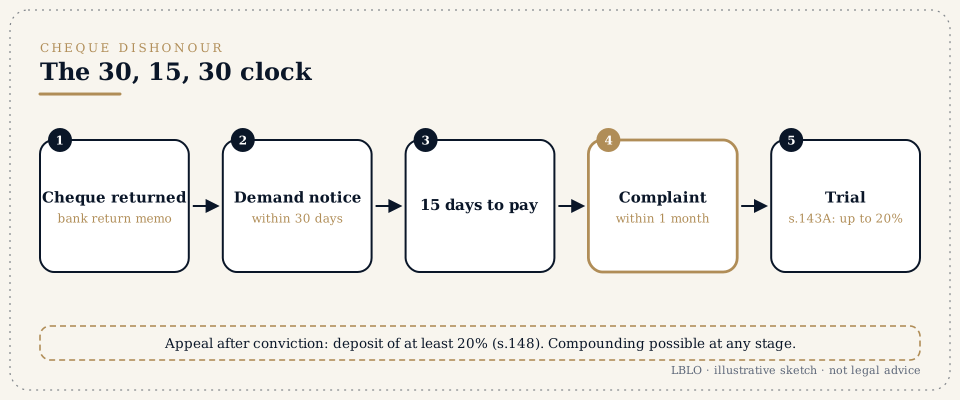
In brief
- A bounced cheque is a criminal offence where it was given for a legally enforceable debt or liability and the drawer fails to pay after a proper notice.
- The clock is strict:
- send a written demand notice within 30 days of the bank's return memo;
- the drawer then has 15 days to pay;
- if they do not pay, file the complaint within one month after those 15 days end.
- The complaint is filed where the payee's bank branch (the branch where the cheque was presented for collection) is located.
- The court can order the accused to pay interim compensation of up to 20% of the cheque amount during the trial (Section 143A).
- An accused who is convicted and appeals can be required to deposit at least 20% of the fine or compensation (Section 148).
- The offence can be compounded (settled) at any stage. Many cases settle once the complaint is on file.
- Missing any date in the chain usually ends the criminal case. A civil recovery suit, or a summary suit under Order XXXVII, is a separate route that can run alongside it.
Terms you will hear
- Drawer and payee
- the person who signed the cheque, and the person in whose favour it was drawn.
- Return memo
- the bank's slip giving the reason for dishonour, such as "funds insufficient", "exceeds arrangement", "account closed", "payment stopped by drawer" or "signature differs".
- Statutory notice (demand notice)
- the written demand for payment, sent by the payee or their advocate within 30 days of the return memo.
- Cause of action
- the date the offence is complete, when the 15 days to pay expire.
- Legally enforceable debt
- a debt the law will recognise. A cheque given as a gift, or for an illegal purpose, does not qualify.
- Presumption (Section 139)
- once the cheque and the signature are admitted, the law presumes the cheque was given for a debt. The accused must rebut this.
- Summoning, plea, evidence by affidavit, Section 145
- the stages of the summary trial. The complainant's evidence can be given by affidavit.
- Compounding
- settlement recorded by the court, which ends the case.
- Section 141 (companies)
- where the drawer is a company, its directors and officers in charge of the business at the time can be prosecuted.
In detail
1. Before anything else: present within validity.
A cheque must be presented within its validity period. Section 138 requires presentation within six months from the date of the cheque or within the period of its validity, whichever is earlier. The validity period itself is set by RBI directions to banks, so confirm the current period with the bank before presenting. A post-dated cheque is valid from the date it bears.
2. The 30-day notice.
The notice must:
- demand payment of the cheque amount;
- identify the cheque by number, date, amount and bank;
- refer to the return memo;
- be sent within 30 days of receiving information of the dishonour from the bank.
Send it by Speed Post, and where available also by email or WhatsApp. Keep the tracking reports. A notice that demands more than the cheque amount without clearly separating the cheque amount from other claims is a common defence point, so the Office keeps the cheque amount distinct.
3. The 15 days.
The drawer has 15 days from receiving the notice to pay. If the notice is returned "unclaimed" or "refused", service is ordinarily presumed when it was sent to the correct address.
4. The complaint.
File the complaint within one month after the 15 days expire. The court can condone delay for sufficient cause, but do not rely on that.
The complaint needs:
- the original cheque;
- the return memo;
- the notice;
- the postal receipts and tracking reports;
- the complainant's affidavit;
- documents that show the debt, such as invoices, a loan agreement, ledgers or messages.
For a company complainant, a board resolution or authority letter for the person filing is required.
5. The trial.
The stages are:
- Summons.
- Appearance and bail.
- Notice of accusation (plea).
- The complainant's evidence, by affidavit.
- Cross-examination.
- The accused's statement and defence evidence.
- Arguments.
- Judgment.
The maximum sentence is imprisonment of up to two years, or a fine of up to twice the cheque amount, or both. In practice, courts focus on compensation.
6. Interim compensation and the deposit on appeal.
- Under Section 143A, the trial court can direct the accused to pay up to 20% of the cheque amount as interim compensation.
- Under Section 148, the appellate court can direct an appellant convicted at trial to deposit at least 20% of the fine or compensation.
These provisions often bring parties to settle.
7. For the person who issued the cheque.
The common defences are:
- no legally enforceable debt;
- the cheque was given as security for a liability that never arose;
- payment was already made;
- the notice was defective or never received;
- the complaint is out of time;
- the director was not in charge of the company's business.
Rebuttal can be on a preponderance of probabilities, from the complainant's own documents and cross-examination.
Questions people ask
The cheque bounced 40 days ago and I have not sent a notice. Is it too late?
For that presentation, likely yes. The cheque can usually be re-presented within its validity, and a fresh dishonour starts a fresh 30-day clock.
Can I file both a cheque bounce case and a recovery suit?
Yes. One is criminal, the other civil. They run independently.
The accused is in another city. Where do I file?
Ordinarily where your bank branch, the collecting branch, is located.
Can a security cheque be the basis of a complaint?
Where a liability had arisen by the date of presentation, yes. Where none had arisen, it is a defence.
We settled. How is the case closed?
By compounding before the court, on a settlement recorded in writing. Keep payment proof on file.
These answers are educational summaries; they are not legal advice on any individual matter.
A serious question deserves a read brief.
Conferences are by appointment at G-46, Basement, Greater Kailash III, New Delhi. The principal reads the correspondence.
This page gives general information about the work of Lokesh Bhardwaj Law Offices, as permitted under the Bar Council of India Rules. It is not legal advice, and it does not create an advocate-client relationship. LBLO acts in a matter only on an engagement agreed in writing.
Law stated as at 14/11/2026.