
Licence Fee, AGR and Spectrum: Disputes with the Licensor and the Move to the Telecommunications Act, 2023
A telecom operator's largest regulatory payments are the licence fee, which is a share of its adjusted gross revenue, and the price and charges for the spectrum it holds. Disputes about them are disputes between licensee and licensor, and the forum Parliament created for them is the Telecom Disputes Settlement and Appellate Tribunal (TDSAT).
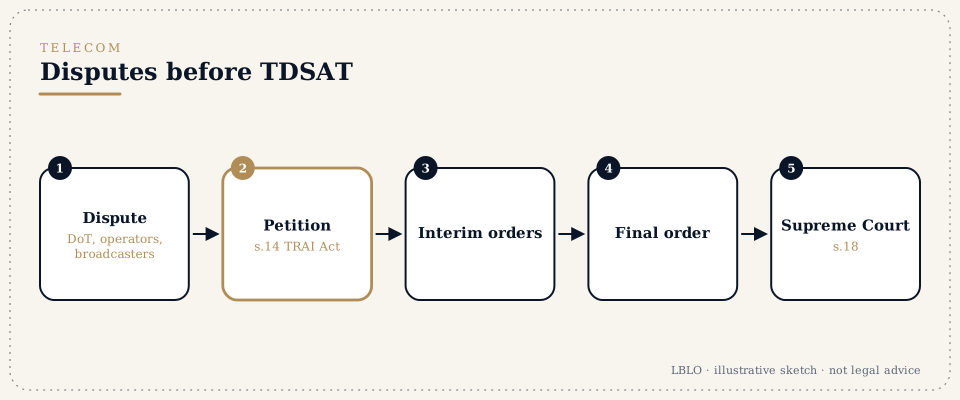
In brief
- What it covers. Licence fee demands computed on adjusted gross revenue (AGR), spectrum payments and charges, the reserve price at which spectrum is auctioned, other disputes between a licensee and the Department of Telecommunications (DoT), the move from licences to authorisations under the Telecommunications Act, 2023, and arbitration clauses in licences and operator agreements.
- The forum. A dispute between the licensor and a licensee goes to the TDSAT under Section 14(a)(i) of the Telecom Regulatory Authority of India Act, 1997 (TRAI Act). Civil courts cannot entertain it (Section 15). An appeal against a final order of the Tribunal lies to the Supreme Court within 90 days on the grounds in Section 100 of the Code of Civil Procedure, 1908 (Section 18).
- The AGR position. The Supreme Court upheld the DoT's reading of the licence definition of gross revenue in 2019. The September 2021 reforms excluded non-telecom revenue from AGR for the future and eased interest, penalties and payment terms.
- The 2023 Act. It is commencing in stages. Section 3(1) and (6), on authorisation and on existing licences, commenced on 23/06/2026. As verified on 16/11/2026, Section 4 (spectrum), Sections 31 to 41 (adjudication) and Section 60 (repeal of the Indian Telegraph Act, 1885) had not.
- Keep ready: the licence and its amendments, the demand and working sheets, audited revenue statements, correspondence, payment records and bank guarantees.
Terms you will hear
- Gross revenue and AGR
- Gross revenue is the licensee's revenue as the licence defines it. Adjusted gross revenue is gross revenue less the deductions the licence allows. The licence fee is a percentage of AGR.
- Spectrum usage charge (SUC)
- A charge for spectrum, computed as a percentage of AGR, payable on spectrum held on terms that provide for it. Spectrum acquired in auctions held after the September 2021 reforms carries no SUC.
- Reserve price
- The minimum price at which a block of spectrum is offered in an auction. The Government seeks the recommendations of the Telecom Regulatory Authority of India (TRAI) on the valuation and reserve price before an auction.
- Licensor and licensee
- The Central Government, acting through the DoT, which grants the licence, and the operator that holds it. Disputes between them go to the TDSAT.
- Authorisation
- The permission the Telecommunications Act, 2023 requires, in place of a licence, to provide telecommunication services, run a telecommunication network or possess radio equipment (Section 3).
- Migration
- The option an existing licensee has under Section 3(6) of the 2023 Act to move from its licence terms to the terms of the relevant authorisation.
- Digital Bharat Nidhi
- The new name, under Section 24 of the 2023 Act, of the Universal Service Obligation Fund. Universal service amounts payable under older licences are treated as payable to it (Section 24(4)).
In detail
Licence fee and AGR demands
How the licence fee is computed
A telecom licence is granted by the Central Government under the Indian Telegraph Act, 1885 and fixes the licence fee as a percentage of adjusted gross revenue. The licence itself defines gross revenue, lists the deductions that turn it into AGR, and sets out how the licensee pays, reports and is assessed. Every licence fee dispute therefore begins with the text of the particular licence and its amendments.
The licensee pays on its own computation and files statements of revenue. The DoT examines them and may raise a demand for the shortfall, with interest under the licence terms, usually with working sheets showing the heads added back and the deductions disallowed. A demand that cannot be traced, head by head, to a licence clause is the first point of challenge.
The AGR judgment and what followed
Operators had long argued that only revenue from licensed telecom activities formed part of gross revenue. The DoT read the licence definition to include revenue from other activities as well. In its judgment of 24/10/2019 on the AGR dispute, the Supreme Court accepted the DoT's reading of the licence definition (the case is named on the Office's main telecom page). Demands raised after that judgment are tested against it.
On 15/09/2021 the Union Cabinet approved a set of telecom reforms. Those relevant to licence fee and AGR are:
- non-telecom revenue is excluded from the definition of AGR, on a prospective basis;
- from 01/10/2021, delayed payment of licence fee and spectrum usage charges attracts interest at the State Bank of India's MCLR plus 2% instead of MCLR plus 4%, compounded annually instead of monthly, and penalty and interest on penalty were removed;
- bank guarantee requirements against licence fee and similar levies were reduced by 80%, and one bank guarantee replaces separate guarantees for each licensed service area;
- operators were offered a deferment of up to four years in annual payments of dues arising out of the AGR judgment, with the net present value protected, and an option to pay the interest on the deferred amount by way of equity.
Because the exclusion of non-telecom revenue was prospective, the period a demand relates to decides which definition applies.
Challenging a demand
A licensee who disputes a demand files a petition before the TDSAT under Section 14(a)(i) of the TRAI Act. The petition sets out the licence clause, the computation the licensee accepts, the heads it disputes and the reasons. Where recovery, encashment of a bank guarantee or action against the licence is imminent, an application for interim protection is filed with the petition, and the Tribunal often grants protection on terms, such as a deposit of part of the amount. Payment made to avoid coercive steps should be made under a written protest that reserves the right to recover it.
The 30-day limit in Section 14A(3) applies to appeals against TRAI's orders, not to a petition on a licensor and licensee dispute, whose timing is examined against the claim itself. Delay is costly in any case, because interest under the licence keeps running on an unpaid demand.
Spectrum charges and reserve price
How spectrum is priced today
Spectrum for commercial mobile services has been assigned by auction, on terms that fix the price, the upfront and deferred payments, the period and any spectrum usage charge. The September 2021 reforms changed the terms for auctions held after that decision: spectrum is assigned for 30 years instead of 20, it may be surrendered after 10 years, no spectrum usage charge is payable on it, no bank guarantee is needed to secure instalments, and the additional 0.5% usage charge for spectrum sharing was removed. Operators were also offered a deferment of up to four years on payments for spectrum bought in earlier auctions (excluding the 2021 auction), with the net present value protected at the interest rate of the auction.
The reserve price
Before an auction, the Government seeks TRAI's recommendations on the valuation and reserve price of the spectrum to be offered. TRAI makes them under Section 11(1)(a) of the TRAI Act, which includes the efficient management of available spectrum, after a consultation paper and comments from the industry. The recommendations do not bind the Government. Where the Government does not accept a recommendation, it refers it back to TRAI, which may send further recommendations within the period Section 11 allows (15 days under the present text; 30 days once Section 59(c) of the 2023 Act commences). The final reserve price is the Government's decision and is published with the auction terms.
A reserve price is a policy decision and is not ordinarily reopened in a licensee dispute. What is litigated is the application of the auction and assignment terms to a particular operator: the amount demanded, the interest charged, the effect of a surrender, a trade or a sharing arrangement, and recovery steps against bank guarantees.
Spectrum under the 2023 Act
Sections 6 to 8 of the Telecommunications Act, 2023 are in force: technologically neutral use of spectrum, secondary assignment, termination of an assignment left unutilised for insufficient reasons after a hearing, and sharing, trading, leasing and surrender of spectrum on prescribed terms. Section 4, which declares the Central Government the owner of the spectrum on behalf of the people and requires assignment by auction except for the uses listed in the First Schedule, had not been brought into force as verified on 16/11/2026. When it commences, spectrum auctioned before the appointed day stays valid on its original terms (Section 4(9)), and spectrum assigned administratively stays valid for five years from the appointed day or until the assignment expires, whichever is earlier (Section 4(8)). The First Schedule, which lists the uses for administrative assignment, includes certain satellite-based services.
Disputes between licensees and the DoT
What the Tribunal decides
Section 14(a)(i) of the TRAI Act gives the TDSAT jurisdiction over any dispute between a licensor and a licensee. Common disputes are:
- licence fee and spectrum usage charge demands, and the interest on them;
- spectrum charges demanded under the auction and assignment terms;
- penalties under the licence for breach of its conditions;
- encashment of bank guarantees and recovery steps;
- suspension, termination or non-renewal of a licence, and refusal of permissions the licence requires;
- refunds and adjustments of amounts paid.
Section 15 bars civil courts from entertaining any suit or proceeding on a matter the Tribunal is empowered to decide, and from granting an injunction on such a matter. Because the Tribunal is the forum Parliament created, a writ petition in a High Court is ordinarily not the first step in a licence dispute.
The proviso to Section 14 keeps out some matters: those within the Monopolies and Restrictive Trade Practices Commission's jurisdiction, complaints of an individual consumer that a consumer forum can decide, and disputes under Section 7B of the Indian Telegraph Act, 1885 (the Act's own arbitration of disputes about telegraph lines, appliances and apparatus).
Regulation is not adjudication
TRAI, the regulator, does not decide disputes. In Telecom Regulatory Authority of India v. Polimer Cable Network, 2026 INSC 742, decided on 24/07/2026, the Supreme Court held that TRAI may issue directions to secure compliance with its regulations and licence conditions, and may act as complainant before a magistrate where a direction is wilfully disobeyed, but cannot finally decide the rights of parties, award damages or quantify arrears; those functions belong to the TDSAT. A licensee facing a TRAI direction appeals to the Tribunal within 30 days of receiving it (Section 14A(2) and (3)); a licensee facing a DoT demand brings a dispute under Section 14(a)(i).
Procedure and the appeal
The Tribunal is not bound by the Code of Civil Procedure, 1908, follows the principles of natural justice and has listed powers of a civil court, including review (Section 16). Section 14A asks it to endeavour to dispose of a matter within 90 days. Its orders are executable as a decree (Section 19), and wilful failure to comply is punishable (Section 20).
An appeal lies to the Supreme Court against any order of the Tribunal that is not interlocutory, on one or more of the grounds in Section 100 of the Code of Civil Procedure, 1908, which in practice means a substantial question of law. It must be filed within 90 days of the order, and the Court may admit it later on sufficient cause. No appeal lies against an order made with the consent of the parties (Section 18).
The Telecommunications Act, 2023 transition
What is in force
The Telecommunications Act, 2023 (Act 44 of 2023) allows different provisions to commence on different dates (Section 1(3)). The provisions brought into force so far, as verified on 16/11/2026, are:
- from 26/06/2024: Sections 1, 2, 10 to 30, 42 to 44, 46, 47, 50 to 58, 61 and 62 (notification S.O. 2408(E));
- from 05/07/2024: Sections 6 to 8, 48 and 59(b) (notification S.O. 2623(E));
- from 23/06/2026: Section 3(1) and Section 3(6) (notification S.O. 3368(E)).
On 23/06/2026 the DoT also notified rules for authorisation to provide telecommunication services under Section 3(1)(a) and rules for migration of existing licences under Section 3(6), and from 25/06/2026 it began accepting applications for authorisation and migration on the Telecom eServices Portal. It had suspended new applications for unified licences and other licences, registrations and permissions from 10/11/2025, pending the new framework.
Existing licences
Section 3(6) protects licences granted before the appointed day. A licence with a definite validity period continues on its own terms for its full duration, or the licensee may migrate to the terms of the relevant authorisation. A licence without a definite period continues on its terms for five years from the appointed day, or may migrate. Whether to migrate is a commercial and legal decision: it turns on the fee and other terms of the authorisation compared with the licence, on pending disputes about the licence, and on what the migration rules require the licensee to give up or accept. Section 3(5) adds that an authorised entity that emerges from a merger, demerger or acquisition must comply with the terms, including fees, that applied to the original entity.
What has not yet commenced
As verified on 16/11/2026, no notification had been found bringing into force Section 4 (assignment of spectrum), Section 5, Section 9 (no refund of fees on suspension or revocation), Chapter VIII (Sections 31 to 41, adjudication of breaches), Section 45, Section 49, the remaining clauses of Section 59 (amendments to the TRAI Act) or Section 60 (repeal of the Indian Telegraph Act, 1885 and the Indian Wireless Telegraphy Act, 1933). Until Section 60 commences, those Acts are not repealed. The commencement position should be checked against the Gazette for each matter, on the date of the act complained of.
The adjudication scheme to come
When Chapter VIII commences, a breach of the terms of an authorisation or assignment will be inquired into by an Adjudicating Officer of at least Joint Secretary rank (Sections 32 and 35). The officer may direct compliance, impose civil penalties under the Second Schedule (up to Rs. 5 crore for a severe breach, Rs. 1 crore for a major one, Rs. 10 lakh for a moderate one, Rs. 1 lakh for a minor one, and a written warning for a non-severe one) and recommend suspension, curtailment or revocation to the Central Government. Section 32(3) lists the factors to be weighed, including gravity, harm, intent, repetition, mitigation and revenue loss, and Section 34 allows a voluntary undertaking. An appeal lies to a Designated Appeals Committee within 30 days of receiving the order (Section 36), and on breach of authorisation terms a further appeal lies to the TDSAT within 30 days (Section 39).
Section 59(d), when it commences, will remove licensor and licensee disputes from the Tribunal's original jurisdiction, exclude matters for the Adjudicating Officer and the Committee, and add the Section 39 appeals; actions pending before the Tribunal on the appointed day will continue to be decided as if the Act had not been passed. Until then, a licensor and licensee dispute continues to go to the TDSAT under Section 14(a)(i).
Arbitration clauses in licences
The statutory forum and arbitration
Arbitration clauses appear in three places in telecom: in licences and older agreements with the licensor, in agreements between operators (interconnection, roaming, infrastructure sharing and capacity agreements), and in agreements between operators and parties who are not service providers, such as vendors and contractors. The question in each case is whether the dispute is one that Section 14 sends to the TDSAT and Section 15 keeps out of civil courts.
Section 2(3) of the Arbitration and Conciliation Act, 1996 preserves any other law under which certain disputes may not be submitted to arbitration. Where Parliament has created a tribunal with exclusive jurisdiction and barred civil courts, an arbitration clause may not take the dispute out of that forum; where the dispute is outside Section 14, for example a contract with a vendor who is not a service provider, the clause operates in the ordinary way. Disputes under the statutory arbitration in Section 7B of the Indian Telegraph Act, 1885 are, by the proviso to Section 14, outside the Tribunal altogether. The answer is settled before the first notice is sent, because a reference to the wrong forum costs time that limitation does not return.
Where arbitration applies
Where a telecom dispute is arbitrable, the steps are those of any arbitration: the notice invoking arbitration under Section 21, appointment of the tribunal under Section 11 if the other side does not cooperate, and interim measures under Sections 9 and 17. These are explained on the Office's pages on commencing an arbitration and on interim measures.
Questions people ask
What is AGR, and why does it decide the licence fee?
AGR, or adjusted gross revenue, is the licensee's gross revenue as defined in its licence, less the deductions the licence permits. The licence fee, and spectrum usage charges where they apply, are percentages of AGR, so every rupee counted in gross revenue increases the fee. The definition is in the licence, not in a statute. In 2019 the Supreme Court accepted the Department of Telecommunications' reading of that definition, which included revenue from activities beyond licensed telecom services. In September 2021 the Government excluded non-telecom revenue from AGR, but only for the future.
Where do I challenge a licence fee demand from the DoT?
Before the Telecom Disputes Settlement and Appellate Tribunal, under Section 14(a)(i) of the TRAI Act, 1997, which covers disputes between the licensor and a licensee. A civil court cannot entertain the dispute (Section 15). The petition should set out the licence clause, the computation the licensee accepts, the heads it disputes and the reasons. If recovery or encashment of a bank guarantee is imminent, an application for interim protection is filed with it. The Tribunal's final order can be appealed to the Supreme Court within 90 days on a substantial question of law (Section 18).
Did the 2021 telecom reforms reduce past AGR dues?
Not the principal. The Cabinet decision of 15/09/2021 excluded non-telecom revenue from AGR on a prospective basis, so it does not reopen the dues for earlier periods that followed the Supreme Court's 2019 judgment. It did change the terms of payment: interest on delayed licence fee and spectrum charges from 01/10/2021 at MCLR plus 2%, compounded annually, removal of penalty and interest on penalty, an 80% cut in bank guarantees, and an option to defer annual payments of AGR dues for up to four years with the net present value protected.
Who decides the reserve price in a spectrum auction?
The Central Government, after seeking the recommendations of the Telecom Regulatory Authority of India. TRAI consults the industry and makes recommendations on the valuation and reserve price under Section 11(1)(a) of the TRAI Act. The Government is not bound by them; if it disagrees, it refers them back, and TRAI may send further recommendations within the period Section 11 allows. The reserve price is then fixed in the auction terms. It is a policy decision, so later disputes usually concern how the auction and assignment terms apply to an operator, not the reserve price itself.
Is spectrum now assigned under the Telecommunications Act, 2023?
Partly. Sections 6, 7 and 8 of the 2023 Act, on technologically neutral use, secondary assignment, termination of unutilised spectrum, and sharing, trading, leasing and surrender, have been in force since 05/07/2024. Section 4, which requires assignment by auction except for the uses in the First Schedule, had not been brought into force as verified on 16/11/2026. When it commences, spectrum already auctioned stays valid on its original terms, and spectrum assigned administratively stays valid for five years or until it expires, whichever is earlier.
Does an existing telecom licence have to migrate to an authorisation?
No. Section 3(6) of the Telecommunications Act, 2023, in force since 23/06/2026, lets a licence with a definite validity period continue on its own terms for its full duration, and a licence without a definite period continue for five years from the appointed day. In either case the licensee may instead migrate to the terms of the relevant authorisation under the migration rules notified on 23/06/2026. The choice turns on the comparative fees and conditions and on any pending dispute about the licence, and should be made after reading the rules in full.
Has the Indian Telegraph Act, 1885 been repealed?
Not yet. Section 60 of the Telecommunications Act, 2023 repeals the Indian Telegraph Act, 1885 and the Indian Wireless Telegraphy Act, 1933, with savings for licences, orders and pending proceedings, but no notification bringing Section 60 into force had been found as verified on 16/11/2026. Other parts of the 2023 Act are in force, including authorisation under Section 3(1) and the continuation and migration of licences under Section 3(6) from 23/06/2026. Which law governs a particular act depends on the commencement notifications in force on the date of that act.
Who will impose penalties for breach of an authorisation under the 2023 Act?
An Adjudicating Officer of at least Joint Secretary rank, after an inquiry, under Sections 32 and 35, with civil penalties under the Second Schedule of up to Rs. 5 crore for a severe breach. An appeal lies to a Designated Appeals Committee within 30 days of receiving the order, and then to the TDSAT within 30 days (Sections 36 and 39). This chapter (Sections 31 to 41) had not been brought into force as verified on 16/11/2026, so breaches of existing licences are still dealt with under the licence terms and disputed before the TDSAT.
Can a dispute with the DoT under a licence be referred to arbitration?
It depends on the dispute. Section 14 of the TRAI Act gives the TDSAT jurisdiction over disputes between licensor and licensee, and Section 15 bars civil courts. Section 2(3) of the Arbitration Act preserves laws under which certain disputes cannot be arbitrated. A dispute that falls within the Tribunal's statutory jurisdiction is therefore usually taken there, whatever an agreement says. Contracts with parties who are not service providers, such as vendors, are outside Section 14 and their arbitration clauses operate normally. The clause and the parties must be examined before the first notice is sent.
How long do I have to appeal a TDSAT order to the Supreme Court?
Ninety days from the date of the Tribunal's order, under Section 18(3) of the TRAI Act, 1997. The Supreme Court may admit a later appeal if it is satisfied that there was sufficient cause for the delay. The appeal lies only against an order that is not interlocutory, and only on the grounds specified in Section 100 of the Code of Civil Procedure, 1908, which in practice means the appeal must raise a substantial question of law. No appeal lies against an order made with the consent of the parties.
These answers are educational summaries; they are not legal advice on any individual matter.
A serious question deserves a read brief.
Conferences are by appointment at G-46, Basement, Greater Kailash III, New Delhi. The principal reads the correspondence.
This page gives general information about the work of Lokesh Bhardwaj Law Offices, as permitted under the Bar Council of India Rules. It is not legal advice, and it does not create an advocate-client relationship. LBLO acts in a matter only on an engagement agreed in writing.
Last reviewed: 16/11/2026. Lokesh Bhardwaj Law Offices.
Law stated as at 16/11/2026.