
Constitutional & Religious Matters
Writ jurisdiction, the law of religious endowments, and the constitutional limits of state control over places of worship.
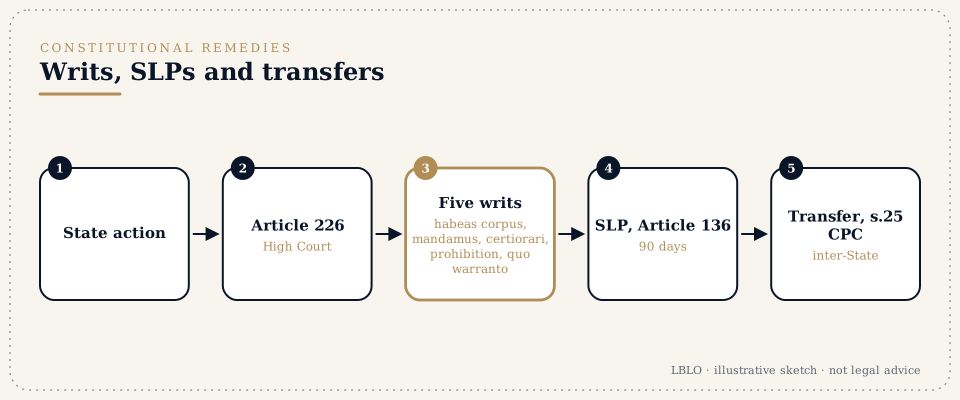
In brief
- High Court writs. Article 226 lets the High Court issue writs against the State and its bodies to enforce fundamental rights and other legal rights. Common uses are against:
- arbitrary government action;
- unlawful tender decisions;
- denial of licences;
- inaction by authorities;
- illegal detention.
- Supreme Court writs. Article 32 lets a person approach the Supreme Court directly for enforcement of fundamental rights.
- The five writs:
- habeas corpus: produce a detained person;
- mandamus: perform a legal duty;
- certiorari: quash an order;
- prohibition: stop a lower body from exceeding jurisdiction;
- quo warranto: question a person's right to hold a public office.
- Special Leave Petition. A Special Leave Petition under Article 136 asks the Supreme Court for permission to appeal. A civil SLP is filed within 90 days of the High Court's judgment or, where the High Court has refused a certificate of fitness to appeal, within 60 days of the order of refusal (Order XXI Rule 1, Supreme Court Rules, 2013). How to count the days is on the Supreme Court limitation page. Leave is discretionary.
- Transfer petition. The Supreme Court can transfer a civil case from a court in one State to a court in another under Section 25 CPC, and a criminal case or appeal under Section 446 of the BNSS (earlier Section 406 of the CrPC). Civil transfers are most often sought in matrimonial cases.
- Alternative remedy. Writ courts generally expect parties to use an effective statutory remedy first. The exceptions include breach of natural justice, an action wholly without jurisdiction, and a challenge to the validity of a law.
Terms you will hear
- Locus standi
- the right to bring the case. Public interest litigation relaxes it for genuine public causes.
- Alternative remedy
- a statutory appeal or revision that the court expects you to use first.
- Delay and laches
- unexplained delay can defeat a writ, even though no fixed limitation period applies.
- Interim relief and status quo
- temporary orders while the case is pending.
- Counter-affidavit and rejoinder
- the respondent's reply, and the petitioner's response.
- Advocate-on-Record (AOR)
- the advocate entitled to file in the Supreme Court.
- Notice, leave granted, dismissed in limine
- the outcomes at an SLP's first hearing: the Court calls for a reply; admits the appeal; or dismisses it at the threshold.
- Curative and review petitions
- the narrow remedies after the Supreme Court's own final order.
The Office's work in this area covers constitutional questions and the law of religious endowments: writ petitions, habeas corpus, special leave and transfer petitions, the rights attached to hereditary office, and the constitutional limits of statutory takeover of religious institutions.
This is a practice in which doctrine matters. The questions that arise, who may administer a shrine, what a statute may lawfully displace, where religious autonomy ends and state regulation begins, are answered in the constitutional courts, and they are answered well only when the brief has been read against the full line of authority. The Office treats every writ as an exercise in careful construction: the right identified, the violation pleaded with precision, and the relief framed so that the order, when it comes, is one that can be enforced.
What the Office takes on
- Writ Jurisdiction, Articles 226 & 32
- Habeas Corpus & Personal Liberty
- Special Leave Petitions & Transfer Petitions
- Letters Patent Appeals
- Contempt, Civil & Criminal
- Religious Endowments & Temple Administration
- Hereditary Rights & Pujari Office
- Statutory Takeover & Religious Autonomy
- Challenges to Notifications & Delegated Legislation
- Writs against Municipal, Utility & Development Authorities
- Service & Pension Matters, Departmental Inquiries
- Public Interest Litigation
In detail
1. Is a writ the right remedy?
The Office asks four questions first:
- Is the respondent "the State" or performing a public function?
- What right is breached?
- Is there an alternative remedy, and is it effective?
- Has there been delay?
2. Drafting a writ petition (Delhi High Court).
The paperbook contains:
- the list of dates;
- the synopsis;
- the petition with grounds;
- the prayer and interim prayer;
- the affidavit;
- the annexures;
- applications (for example for interim relief and exemption);
- the vakalatnama.
The petition must disclose other proceedings on the same subject.
3. Habeas corpus.
For illegal detention, including by the police without production before a Magistrate within 24 hours of arrest (Article 22(2) of the Constitution; Section 58 of the BNSS). In appropriate cases it is also used in child custody disputes, including where a child has been brought from abroad; the welfare of the child is the paramount consideration. Habeas corpus petitions are taken up urgently.
4. Special Leave Petitions.
The SLP sets out:
- the questions of law;
- the grounds;
- a declaration about other proceedings;
- the impugned judgment;
- the record.
A delay beyond the limitation period needs an application for condonation. Leave is granted only where the case raises a question worth the Supreme Court's attention or shows a grave injustice.
5. Transfer petitions.
Grounds include the distance and expense for a party, especially a wife with children, safety, and the convenience of witnesses. The Court weighs the requirement of justice in each case.
How the work is conducted
Writ work is conducted by the principal personally, before the Hon'ble Supreme Court of India and the Hon'ble High Court of Delhi. Matters begin with a conference at the Office; the papers are read before any opinion is given, and the choice between Article 32, Article 226, and the ordinary civil remedy is treated as the first strategic decision of the matter, not an afterthought.
Frequently asked questions
What kinds of matters does a constitutional practice cover?
Writ proceedings under Article 32 of the Constitution before the Hon'ble Supreme Court of India and under Article 226 before the High Courts: challenges to state action, service matters, statutory takeovers, questions of religious autonomy and endowment administration, and public interest litigation. A writ ordinarily lies against the State as Article 12 defines it, which includes the Government, Parliament and the legislatures, local authorities and bodies that are instrumentalities of the State, and in some cases against private bodies performing public duties. The common thread is that the dispute is with the state or turns on a constitutional right.
Can the administration of a temple be challenged in court?
Yes. Article 25(2)(a) of the Constitution allows the State to regulate the economic, financial and other secular activity associated with religious practice, while Article 26 protects the right of a religious denomination to manage its own affairs in matters of religion and to administer its property in accordance with law. Statutes that vest temple administration in government bodies must operate within those limits, and the rights of hereditary office holders, priests and worshippers can be asserted before the constitutional courts. Each challenge turns on the statute in question, whether the institution belongs to a denomination, and its history.
What is the difference between Article 32 and Article 226?
Article 32 is itself a fundamental right: the right to move the Hon'ble Supreme Court of India directly for the enforcement of the fundamental rights in Part III of the Constitution. Article 226 empowers a High Court to issue writs not only for fundamental rights but for any other purpose, which includes other legal rights, and under Article 226(2) a High Court may act wherever the cause of action arises wholly or in part within its territory. Because the High Court's jurisdiction is wider, the Supreme Court often expects a petitioner to approach the High Court first.
What is a habeas corpus petition and when is it filed?
A habeas corpus petition asks the High Court under Article 226, or the Supreme Court under Article 32, to produce a person who is alleged to be in unlawful custody and to order release if the detention is not justified in law. It is moved urgently, often the same day, and is available whether the confinement is by the police, by a private person, or by an authority acting without a valid order.
Can a government notification or an amendment be challenged in a writ?
Yes. Delegated legislation, including notifications, rules and amendments, can be challenged before the High Court under Article 226 on the grounds that it exceeds the power conferred by the parent statute, violates a fundamental right such as equality under Article 14, or is manifestly arbitrary. The groundwork is often done under the Right to Information Act, 2005, by applying under Section 6 for the file that led to the notification, including the notings and approvals, before the writ is drafted. Delay matters: a challenge brought long after the notification may be refused on that ground alone.
How long do I have to appeal to the Supreme Court against a High Court judgment?
Most appeals from the High Courts reach the Hon'ble Supreme Court of India as special leave petitions under Article 136 of the Constitution. Under Order XXI of the Supreme Court Rules, 2013, a civil special leave petition is to be filed within 90 days from the date of the judgment or order, or within 60 days from the date on which the High Court refuses a certificate of fitness to appeal. Delay can be condoned for sufficient cause, but it must be explained fully, and unexplained delay is a common reason for dismissal.
What can I do if a government department does not obey a court order?
Wilful disobedience of a judgment, order or direction of a court is civil contempt under Section 2(b) of the Contempt of Courts Act, 1971. The Hon'ble Supreme Court and the High Courts are courts of record with power to punish contempt under Articles 129 and 215 of the Constitution. Section 12 provides for simple imprisonment of up to six months, a fine of up to Rs. 2,000, or both, and Section 20 bars proceedings begun more than one year after the contempt is alleged to have been committed. In practice the court's first concern is compliance, and the officer responsible is usually directed to comply or explain.
Can I file a writ against a private company?
Generally not, unless the company performs a public function or a statutory duty.
Is there a time limit for a writ?
No fixed period, but delay must be explained. Act promptly.
Will the Supreme Court hear my case if the High Court has ruled against me?
Only if leave is granted. Many SLPs are dismissed at the first hearing.
How quickly can a habeas corpus petition be heard?
It is treated as urgent and is usually listed quickly; the court decides how soon.
My wife has filed for divorce in another State. Can I get it moved?
You can apply. Courts often consider the wife's convenience in matrimonial transfers. Each case turns on its facts.
These answers are educational summaries; they are not legal advice on any individual matter.
A serious question deserves a read brief.
Conferences are by appointment at G-46, Basement, Greater Kailash III, New Delhi. The principal reads the correspondence.
This page gives general information about the work of Lokesh Bhardwaj Law Offices, as permitted under the Bar Council of India Rules. It is not legal advice, and it does not create an advocate-client relationship. LBLO acts in a matter only on an engagement agreed in writing.
Law stated as at 15/11/2026.