
Temples, Religious Endowments and Hereditary Rights
In Indian law, a deity is a juristic person that can own property.
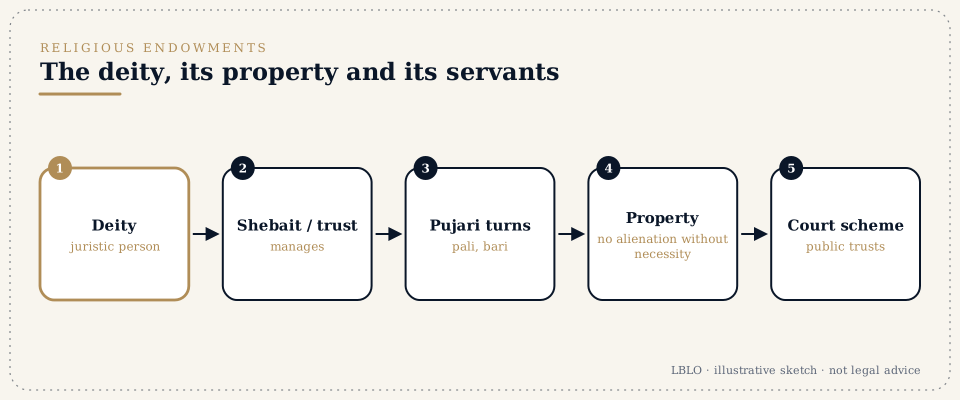
In brief
- In Indian law, a deity is a juristic person that can own property. The property is managed by a shebait, manager or trust on the deity's behalf.
- The Constitution. Article 25 protects freedom of conscience and the right to profess, practise and propagate religion, and lets the State regulate the secular activity associated with religious practice. Article 26 gives every religious denomination the right to manage its own affairs in matters of religion and to administer its property in accordance with law. Under Article 13, a law that takes away or abridges these rights is void to that extent.
- Typical disputes:
- who manages the temple;
- hereditary rights of priests (pujaris and shebaits) to perform worship and receive offerings by turn (pali or bari);
- alienation of temple property;
- accounts;
- encroachment;
- the framing of a scheme for administration.
- Public or private? It matters whether the temple is a public or a private religious endowment. Public endowments attract wider court supervision. In many States, statutory bodies also supervise them.
- Court schemes. Courts can frame a scheme of administration for a public religious trust in a suit brought under the provisions on public charities, such as Section 92 CPC. Such a suit is brought by the Advocate-General, or by two or more persons having an interest in the trust who have obtained the leave of the court.
- Evidence. Hereditary rights are proved from records: old documents, court decrees, revenue entries, the history of the turn system, and consistent practice.
Terms you will hear
- Deity (idol) as juristic person
- the deity holds property in law. Its interests are represented by the shebait or a next friend.
- Shebait, mahant, pujari, trustee
-
- shebait: the manager of the deity's affairs;
- mahant: the head of a math (a religious institution);
- pujari: the priest who performs worship;
- trustee: the manager under a trust deed.
- Pali, bari (turn of worship)
- the rotation among families with hereditary rights.
- Chadhava (offerings)
- cash and kind received at the shrine. Rights to share them are often the core of the dispute.
- Public religious trust and private endowment
- dedicated to the public, or to a family's worship.
- Scheme suit
- a suit for framing a scheme of management.
- Debutter property
- property dedicated to a deity.
- Religious denomination
- a body of persons with a common faith, a common spiritual organisation and a distinctive name. Article 26 protects its rights.
- Essential religious practice
- the test courts apply to decide whether a practice is an essential or integral part of a religion, and so protected as a matter of religion.
In detail
1. The constitutional framework.
Article 25(1) guarantees freedom of conscience and the right freely to profess, practise and propagate religion, subject to public order, morality, health and the other fundamental rights. Article 25(2)(a) allows the State to regulate or restrict economic, financial, political or other secular activity associated with religious practice. Article 25(2)(b) allows laws for social welfare and reform, and for throwing open Hindu religious institutions of a public character to all classes and sections of Hindus. Article 26, subject to public order, morality and health, gives every religious denomination, or any section of it, the right:
- to establish and maintain institutions for religious and charitable purposes;
- to manage its own affairs in matters of religion;
- to own and acquire movable and immovable property;
- to administer such property in accordance with law.
Article 13 makes a law void to the extent that it takes away or abridges these rights. State laws on religious and charitable endowments, which provide for supervision, accounts and schemes of administration, are tested against Articles 25 and 26 in writ proceedings.
2. What the Supreme Court has held.
- In Commissioner, Hindu Religious Endowments, Madras v. Sri Lakshmindra Thirtha Swamiar of Sri Shirur Mutt, AIR 1954 SC 282, the Court held that religion covers not only doctrine but also the rituals, observances, ceremonies and modes of worship that are integral parts of it; that what is essential to a religion is to be ascertained primarily from the doctrines of that religion itself; and that a law which takes the right of administration away from a denomination altogether and vests it in another authority violates Article 26(d).
- In Ratilal Panachand Gandhi v. State of Bombay, AIR 1954 SC 388, the Court distinguished regulation of the economic, commercial or political activities associated with religious practice, which the State may undertake, from a law that takes the right of administration away from the denomination altogether, which violates Article 26.
- In Durgah Committee, Ajmer v. Syed Hussain Ali, AIR 1961 SC 1402, the Court held that the protection extends to practices that are essential and integral to the religion, and noted that some practices, though religious in form, may be secular or extraneous accretions that fall outside it.
- In Seshammal v. State of Tamil Nadu, (1972) 2 SCC 11, the Court held that the appointment of an archaka (priest) by the trustee is a secular act and upheld a law ending hereditary succession to the office, while recognising that the rituals the archaka performs are matters of religion.
- In Pannalal Bansilal Pitti v. State of Andhra Pradesh, (1996) 2 SCC 498, the Court upheld the abolition of hereditary trusteeship of Hindu religious institutions as part of their secular administration, and held that laws need not be made uniformly applicable to all religions at one time.
Each challenge turns on the statute in question, the character of the institution and its history.
3. Identify the character of the institution.
Read the dedication documents, the history, public access, the source of funds and any statutory registration. The rights and the forum depend on it.
4. Hereditary rights cases.
Build the family tree and the history of the turns. Collect old decrees and compromises. Show consistent exercise of the right. Challenges often involve exclusion of a branch, sale or mortgage of a turn, or a dispute between the trust and the hereditary priests.
5. Property.
A deity is a juristic entity capable of holding property, through the shebaits entrusted with its possession and management (Yogendra Nath Naskar v. Commissioner of Income-tax, (1969) 1 SCC 555). Temple property generally cannot be sold or mortgaged except for legal necessity or the benefit of the deity, with proper authority. Encroachment is resisted through suits for possession and injunction on the deity's behalf.
6. Management disputes.
Disputes over trust elections, accounts and misappropriation go to the civil court or the statutory authority. Interim administrators or receivers may be appointed in serious cases.
7. Writs.
Where a statutory body or government acts on a temple's affairs, a writ may lie to test the action against Articles 25 and 26 and against the statute under which it is taken. Endowment statutes usually provide their own remedies, which are ordinarily used first, unless the challenge is to the statute itself or the authority has acted without jurisdiction.
Questions people ask
Can a pujari's right be inherited?
Hereditary rights recognised by custom or by documents can pass in the family, subject to the institution's rules and the law.
Can the temple trust sell temple land?
Only within strict limits, for legal necessity or the deity's benefit, with proper authority.
Who sues on behalf of the deity?
The shebait or manager, or a next friend where the manager's interest conflicts with the deity's.
Can devotees challenge mismanagement?
In a public religious trust, two or more persons having an interest in the trust can sue under Section 92 CPC with the court's leave, including for settling a scheme of management.
Our family's turn was given to another branch. What can we do?
A suit for declaration and injunction, based on the records of the turn system.
These answers are educational summaries; they are not legal advice on any individual matter.
A serious question deserves a read brief.
Conferences are by appointment at G-46, Basement, Greater Kailash III, New Delhi. The principal reads the correspondence.
This page gives general information about the work of Lokesh Bhardwaj Law Offices, as permitted under the Bar Council of India Rules. It is not legal advice, and it does not create an advocate-client relationship. LBLO acts in a matter only on an engagement agreed in writing.
Law stated as at 15/11/2026.